- Governor Maura Healey and Lt. Governor Kim Driscoll
- Executive Office of Health and Human Services
- Department of Public Health
- Bureau of Substance Addiction Services
Media Contact
Jacqueline Manning, Press Secretary
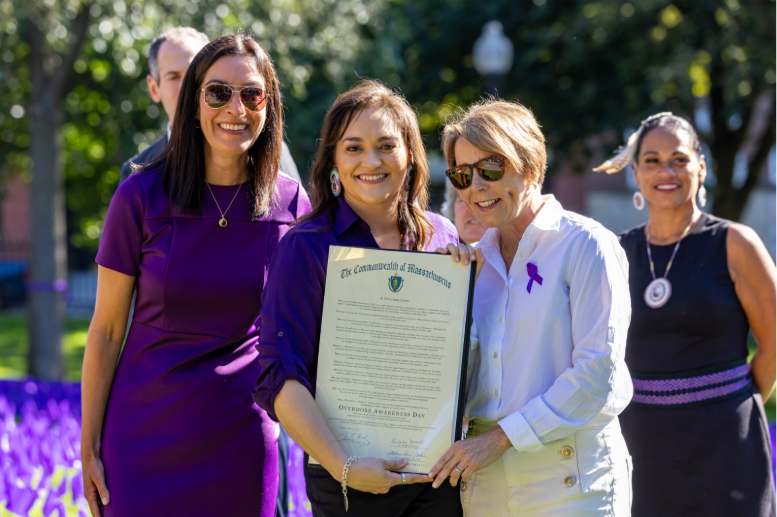
BOSTON — Governor Maura Healey, First Lady Joanna Lydgate, Lieutenant Governor Kim Driscoll, other public officials, families and volunteers gathered today on Boston Common to plant more than 20,000 purple flags in memory of Massachusetts residents who have died from overdoses since 2013 in observance of International Overdose Awareness Day.
“Today, we remember the people we have lost to overdose and stand with the families and friends who carry that grief every day,” said Governor Maura Healey. “Behind every flag is a life, a story and a community that still feels that loss. We will honor them by continuing to expand the proven services that prevent overdoses, support recovery and save lives.”
“Each purple flag represents a person who was deeply loved and a family or community forever changed by their loss,” said Lieutenant Governor Kim Driscoll. “Today, we honor their lives and send a clear message that substance use disorder is not a moral failing. Help is available, recovery is possible and no one should ever feel ashamed to ask for support.”
The flag planting event is a collaboration between the Massachusetts Department of Public Health (DPH), Boston Public Health Commission, and Boston Medical Center. It is one of many observances taking place across Massachusetts and the country to raise awareness about overdose and its devastating impact on families and communities.
Following a moment of silence, Governor Healey, Secretary of Health and Human Services Kiame Mahaniah, MD, MBA, State Representative Kate Donaghue, Commissioner of Public Health Robbie Goldstein, MD, PhD, Boston Public Health Commissioner Bisola Ojikutu, MD, MPH, and DPH’s Bureau of Substance Addiction Services (BSAS) Director Deirdre Calvert, MSW, LICSW, delivered remarks about the importance of expanding access to harm reduction, treatment and recovery services.
Since 2022, August 31 has been officially proclaimed as Overdose Awareness Day in Massachusetts. Governor Healey presented this year’s proclamation to Nichol Brewer-Lowry, Deputy Director of Native American LifeLines in Boston, an Urban Indian Health Services Program.
“Lives lost to overdose leave devastating impacts on our families and in our communities. In Massachusetts, we have worked hard to reduce the stigma associated with drug use through a collaborative public health response rooted in science and compassion that has had a direct impact in reducing fatal overdoses,” said Secretary Mahaniah. “Data show us that providing harm reduction measures, treatment options, and supportive peer communities to build community and belonging can reduce overdose rates. We remain committed to supporting and expanding access to these tools and services.”
The purple flags represent the 971 residents who died from opioid-related overdoses in 2025, the first time in over a decade that the state recorded fewer than 1,000 opioid-related overdose deaths in a single year and a nearly 60 percent decline from the record high of 2,364 deaths in 2022.
“I recognize the grief carried every day by so many families in Massachusetts who lost a loved one to overdose. Behind every single one of these commemorative flags is a life – a son, a daughter, a mother, a father, a brother, a sister, a friend, a neighbor, a colleague,” said Commissioner Goldstein. “Last year, the number of opioid overdose deaths in our state fell below 1,000. This trend is heartening. And it is also a call to action. Continued support of and expanded access to the public health tools that prevent overdose, reduce harm, and promote dignity for those who use substances is how we will get to zero overdose deaths.”
Since 2023, the Governor Healey has invested more than $1 billion in prevention, intervention, harm reduction, treatment and recovery programs.
In fiscal year 2025 (FY25), these investments supported six comprehensive mobile addiction treatment programs, the distribution of more than 150,000 naloxone kits to community organizations, nearly 400,000 fentanyl strips for community use, and SafeSpot, a virtual overdose detection hotline that has detected 48 overdoses as of July 2025. The administration also supports access to residential, outpatient, and other forms of treatment, including more than 500 treatment programs, access to low-threshold housing, and 39 peer recovery support centers serving more than 13,000 people statewide.
“Stigma around substance use can prevent people from reaching out for help, but we can all play a role in combating this by bringing care and compassion to the words that we use and our programs and services,” said BSAS Director Calvert. “We are incredibly grateful that Massachusetts overdose deaths are down, and we must continue to build on that momentum. These declines show us that when we make investments in evidence-based, public health approaches that promote the health, safety, and dignity of those who use substances, it works.”
The commemorative flags and resource tables offering harm reduction, prevention, and recovery information, will remain on Boston Common through September 4.
International Overdose Awareness Day is followed by National Recovery Month in September, which celebrates people in recovery and highlights the importance of evidence-based treatment and support.
Learn more about Massachusetts’ efforts to address substance use disorders and reduce stigma.
If you are struggling with substance use, or have a family member, a friend, a neighbor, or a colleague who may need help and support, please call the Massachusetts Substance Use Helpline at 800-327-5050, or visit www.helplinema.org.
###