- Department of Fish and Game
- Division of Ecological Restoration
- Division of Marine Fisheries
Media Contact
Julia E. Hopkins, Communications Director
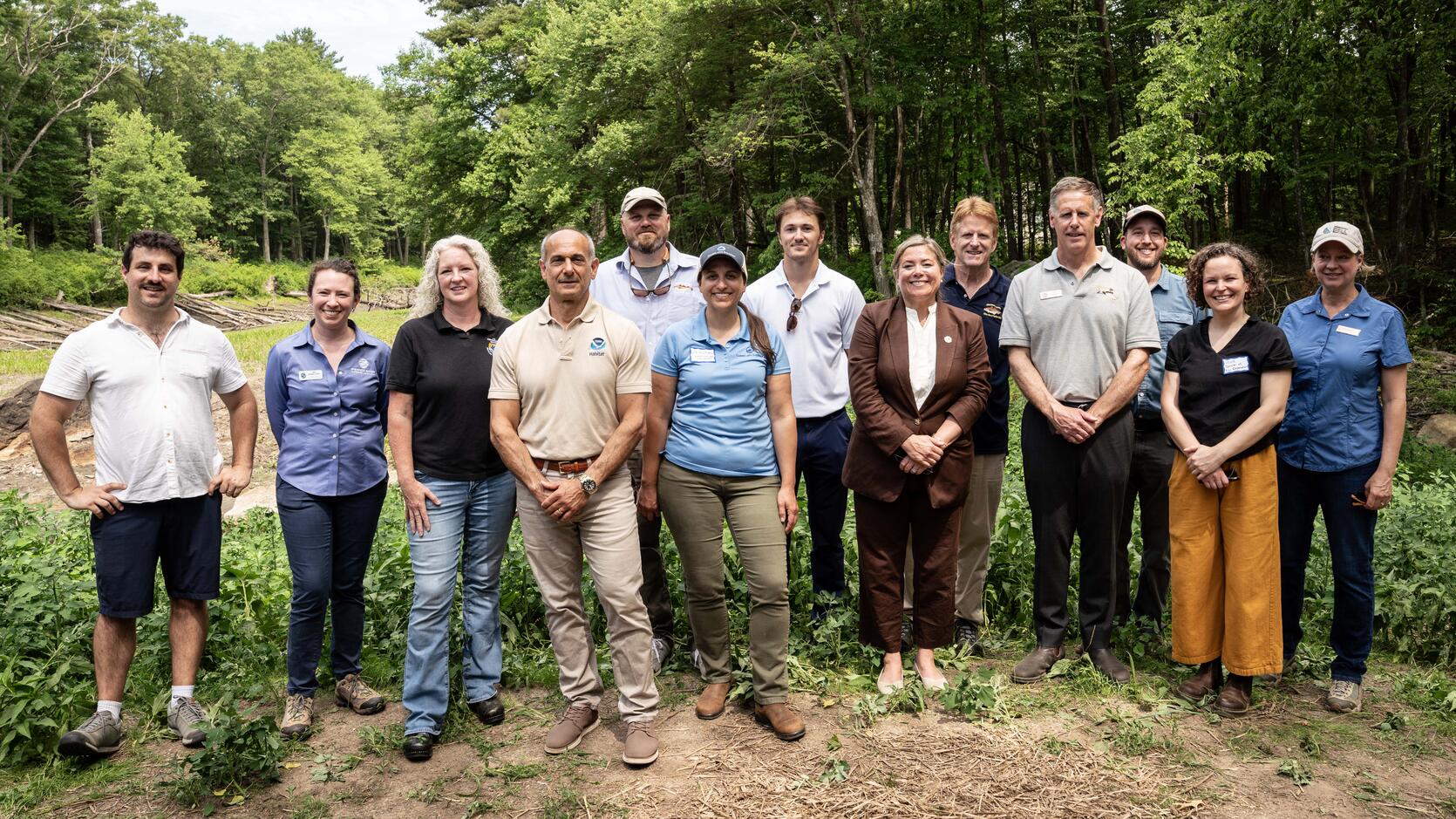
NEWBURY — After a decades-long effort to restore the Parker River, the Healey-Driscoll Administration, the Town of Newbury, and federal and nonprofit partners today celebrated the successful removal of the obsolete Larkin Dam and the restoration of a free-flowing Parker River. This marks a major milestone for river health, public safety, and climate resilience, reconnecting more than a mile of upstream habitat for migratory and resident fish while reducing flood risks.
The Town of Newbury, which owned the dam, had long recognized that the dam was slowly deteriorating and a barrier to migratory fish passage. Since 2022, state, federal, town, and non-profit partners have invested $1,834,735 to remove the aging structure and restore the river for people and nature.
“Restoring free‑flowing rivers is one of the most effective actions we can take to strengthen biodiversity and climate resilience in Massachusetts,” said Department of Fish & Game Commissioner Tom O’Shea. “By removing the Larkin Dam, we’re reopening habitat for native fish, revitalizing the Parker River ecosystem, and advancing the Commonwealth’s commitment to safeguarding fish and wildlife and habitats they depend upon. This project shows what’s possible when partners come together to let rivers be rivers again.”
Today’s celebration brought together project partners, including Town of Newbury, the Massachusetts Division of Ecological Restoration (DER), the Massachusetts Division of Marine Fisheries (DMF), the Ipswich River Watershed Association (IRWA), the National Oceanic and Atmospheric Administration (NOAA), and the U.S. Fish and Wildlife Service (USFWS). Attendees cut a ceremonial ribbon and provided guided walks to view the newly restored river channel.
“Today’s celebration highlights the growing momentum for river restoration across Massachusetts,” said DER Director Beth Lambert. “Since 2005, DER and its partners have advanced more than 70 dam removal projects statewide, reconnecting hundreds of miles of rivers and streams and strengthening the Commonwealth’s resilience to climate change. We are proud to see another barrier removed and river restored thanks to the leadership of the dam owner, the Town of Newbury, and our strong community of partners When dams come down, nature comes back.”
The removal of the Larkin Dam restores access to nearly 8 river miles and over 120 acres of habitat for migratory fish, including river herring, sea lamprey, American eel, and sea-run brook trout. Migratory fish rely on free-flowing rivers to complete their life cycle, moving between the ocean and freshwater rivers and streams to reproduce. While the previous dam had a fish ladder, it was old and ineffective, limiting passage of fish during their migration in the Parker River. The project also restores natural processes of the river, improves water quality, and reduces local flood risks by eliminating an obsolete structure that had long constrained the river.
“DMF has deep experience monitoring diadromous fish passage in the Parker River for over 50 years. The Parker River supports one of the most diverse communities of diadromous fish found in coastal rivers in Massachusetts, with 10 species documented including the iconic river herring and sea-run brook trout. The Larkin Mill dam removal will improve passage and connectivity for and help these species flourish,” said DMF Director Dan McKiernan.
The project reflects years of planning, engineering, and partnership among local, state, federal, and nonprofit organizations. In addition to removing the dam, partners have planted thousands of native shrubs and trees to stabilize riverbanks, improve habitat, and support long-term ecological recovery. With the dam removed, and this section of the river flowing freely for the first time in more than a century, the Parker River is already showing signs of recovery. Native vegetation is taking hold, sediment is moving naturally through the system, and fish are returning to upstream habitat.
“Projects like the Larkin Dam removal remind us that conservation is often most successful when communities, agencies, and nonprofit partners work together toward a common goal,” said Town of Newbury Conservation Agent Mason Ferrick. “The ecological benefits of restoring a free-flowing river will be felt for generations, and we hope this project encourages other communities to explore opportunities to remove obsolete barriers and reconnect critical habitat.”
"We are proud to be part of a state-wide, and indeed, nation-wide trend of removing obsolete dams in order to restore our free-flowing rivers,” said Ipswich River Watershed Association Executive Director Erin Bonney Casey. “This project represents the first large-scale dam removal on the North Shore and will serve as an important, local restoration success story to clear the way for future dam-removal and large-scale river restoration projects in the region."
In 2025, Massachusetts led the nation in dam removal and river restoration, with 15 dams, including Larkin Dam, removed by state agencies and partners. This supports the Healey-Driscoll Administration’s biodiversity and climate resilience priorities, including the Massachusetts Biodiversity Goals which set ambitious targets to remove over 10% of the state’s 3,000 dams by 2050. The Healey Driscoll Administration’s Mass Ready Act supports this growing movement for dam removal, with historic funding of $308 million proposed to accelerate efforts to address high-risk dams and improve inland and coastal flood resilience. River restoration is one of the most cost-effective and impactful nature-based climate solutions. Investments will deliver safer, healthier communities for future generations.
"Dam removal is a powerful tool for river and habitat stewardship, and the elimination of the Larkin Dam is a prime example of the effective use of that tool,” said Senate Minority Leader Bruce Tarr (R-Gloucester). “The removal project enhanced fish habitat, increased spawning potential, improved public safety and will support flood control. All of these benefits are important, and all have been secured with the action taken to dismantle the dam."
“The Parker River is one of our critical resources and home to river herring, sea-run brook trout, and other species important to our ecosystem. A project spanning decades, the removal of the Larkin Dam will finally allow the river and all its inhabitants to run free,” said State Representative Kristin E. Kassner (D-Hamilton). “I'm thankful for the fortitude of all the state and local partners and volunteers that made this day a reality.”
###