- Executive Office of Energy and Environmental Affairs
- Department of Fish and Game
- Division of Marine Fisheries
- Massachusetts Environmental Trust
Media Contact
Julia E. Hopkins, Communications Director
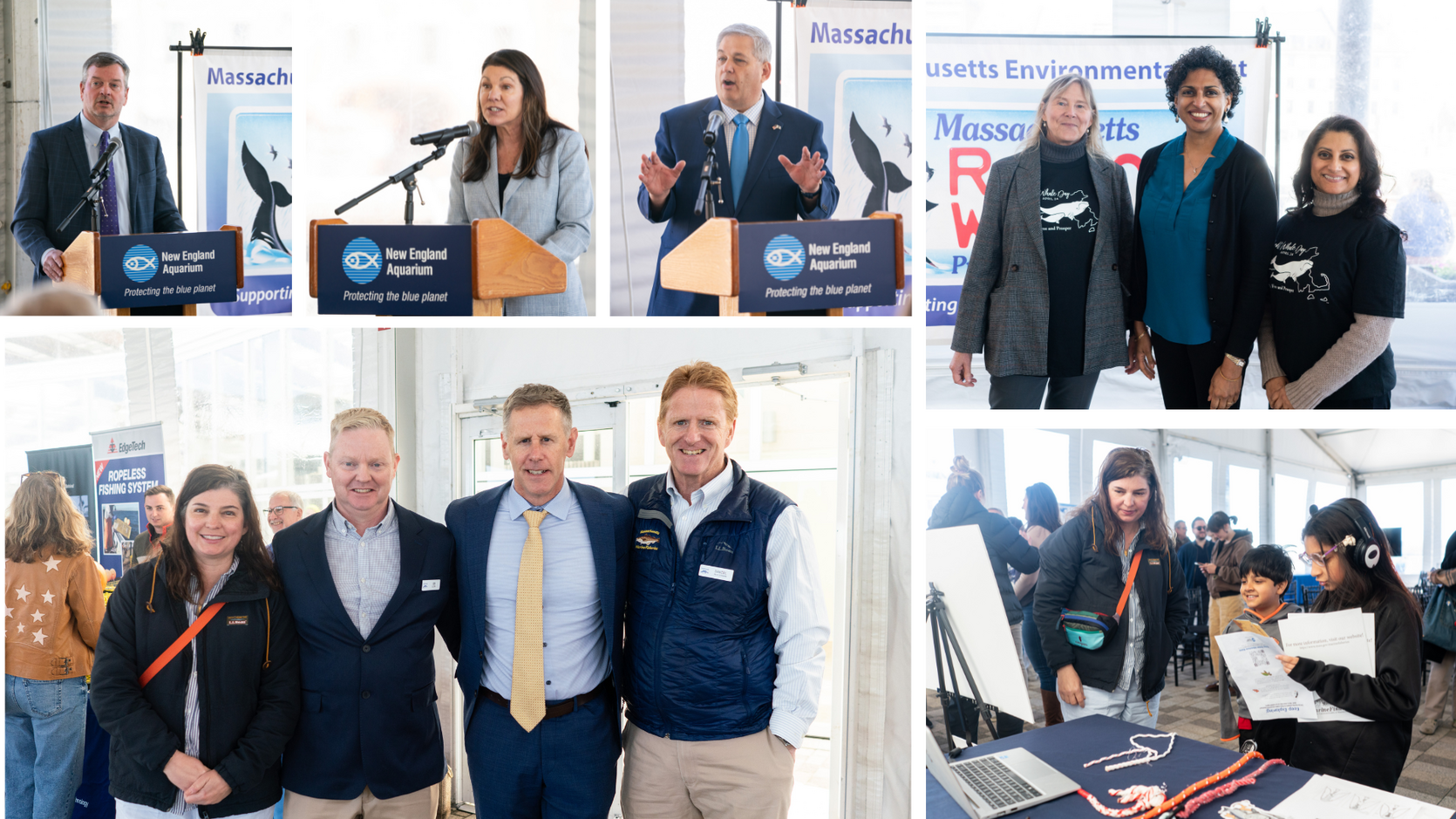
Boston — In an effort to promote conservation and recovery of North Atlantic right whales, Governor Maura Healey declared April 24th as Massachusetts Right Whale Day. The Healey-Driscoll Administration partnered with the New England Aquarium to commemorate the day, highlight the continued partnership to protect this species, and inspire the public to take action.
Established in 2023, Massachusetts Right Whale Day celebrates the state’s official marine mammal and partners who champion their protection. With the leadership of State Representative Josh Cutler and inspired by a powerful local encounter between the Delaney family and a breaching right whale, this day honors both the species and the individuals who have supported its protection. This year, the event bridged conservation, education, and artistic expression, featuring interactive science stations, a dance performance, an auction of right whale-inspired art, and a chance to win a low-number right whale plate #380.
“Every Earth Week, we are reminded that our actions can make a real difference for endangered species like the North Atlantic right whale,” said Energy and Environmental Affairs Secretary Rebecca Tepper. “Through partnership and collaboration, we are advancing critical research, strengthening conservation efforts, and empowering the public to help protect North Atlantic right whales for generations to come.”
“Massachusetts Right Whale Day is an opportunity for us to educate the public about the importance of this critically endangered species and inspire action,” said New England Aquarium President and CEO Vikki N. Spruill. “Our scientists in the New England Aquarium’s Anderson Cabot Center for Ocean Life have seen first-hand, through more than 40 years of research, the power of collaborative conservation efforts when it comes to protecting right whales for generations to come.”
North Atlantic right whales are listed as endangered under the federal Endangered Species Act (ESA) and Massachusetts Endangered Species Act (MESA). Over two-thirds of the estimated population of 384 whales visit our coastal waters each year, migrating to Cape Cod Bay to feed in winter and spring. Because of this, Massachusetts has the most stringent state regulations in the country to conserve and achieve coexistence with the species. This includes seasonal, three-month, dynamically managed fishing closures and vessel speed limits when right whales are present in Cape Cod Bay, mandatory use of weak buoy lines, and other strategies to reduce risks of entanglements and ship strikes.
Through strong partnerships, the Massachusetts Department of Fish & Game’s (DFG) Division of Marine Fisheries (DMF) Protected Species Program advances a leading research and monitoring program, coordinates disentanglement efforts, and researches the feasibility of alternative gear solutions like ropeless or on-demand technology. Because of its leadership, DMF received the NOAA Fisheries “Partner in the Spotlight” Award in 2023 and was awarded $4.6 million from a congressional appropriation through the Atlantic States Marine Fisheries Commission (ASMFC) to expand their efforts. In 2025, DMF launched a coastwide, passive acoustic monitoring program to better understand North Atlantic right whale presence in Massachusetts waters, inform dynamic management of seasonal fisheries closures and vessel speed limits, and support future conservation efforts. Building upon the long-standing aerial surveillance program conducted in partnership with the Center for Coastal Studies (CCS) since 1998, this will further enhance understanding of right whale migration and behavior.
“As our state’s official marine mammal, we are proud to join partners and the public to celebrate the 4th annual Right Whale Day,” said DFG Commissioner Tom O’Shea. “This is a critical moment for action—that’s why we are proud to partner with conservation organizations and the lobster industry to strengthen our efforts to give this awe-inspiring and imperiled species the best chance at recovery.”
“For nearly three decades, our critical research in partnership with CCS, New England Aquarium, and MET has allowed us to monitor right whale populations in Massachusetts. Because of this strong backbone of science, we’re able to uphold incredible protections for this species through dynamic seasonal fishing closures and speed restrictions that dramatically reduce risks, without overburdening the industry,” said DMF Director Daniel McKiernan. “Thanks to generous support from NOAA Fisheries, we are excited to launch our new passive acoustic monitoring program in partnership with Woods Hole Oceanographic Institution to further our understanding of right whale movements and behavior and continue to innovate practical solutions in partnership with our lobster industry to conserve this important species.”
Over the last 30 years, the Massachusetts Environmental Trust (MET) has awarded more than $28 million to 800 projects to support protection of endangered marine animals and river and wetland restoration. Through the sale of specialty license plates like the Right Whale/Roseate Tern license plate, the Trust leverages public support to fund solutions. In particular, MET has invested nearly $10 million in protecting marine life and the ecosystems they depend on through science, rescue, innovation, and public engagement. From Center for Coastal Studies leading disentanglement efforts and vital research, to the New England Aquarium’s Anderson Cabot Center for Ocean Life maintaining the global North Atlantic Right Whale Catalog, to Ocean Alliance using drone technology for non-invasive whale research, to Whale and Dolphin Conservation advancing emergency response—MET’s powerful network of partners are tackling the most urgent threats facing whales today. MET also provides $200,000 annually to support the state’s Large Whale and Sea Turtle Conservation Program—a critical, year-round effort led by the Massachusetts Division of Marine Fisheries and the Center for Coastal Studies, in partnership with NOAA Fisheries.
“Over the last three decades, our beloved specialty plates have funded hundreds of projects that have had immense benefits to both wildlife and people. No work is more important to the Trust’s mission than our right whale research and recovery work—we are proud to be here today with our many partners to highlight the progress we’ve made, and the critical need for continued action,” said MET Board Member RJ Lyman. “Together, these investments power conservation—saving whales, reducing human impacts, and building a future where marine life and coastal communities thrive side by side.”
“With nearly 20,000 of these license plates on the road in Massachusetts, the Right Whale/Roseate Tern design is not only one of the state’s earliest specialty plates but continues to be very popular,” said Massachusetts Registrar of Motor Vehicles Colleen Ogilvie. “The RMV is proud to partner with the Massachusetts Environmental Trust so that revenue from these plates can support whale research, habitat restoration, and disentanglement efforts along our coast.”
Additionally, in partnership with the state legislature, conservation organizations, and lobster industry, Massachusetts recently expanded opportunities for cleanup of fishing gear debris. Following modernization of state law, DMF established new regulations to allow efficient and timely removal of lost, abandoned, or derelict fishing gear from our coasts. While DMF has always collaborated with Massachusetts Environmental Police (MEP) to clean up lost gear and ensure compliance, partners and the public will now be able to clean up fishing gear debris to prevent ghost fishing, protect marine life, and enhance public safety.
“The Massachusetts Environmental Police are out on the water reporting right whale sightings, tracking and removing lost fishing gear and helping boaters understand how to safely share these waters with this endangered species,” said MEP Colonel John Monaghan. “On Right Whale Day, we’re proud to highlight this work and the role it plays in protecting an important species in our ecosystem.”
“It’s been an encouraging season for the North Atlantic right whale, with 23 new mom-calf pairs!” said Anne-Marie Runfola, Executive Director, Center for Coastal Studies. “As we celebrate the Center for Coastal Studies’ 50th anniversary, we can look back at the tremendous progress that’s been made in understanding and protecting these critically endangered animals, and we’re so grateful to our network of partners and collaborators for their support. Working together, I can’t help but be optimistic about our collective efforts to restore this magnificent species, the official marine mammal of Massachusetts.”
"Each year, Right Whale Day provides us with an opportunity to reflect on our special role as stewards of this endangered species, and to think about how we can fulfil that role with innovation, leadership, and dedication to not only this species, but the marine environment that is imbedded into the identity of our state. Thanks to all of the partners who make the commemoration of this day possible, said Coastal Caucus Chair Senator Bruce Tarr (R—Gloucester)."
“Right Whale Day is an opportunity to recognize our official marine mammal and reflect on our responsibility to protect our oceans,” said Coastal Caucus Chair Representative Kathleen LaNatra (D—Plymouth) “As House Chair of the Coastal Caucus, I’m proud of the progress we’ve made, but I also know there’s more work ahead to address the threats facing right whales and the ecosystems they depend on. Our ocean is part of who we are in Massachusetts—it supports our communities, our economy, and our way of life. Protecting it for future generations isn’t optional—it’s our responsibility.”
Support MET:
Support MET by choosing or renewing one of the four specialty license plates via the RMV, participating in low-number license plate auctions, or by making a direct donation to the Trust. 100% of your donation is dedicated to the Massachusetts Environmental Trust’s work in conservation, education, habitat protection, research, and whale rescue – Explore our website. Additionally, MET presents Discover Art with Purpose, an online auction of marine-life-inspired works by Massachusetts artists—raising awareness and critical funds for ocean conservation. The auction is live through April 25, 2026, at https://WhaleArt.givesmart.com.
###