
- Scientific name: Huperzia appressa
- Species of Greatest Conservation Need (MA State Wildlife Action Plan)
- Endangered (MA Endangered Species Act)
Description
Appalachian firmoss is a small, evergreen member of the firmoss family (Huperziaceae), found on cliff faces, summits, and other exposed, harsh environments. It has dichotomously branching shoots that are 6-10 cm (2.4-4 in) tall, covered with small, pointed, simple leaves that are 2-6 mm (0.08-0.24 in) long.
Firmosses differ from clubmosses (Lycopodiaceae) in having their sporangia (spore-bearing structures) borne in leaf axils along the stem, rather than in strobili (cones) at the tip. In addition to spores, they produce small, vegetative propagules called “gemmae” on specialized branches called “gemmiphores.” Leaves (microphylls) have two forms: “sporophylls” are associated with sporangia, which are distributed in distinct areas along the stem; the leaves not associated with sporangia are called “trophophylls”. In Appalachian firmoss, the trophophylls near the apex of a shoot are conspicuously shorter and more ascending (appressed) than those near the base. Like other firmosses and clubmosses, Appalachian firmoss is identifiable throughout the year.
Two other firmoss species occur in Massachusetts: shining firmoss (H. lucidula), which is common and found throughout most of the state, and mountain firmoss (H. selago), which is rare and listed as Endangered in Massachusetts. H. lucidula and H. selago differ from Appalachian firmoss in having trophophylls that are similar throughout the plant: they are neither conspicuously smaller nor more ascending at the apex than near the base. These species also have gemmiphores borne in a single whorl at the apex of a season’s growth, rather than throughout the apical portion of the plant as in Appalachian firmoss. The lateral leaves of the gemmae are sharply pointed and 0.5-1.1 mm (0.02-0.04 in) wide in Appalachian firmoss; in the other two species, they are wider (1.3-2.5 mm [0.05-0.1 in]) and have blunt tips. A hybrid between Appalachian firmoss and shining firmoss, H. x protoporophila, occurs with Appalachian firmoss in Massachusetts. It is intermediate between its parent species in the degree of distinction between the lower and upper trophophylls, as well as in the width of the lateral gemmae leaves, and the gemmae are borne in one or two pseudo-whorls at the apex of each season’s growth.
Life cycle and behavior
This is an evergreen species.
Population status
Appalachian firmoss is listed under the Massachusetts Endangered Species Act as endangered. All listed species are protected from killing, collecting, possessing, or sale, and from activities that would destroy habitat and thus directly or indirectly cause mortality or disrupt critical behaviors. MassWildlife’s Natural Heritage & Endangered Species Program has 11 records from 5 counties: Berkshire, Franklin, Hampshire, Middlesex, and Worcester. One of these records has been observed within the last 25 years.
Distribution and abundance
Appalachian firmoss occurs in Greenland, eastern Canada, and the northeastern United States from Minnesota to Massachusetts. It also occurs in the southern Appalachians from Virginia to Georgia. It is listed as Endangered in Michigan and Massachusetts, Threatened in New York and Tennessee, and Special Concern in Maine.
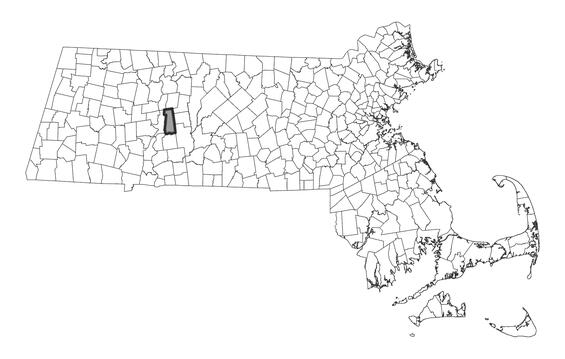
Distribution in Massachusetts. 2000-2025. Based on records in the Natural Heritage Database.
Habitat
Appalachian firmoss occurred historically at several mountaintop sites in western Massachusetts. It is currently known from a single station in the Connecticut Valley, where it occurs on a damp, mossy, north-facing cliff along with the hybrid Huperzia x protoporophila.
Healthy habitats are vital for supporting native wildlife and plants. Explore habitats and learn about conservation and restoration in Massachusetts.
Threats
At the single site in Massachusetts where it has been confirmed recently, it is unlikely to be directly impacted by human activities. However, like other species with primarily northern distributions, it may be threatened by climate change.
Conservation
As for many rare species, exact needs for management of Appalachian firmoss are not known. All active management of rare plant populations (including invasive species removal) is subject to review under the Massachusetts Endangered Species Act and should be planned in close consultation with MassWildlife’s Natural Heritage & Endangered Species Program.
References
Gleason, H.A., and A. Cronquist. 1991. Manual of Vascular Plants of Northeastern United States and Adjacent Canada, 2nd edition. The New York Botanical Garden, Bronx, NY.
Haines, A. 2011. Flora Novae Angliae – a Manual for the Identification of Native and Naturalized Higher Vascular Plants of New England. New England Wildflower Society, Yale Univ. Press, New Haven, CT.
Contact
| Date published: | April 29, 2025 |
|---|