
- Scientific name: Limosella autralis R. Br.
- Species of Greatest Conservation Need (MA State Wildlife Action Plan)
Description
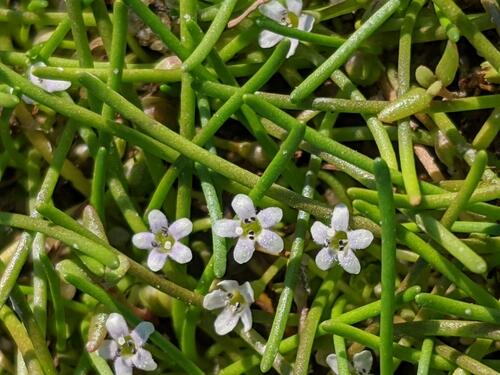
Photo by Lily Morel.
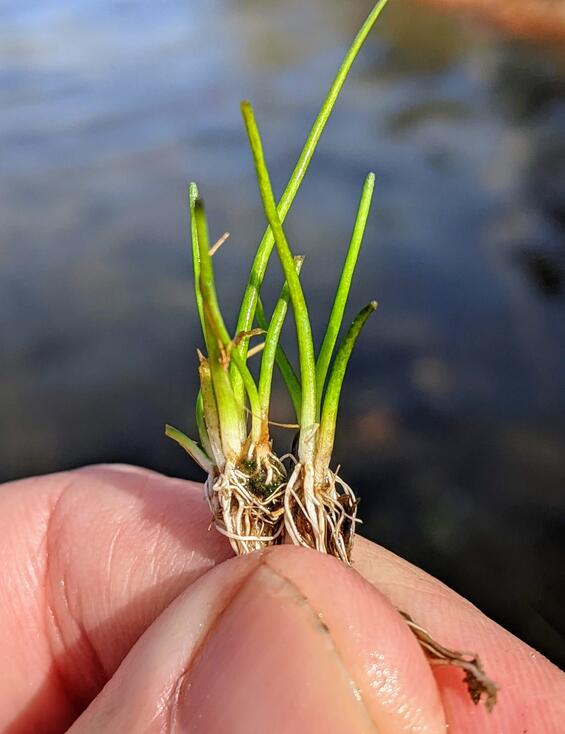
A small, diminutive, green, annual, coastal species that tends to form mats of dozens of plants. The leaves are bladeless, appear succulent, all looking like stems, and are clustered in rosettes of 5 to 10 leaves along stolons (above ground runners). Each leaf is linear, 1-3.5 cm (0.4-1.4 in) in length and up to 2 mm (0.08 in) wide, round in cross-section. The flower stem is shorter than the leaves. Flowers are tiny and consist of a five-lobed calyx and white to pale lavender corolla, 2-3 mm (0.08-0.12 in) across with rounded lobes. The seed capsules are round and 2-3 mm (0.08-0.12 in) in size (Gleason & Cronquist 1991, Crow & Hellquist 2023).
Life cycle and behavior
Atlantic mudwort is an herbaceous annual, found in small ponds and shores very near the ocean shore.
Population status
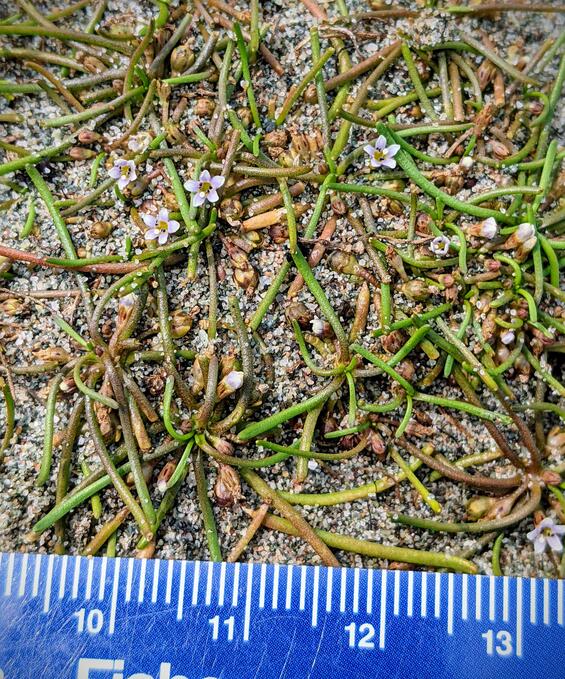
Atlantic mudwort is on the Massachusetts state watch list and has been included as a species of greatest conservation need in Massachusetts. Atlantic mudwort is historically known from Barnstable, Bristol, Dukes, Essex, Nantucket and Plymouth counties (Cullina et al. 2011). There are 72 herbarium specimens from Massachusetts with legible dates, half of which are from the last 90 years (CHN 2025). There are currently 16 known populations of Atlantic mudwort in the state on iNaturalist as research grade observations (iNaturalist 2025 with two in Barnstable County and the remaining in Dukes and Nantucket.
Distribution and abundance
iNaturalist shows that Atlantic mudwort is rare across northeastern North America with only 77 research grade observations in that region (iNaturalist 2025). It is distributed in all US states with a seacoast from North Carolina to Maine. It is considered extirpated or possibly extirpated in Virginia, Delaware, Pennsylvania and New Hampshire, critically imperiled in North Carolina, New Jersey, New Hampshire and not occurring in any inland state except West Virginia (NatureServe 2025). Around the globe, the plant is common in Australia, New Zealand and Québec.
Habitat
Atlantic mudwort is an obligate wetland, often fully aquatic, species that grows in shallow coastal plain ponds, salt ponds, pond edges, ocean shore areas both rocky and sandy, and mud flats.
Healthy habitats are vital for supporting native wildlife and plants. Explore habitats and learn about conservation and restoration in Massachusetts.
Threats
Non-migratory flocks of Canada geese and mute swans have become common to abundant in these shallow ponds, often consuming large areas of emergent or submersed aquatic and wetland vegetation including Atlantic mudwort. These bird populations have hugely increased in the last 40 years in Massachusetts and post a serious threat to rare plant populations in this type of habitat (Baker et al. 2018, Cyr and Pace 1993, Jobe et al. 2022, Kjeller et al. 2024, Mass Audubon 2025a, Mass Audubon 2025b, Nichols 2014). In addition to herbivory, the effects of Canada geese presence include eutrophication and serious worsening of water quality, degrading growing conditions for rare plant species.
Threats also come from shoreline development, invasive species such as purple loosestrife, gray willow and giant reed grass, off-road vehicle use when ponds dry up (which happens in some locations in a prolonged drought), succession with woody species taking over formerly open bog habitat, and changes in hydrology due to development, road construction or beaver activity.
Conservation
Much more survey work is needed to find more populations, especially because this species is quite small, and as an annual, does not appear until later in the year. Some populations may be difficult to access. One approach is to review old specimen data for locations and resurvey those sites to see if the plants might still be there. Surveys of known populations are needed to establish numbers and extent of the population, and gather data on associated species, water quality, and potential threats. Once surveyed, a population should be resurveyed every five years to check on its status. Annual species need more frequent surveys as they numbers will change from year to year.
Conservation planning for Atlantic mudwort should focus on land protection and the preservation of natural habitat conditions. Management needs could include hazing of geese and swans to move them off the habitat, and removal or treatment of invasive, non-native plant species. Research is needed on seed production, seed fertility, seed dispersal and germination.
References
Bakker, E. S., C. G. F. Veen, G. J. N. Ter Heerdt, N. Huig, and J. M. Sarneel. 2018. High Grazing Pressure of Geese Threatens Conservation and Restoration of Reed Belts. Frontiers in Plant Science 9.
Consortium of Northeastern Herbaria. 2025. Herbarium records. https://portal.neherbaria.org/portal/collections/list.php. Accessed 8 April 2025
Garrett E. Crow and C. Barre Hellquist. 2023. Aquatic and Wetland Plants of Northeastern North America, Second Edition. University of Wisconsin Press, Madison. lx + 887 pp., hardback. ISBN 978-0-299-34300-2. $99.95.
Cullina M, Connolly B, Sorrie B, Somers P (2011) The vascular plants of Massachusetts: a county checklist, 1st revision. Massachusetts Natural Heritage & Endangered Species Massachusetts Division of Fisheries and Wildlife, Westborough, MA
Cyr, H., and M. L. Pace. 1993. Magnitude and patterns of herbivory in aquatic and terrestrial ecosystems. Nature 361: 148–150.
Fernald, M. L. 1950. Gray’s Manual of Botany, Eighth (Centennial) Edition—Illustrated. American Book Company, New York.
Gleason, Henry A., and Arthur Cronquist. 1991. Manual of Vascular Plants of Northeastern United States and Adjacent Canada, Second Edition. Bronx, NY: The New York Botanical Garden.
Haines A. 2011. New England Wild Flower Society’s Flora Novae Angliae: a manual for the identification of native and naturalized higher vascular plants of New England. Yale University Press. 1008 pp.
iNaturalist 2025. Available from https://www.inaturalist.org. Accessed 10 April 2024
Jobe, J., C. Krafft, M. Milton, and K. Gedan. 2022. Herbivory by Geese Inhibits Tidal Freshwater Wetland Restoration Success. Diversity 14: 278.
Kjeller, E., J. Waldenström, J. Elmberg, and G. Gunnarsson. 2024. Herbivory on aquatic macrophytes by geese and swans—a review of methods, effects, and management. Ornis Svecica 34: 119–137.
Mass Audubon. 2025. Find a Bird: Canada Goose, Branta canadensis. Mass Audubon Breeding Bird Atlas. Website https://www.massaudubon.org/our-work/birds-wildlife/bird-conservation-research/breeding-bird-atlases/find-a-bird?id=76 [accessed 9 April 2025].
Mass Audubon. 2025. Find a Bird: Mute Swan, Cygnus olor. Mass Audubon Breeding Bird Atlas. Website https://www.massaudubon.org/our-work/birds-wildlife/bird-conservation-research/breeding-bird-atlases/find-a-bird?id=100 [accessed 9 April 2025].
NatureServe. 2025. NatureServe Network Biodiversity Location Data accessed through NatureServe Explorer [web application]. NatureServe, Arlington, Virginia. Available https://explorer.natureserve.org/. Accessed: 4/10/2025.
Nichols, T. C. 2014. Ten years of resident Canada goose damage management in a New Jersey tidal freshwater wetland. Wildlife Society Bulletin 38: 221–228.
Staudinger, M.D., A.V. Karmalkar, K. Terwilliger, K. Burgio, A. Lubeck, H. Higgins, T. Rice, T.L. Morelli, A. D'Amato. 2024. A regional synthesis of climate data to inform the 2025 State Wildlife Action Plans in the Northeast U.S. DOI Northeast Climate Adaptation Science Center Cooperator Report. 406 p. https://doi.org/10.21429/t352-9q86
Contact
| Date published: | April 29, 2025 |
|---|