
- Scientific name: Lechea pulchella var. moniliformis
- Species of Greatest Conservation Need (MA State Wildlife Action Plan)
- Endangered (MA Endangered Species Act)
Description
Beaded pinweed is a perennial member of the Rockrose family (Cistaceae) found in early successional habitats along the coastal plain. In addition to the upright stems, beaded pinweed has creeping basal shoots. Like other Lechea species, beaded pinweed’s basal leaves are formed in late summer, overwinter on the plant, and then senesce when flowering shoots are produced in the spring and summer. The ultimate branches are crowded with tiny, pink to red flowers that are radially symmetrical with 5 sepals.
The minute leaves (0.41-0.8 cm; 0.16–0.31 in) of beaded pinweed are crowded on the stem, and have hard, shiny, conical brown tips. The basal leaves are usually whorled, with 3 to 4 leaves per node, or rarely alternate, and are narrowly lanceolate to narrowly elliptic. One to many upright flowering shoots are typically 30-60 cm (11.8-23.6 in) tall. Leaves on the upper part of the stem are opposite to sub-opposite, linear to narrowly elliptic, glabrous above, and very sparsely hairy on the mid-vein below. The primary branches diverge at 45° to 60° angles. The flowers are borne individually or in few-flowered clusters on the tertiary branches. Fruits are round capsules with 1 to 3 seeds.
Species of Lechea are difficult to identify, and a technical manual should be consulted. Identification should be based on plants with mature fruits viewed with a good hand lens or microscope. Beaded pinweed can be distinguished by the following combination of characters: outer sepals much shorter than the 3-nerved inner sepals; leaves with hard, shiny, conical brown tips; fruiting calyx less than 1.5 mm (0.06 in) broad, obovoid and acute at base, and containing 1-3 seeds. Bead pinweed may be confused with the round-fruited pinweed (Lechea intermedia), which has round fruits; bead pinweed is distinguished by its smooth seeds that do not have a membranous cover, in contrast to the fruits of round-fruited pinweed.
Life cycle and behavior
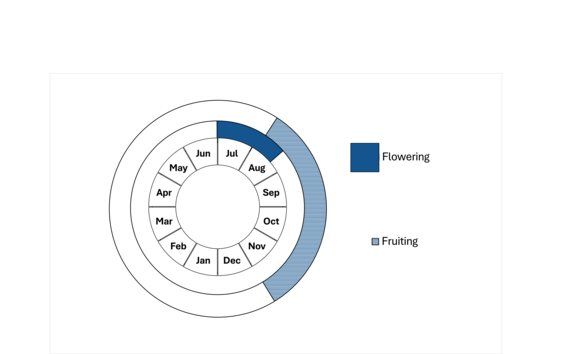
This is a perennial species that flowers in summer.
Population status
Beaded pinweed is listed under the Massachusetts Endangered Species Act as endangered. All listed species are protected from killing, collecting, possessing, or sale, and from activities that would destroy habitat and thus directly or indirectly cause mortality or disrupt critical behaviors. Beaded pinweed is currently known from Nantucket County, and it occurred historically in Bristol and Dukes Counties.
Distribution and abundance
Beaded pinweed occurs along the Atlantic coast from Maryland to New York and Massachusetts, west to Illinois and the Great Lakes.
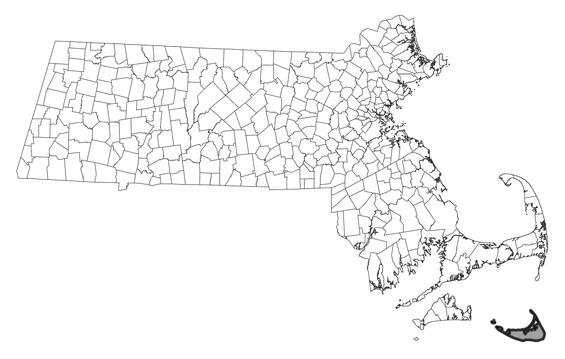
Distribution in Massachusetts. 1999-2024. Based on records in the Natural Heritage Database.
Habitat
Beaded pinweed is typically found in dry, gravelly or sandy, open ground and fields. It prefers dry to moist sandy plains, disturbed meadows, shores, and open woods. Beaded pinweed is at the northern edge of its range in Massachusetts. Associated species are generally representative of successional coastal plain grasslands, including bayberry(Morella caroliniensis), little bluestem(Schizachyrium scoparium), bearberry (Arctostaphylos uva-ursi), bushy aster (Symphyotrichum dumosum), and false heather (Hudsonia ericoides).
Healthy habitats are vital for supporting native wildlife and plants. Explore habitats and learn about conservation and restoration in Massachusetts.
Threats
Habitat loss due to development and natural succession are the major threats to beaded pinweed. Extant populations are threatened by increased shading from shrubs such as scrub oak (Quercus ilicifolia) and black huckleberry (Gaylussacia baccata).
Conservation
Beaded pinweed is an early successional species that requires some disturbance to proliferate, but it is also vulnerable to off-road vehicle impacts and development. Prescribed fire may be beneficial to maintain early successional habitats. Beaded pinweed may also occur in intermittent wetlands, and known populations should be protected from dramatic changes in light or moisture conditions. All active management of rare plant populations (including invasive species removal) is subject to review under the Massachusetts Endangered Species Act and should be planned in close consultation with MassWildlife’s Natural Heritage & Endangered Species Program.
References
Barringer. K. 2004. New Jersey Pinweeds (Lechea, Cistaceae). Journal of the Torrey Botanical Society, 131: 261-276.
Gleason, H. A., and A. Cronquist. 1991. Manual of Vascular Plants of Northeastern United States and Adjacent Canada, 2nd edition. The New York Botanical Garden, Bronx, NY.
NatureServe. 2009. NatureServe Explorer: An online encyclopedia of life [web application]. Version 7.1. NatureServe, Arlington, VA. http://www.natureserve.org/explorer
USDA, NRCS. 2011. The PLANTS Database (http://plants.usda.gov, April 2012). National Plant Data Center, Baton Rouge, LA.
Contact
| Date published: | April 30, 2025 |
|---|