
Study overview
The Boston Metropolitan Coastal Watershed Study (“Study”) is authorized under Section 729 of the Water Resources Development Act that allows the USACE to study the water resources needs of coastal regions of the United States in consultation with federal, state, tribal, interstate, and local governmental entities. Funding was appropriated by Congress in 2021 and a cost share agreement (75% federal, 25% state) was signed with EEA in December 2021. The study provides a watershed-scale assessment of coastal flood risk and develops a screening framework for identifying potential opportunities for risk reduction strategies. The framework considers coastal flood risk, potential economic damages, populations, critical infrastructure, environmental resources, and input from key stakeholders. Between 2023 and 2025, the watershed study paused while ResilientCoasts, the Commonwealth’s statewide comprehensive strategy to strengthen coastal resilience, was underway. Following the release of the ResilientCoasts Plan in November 2025, the watershed study was rescoped to better align with the statewide framework.
This USACE-led watershed study will result in a Final Report that may support future regional collaboration and coastal resilience planning. The study does not identify or recommend specific strategies, prioritize areas for investment, conduct a Benefit Cost Analysis or lead to Federal Authorization for implementation funding. The study does not replace the ResilientCoasts Plan for this region but may serve as an additional resource for Boston Harbor communities working together through the ResilientCoasts implementation process to identify priority regional projects.
Study Area
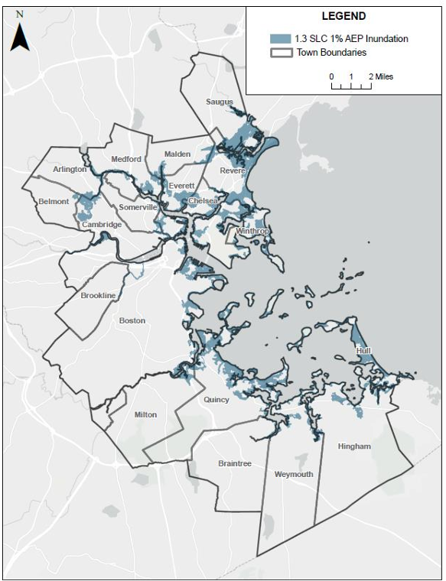
The broad study area was informed by the extent of flooding associated with the 1% annual storm event in 2070 with 4.2 feet of sea level rise (Massachusetts Coast Flood Risk Model (PDF)) and includes 19 coastal and tidally-influenced inland communities within Boston Harbor. The risk assessment and screening framework focused on areas exposed to near-term flood risk (flooding associated with the 1% annual storm event in 2030 with 1.3 feet of sea level rise). See Figure 1.
Partners and Stakeholder Engagement
Initial stakeholder engagement for the watershed study focused on the Shared Vision Milestone and was conducted between December 2022 – May 2023,prior to the launch of ResilientCoasts in November 2023. Stakeholders included representatives from federal and state agencies, tribal government, coastal and inland municipalities in the study area, and members of watershed associations and community-based organizations. Through a series of meetings, focus groups, and interviews facilitated in partnership with the Metropolitan Area Planning Council (MAPC), stakeholders provided input on the study goals and objectives and developed an agreed-upon shared vision for the future.
Please see the workgroup meeting presentations below:
- Workgroup Meeting #1 (December 5, 2022)
- Workgroup Meeting #2 (January 19, 2023)
- Workgroup Meeting #3 (May 11, 2023)
Stakeholder engagement continued through the ResilientCoasts process which helped shape the final ResilientCoasts Plan, including six virtual public meetings across three waves of engagement, two online surveys, focus groups, and meetings with internal and external workgroup members, and three in-person public meetings post-release of the draft plan. For more information about the ResilientCoasts planning process, engagement materials, and a copy of the final plan, please visit the ResilientCoasts Initiative page.
Following the release of the ResilientCoasts Plan, the USACE integrated the ResilientCoasts Coastal Resilience Districts, Near-Term Adaptation Areas, and coastal typologies into the watershed study methodology. CZM conducted several targeted outreach meetings with municipalities, non-profits and watershed organizations prior to and during the Draft Report public comment period. Please see the presentation below:
Timeline and Milestones
Key study milestones and target completion dates include:
- Shared Vision Milestone: Completed June 2023
Inventories existing local studies and plans, develops the study goals and objectives, and defines the overall shared vision among stakeholders. Following the completion of this milestone, the study was paused while ResilientCoasts was under development. - Recommendations Milestone: Completed May 2026
Assesses regional coastal flood risk and applies a screening framework to identify potential opportunities for resilience strategies. - Draft Report Released for Public and Concurrent Agency Review: September - November 2026
Draft Report detailing the study and draft recommendations released publicly on the USACE’s website for review. The Draft Report was released on September 19, 2026 and following a 30-day extension of the original public comment deadline, public comments are due to USACE by November 23, 2026. - Final Report Milestone and Approval: December 2026 /Early 2027
The Final Report is prepared and provided for approval to the USACE North Atlantic Division Commander. If approved, the Final Report is transmitted to the USACE Headquarters and Congress. The Final Report does not lead to Federal Authorization for implementation funding.
Contacts
For more information, please contact the following staff:
Mia Mansfield, EEA Assistant Secretary for Resilience
mia.mansfield@mass.gov
Deanna Moran, CZM Chief Coastal Resilience Officer
Joanna Yelen, CZM Boston Harbor Regional Coordinator
joanna.m.yelen@mass.gov
Patricia Bowie, CZM Coastal Resilience Specialist
patricia.bowie@mass.gov