
- Scientific name: Carex castanea Wahlenb.
- Species of Greatest Conservation Need (MA State Wildlife Action Plan)
- Endangered (MA Endangered Species Act)
Description
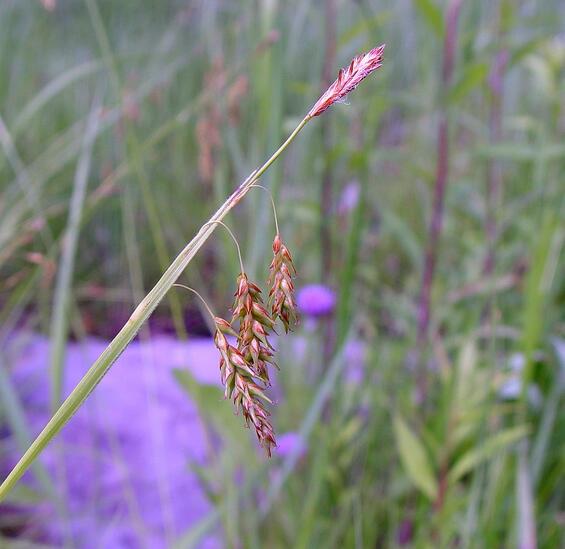
Chestnut-colored sedge flowering spikes. Image credit: Arthur Haines, Native Plant Trust.
Chestnut-colored sedge (Carex castanea) is a member of the sedge family (Cyperaceae) within Carex section Hymenochlaenae. It is a perennial, herbaceous, grass-like plant of calcareous seeps, fens, and wet meadows. It typically forms loose clusters of stems, reaching a height of 30-90 cm (11-35 in) and is purple tinged at its base.
To identify chestnut-colored sedge and other members of the genus Carex, a technical manual should be consulted. Species in this genus have tiny, wind-pollinated flowers that are borne in spikes. Each flower is unisexual and is closely subtended by small scales that largely conceal the flowers. The staminate (i.e., pollen-bearing) flowers are subtended by a single scale. The pistillate (i.e., ovule-bearing) flowers are subtended by two scales, an outer flat scale (pistillate scale) and an inner, sac-like scale, called a “perigynium,” that encloses the flower, and later, the achene (a small, hard seed-like fruit). If the perigynium tapers or contracts to a tip, it is described as a “beak.” Chestnut-colored sedge perigynia have beaks.
The fruiting stems of the chestnut-colored sedge are longer than the leaves. The uppermost spike is 2 to 3 cm (1 inch) long and is entirely staminate. The 2-4 lateral, pistillate spikes are narrowly cylindric, 8-25 mm long (0.3 – 1 in.), 4-5 mm (0.1.5-0.2 in.) wide, and droop from long, slender stalks (peduncles). The pistillate scales, for which the plant is named, are tinged with a chestnut-brown color with a green central stripe then extends into a short awn. These scales are sparsely pubescent and are almost as long as the perigynia. The perigynia are pale green, lance-shaped, and hairless with two prominent ribs and several fine veins. The perigynia taper to a short, minutely two-toothed beak that is half as long as the body. Achenes are three-sided with concave sides. The leaves of chestnut-colored sedge are 3-8 mm (0.1-0.3 in) wide and softly pubescent (hairy). Leaves mostly occur at the base of the plant.
In Massachusetts, the chestnut-colored sedge is distinct in having the following combination of features: hairy leaves, drooping pistillate spikes, base of plant is reddish purple, and entirely staminate terminal spikes. Other rare sedges of calcareous areas that may be confused with the chestnut–colored sedge are Davis’ sedge (C. davisii; Endangered) and the handsome sedge (C. formosa; Threatened), which also have drooping pistillate spikes, pubescent leaves, and red-dotted perigynia. However, in these two sedges, the terminal spike bears both staminate flowers (usually evident as empty-looking scales at the base of the spike) and pistillate flowers. An additional species that might be confused with chestnut-colored sedge is long-beaked sedge, Carex sprengelii, which is in the same section, has hairless leaves and perigynia that more abruptly taper to a beak. In addition, the base of the plant is brown rather than reddish purple.
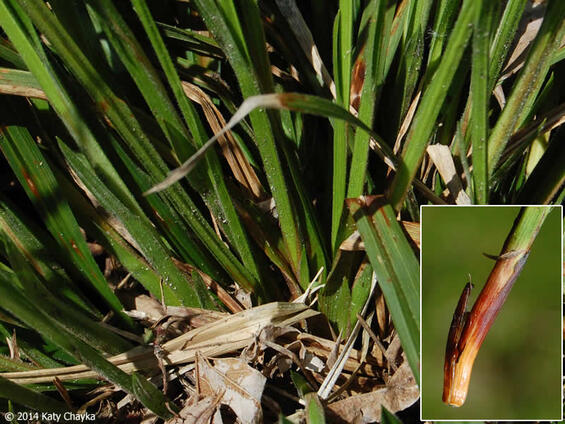
Basal sheaths. Image credit: Katy Chayka, MinnesotaWildflowers.info.
Life cycle and behavior
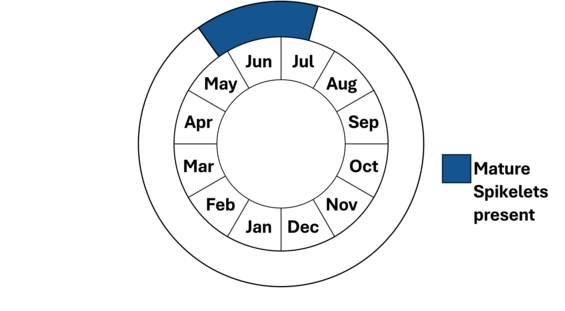
Chestnut-colored sedge is a perennial species that grows in loose tufts and can form colonies from short rhizomes. The flowers are wind-pollinated in early spring. The achenes start to mature in late spring, ripening by mid-summer.
Population status
Chestnut-colored sedge is listed under the Massachusetts Endangered Species Act as Endangered. All listed species are protected from killing, collecting, possessing, or sale and from activities that would destroy habitat and thus directly or indirectly cause mortality or disrupt critical behaviors. Chestnut-colored sedge was first discovered in Massachusetts in 1984. The five known populations are all in Berkshire County. Massachusetts is at the southern extent of chestnut-colored sedge's range. The sedge is believed to be rare in the state because it prefers cooler northern climates and calcareous soils that are not plentiful in the Commonwealth. The Massachusetts Natural Heritage & Endangered Species Program database has 6 records all from Berkshire County. Five of these records have been observed within the last 25 years.
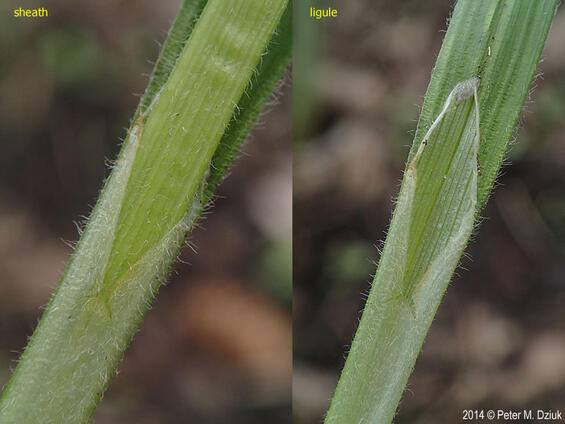
Pubescent leaves. Image credit: Peter Dziuk, MinnesotaWildflowers.info
Distribution and abundance
The documented range of chestnut-colored sedge extends from Newfoundland and Labrador west to Manitoba, south to Connecticut, and west to Minnesota, and south to Indiana. It is considered possibly extirpated in New Hampshire, Critically Imperiled in Connecticut, Indiana and Massachusetts, Imperiled in Manitoba, and Vulnerable in Labrador, Newfoundland, Nova Scotia, and Quebec. Vermont considers it Apparently Secure, it has not been ranked in Maine and is not known to occur in Rhode Island.
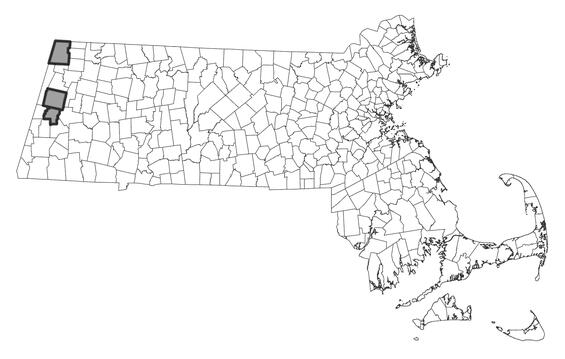
Distribution in Massachusetts
1999-2024
Based on records in the Natural Heritage Database
Habitat
Chestnut-colored sedge is found in calcareous seeps within wet meadows, deciduous or mixed forests, and along river and pond shores. It is capable of tolerating disturbance and is often found in transitional habitats, such as in forest edges next to open land. The known occurrences in Massachusetts are in a seepage marsh at the edge of an artificial pond and in open, calcareous wet meadows. Typically associated with this species are other sedges, including marsh-sedge (C. lacustris), panicled sedge (C. diandra), inland prickly sedge (C. interior), porcupine sedge (C. hystericina), awl-fruited sedge (C. stipata), and yellow sedge (C. flava). Other associates include willows, such as autumn willow (Salix serissima), hoary willow (S. candida), and long-beaked willow (S. bebbiana). Other species documented to occur with chestnut-colored sedge in Massachusetts include sugar maple (Acer saccharum), old field cinquefoil (Potentilla simplex), steeplebush (Spiraea tomentosa), sensitive fern (Onoclea sensibilis), and marsh fern (Thelypteris palustris).
Healthy habitats are vital for supporting native wildlife and plants. Explore habitats and learn about conservation and restoration in Massachusetts.
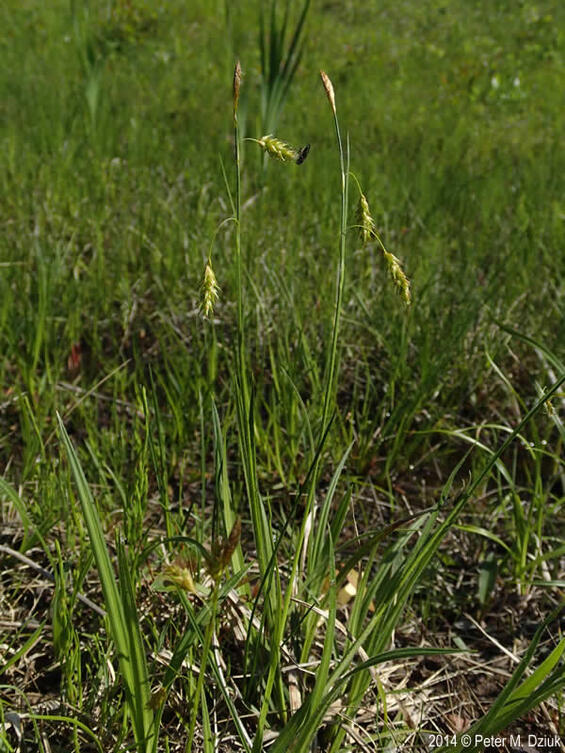
Image creadit: Peter Dziuk, MinnesotaWildflowers.info
Threats
The primary threats to chestnut-colored sedge in Massachusetts are succession and invasive species, particularly shrub honeysuckles and buckthorns. Combined, these two can limit the open habitats that this species needs to flourish. Hydrological alteration may also negatively impact this species as it prefers seepy soil in which to grow.
Loss of habitat from development and right-of-way maintenance likely decreased habitat more in the past, at least one current population has been threatened several times by development. As the species has only been known in the state since 1984, little is known about its population trends, though at least one population can no longer be found.
With Connecticut, Massachusetts represents the southeastern extent of the species; warming and more erratic climate events will probably have negative impacts on this species, though the exact mechanisms are not known. The populations are relatively small and a single stochastic event could wipe out an occurrence.
Conservation
Survey and monitoring
Regular survey of rare species is always needed. These sedges are perennial and one genetic individual can form small colonies with several clumps, each with several fruiting ramets. Figuring out the number of genets can be very difficult, so reporting ramets is best. The best time to survey the species is early-summer when the chestnut-colored perigynia stand out against the green of other plants. Threats to the species is always an important aspect of regular monitoring.
Management
As for many rare species, exact needs for management of chestnut-colored sedge are not known. The following comments are based primarily on observations of the population in Massachusetts.
The Massachusetts populations are found growing in full sunlight. Hand-clearing of woody vegetation that creates shade may be necessary to maintain these populations. In particular, woody non-native species, such as shrubby honeysuckles (Lonicera spp.) and buckthorns (Rhamnus cathartica and Frangula alnus), should be removed due to their aggressive growth and potential for shading.
Research needs
It is not known how long the seed will remain viable in the soil (the seed bank), which is important for restoration of sites that become overgrown. As this species is at the southern extent of its range, it is expected that a warmer climate will negatively impact the species. It is not known how to maintain this plant in Massachusetts as it needs full sun to grow. Mechanisms for the seed to be moved to new locations, in the same habitat or to a new one, are not known.
References
Arsenault, Matt, Glen H. Mittelhauser, Don Cameron, Alison C. Dibble, Arthur Haines, Sally C. Rooney, and Jill E. Weber. 2013. Sedges of Maine, A Field Guild to Cyperaceae. University of Maine Press, Orono, Maine.
Gleason, Henry A., and Arthur Cronquist. Manual of Vascular Plants of Northeastern United States and Adjacent Canada, Second Edition. Bronx, NY: The New York Botanical Garden, 1991.
Haines, A. 2011. Flora Novae Angliae – a Manual for the Identification of Native and Naturalized Higher Vascular Plants of New England. New England Wildflower Society, Yale Univ. Press, New Haven, CT.
MinnesotaWildflowers.info Accessed 3/27/2026
Native Plant Trust. 2014. NORM Phenology Information.
NatureServe. 2026. NatureServe Network Biodiversity Location Data accessed through NatureServe Explorer [web application]. NatureServe, Arlington, Virginia. Available https://explorer.natureserve.org/. Accessed: 3/27/2026.
POWO. 2026. Plants of the World Online. Facilitated by the Royal Botanic Gardens, Kew. Published on the Internet; https://powo.science.kew.org/ Accessed: 3/27/2026.
Standley, Lisa A. 2011. Field Guide to Carex of New England. Special Publication of the New England Botanical Club
Staudinger, M.D., A.V. Karmalkar, K. Terwilliger, K. Burgio, A. Lubeck, H. Higgins, T. Rice, T.L. Morelli, A. D'Amato. 2024. A regional synthesis of climate data to inform the 2025 State Wildlife Action Plans in the Northeast U.S. DOI Northeast Climate Adaptation Science Center Cooperator Report. 406 p. https://doi.org/10.21429/t352-9q86
Contact
| Date published: | April 9, 2025 |
|---|---|
| Last updated: | May 5, 2026 |