

Explore our tips that can help you stay safer and healthier, whatever changes you decide to make. Drinking more safely doesn’t eliminate all risks, but it can lower the chances of serious harm. You matter and your safety matters.
Staying healthier while you drink
If you drink, stay safer and healthier:
| Tip for staying healthier | Rationale |
|---|---|
| Drink water | Drinking water between alcoholic drinks can help you drink less overall and keep your body hydrated. Being hydrated also makes hangovers not as bad. |
| Eat food | Food slows how fast alcohol gets into your blood, so it causes less harm. Try to eat before you drink and while you drink. Foods with protein (meat, cheese, eggs, beans) and carbs (bread, rice) are good choices when drinking. |
| Count your drinks | Knowing how much you drink helps you decide how much alcohol you want and helps you stay in control of how alcohol affects you. Keep bottle caps or can tabs in your pocket to keep track of your drink total. Over time, this can help you see what amount works best for you. |
| Space out your drinks and alternate with non-alcoholic beverages | Feel good for longer and avoid the bad effects. Go slow. Take small sips. Switch between alcohol and water. |
| Avoid mixing drugs | Using alcohol and drugs together can harm your heart and liver. This can also cause an overdose, especially when mixing alcohol with benzodiazepines (benzos) and/or opioids. When you drink, try not to use other drugs. Drinking alcohol with opioids or benzodiazepines can slow breathing and increase the risk of overdose and death. Mixing alcohol with cocaine can trigger heart attacks, seizures, or strokes, even in young and otherwise healthy people. |
| Protecting yourself and others | Do not drink alcohol if you are pregnant, planning on driving, or under 21. |
| The difference between beer and malt liquor | You may be drinking more alcohol than you realize. A 24-oz can of malt liquor can equal between 4-6 regular 12-oz beers, depending on the brand. Drinking beer will lessen your consumption. |
Tips for changing how much you drink
Your recovery process is a personal journey. Recovery may not mean abstinence (not drinking). It may mean changing your relationship with alcohol.
| Suggestion | Rationale |
|---|---|
| Set SMART Change goals | Set a goal of how much you want to drink according to the SMART criteria (specific, measurable, achievable, realistic, and timely). Work towards setting a goal that puts you at low risk [link to “Knowing your risk” section of Alcohol and Health landing page] for alcohol related complications. Decreasing drinking can still improve health. Tell your friends about your goals. |
| Drink in a safe place | When you are tipsy or drunk, people may take advantage of you. Drinking on the street or in unsafe places can lead to trouble, injury, or even arrest. If you can, don’t drink a lot around people you don’t trust. Try to drink in places where you feel safer and more in control. |
| Take a break | Not drinking, even for a short time, gives your liver, kidneys, and pancreas a break and may help prevent health problems. Try not drinking for a few hours or pick one day a week to not drink. Limit the amount of alcohol you keep at home. If you want to stop fully, medical withdrawal management (detox) will help. |
| Record your drinks | Write down your alcohol use for several weeks to help you get a better idea of how much you are drinking. |
| Avoid withdrawal | Alcohol withdrawal, like shaking, seizures, or Delirium Tremens (DTs), can be dangerous. If you want to stop drinking and get shaky when you don’t drink, medical withdrawal management (detox) is the safest option. If you keep drinking, alcohol can stop withdrawal symptoms. Talk to your doctor about medicines that help prevent these symptoms including seizures. Find inpatient 24-Hour Withdrawal programs (formally known as ATS). |
You can find all of these tips and strategies summarized in this Safer Use Strategies PDF.
Download and share
Strategies for managing the "fear of missing out" when reducing or stopping drinking
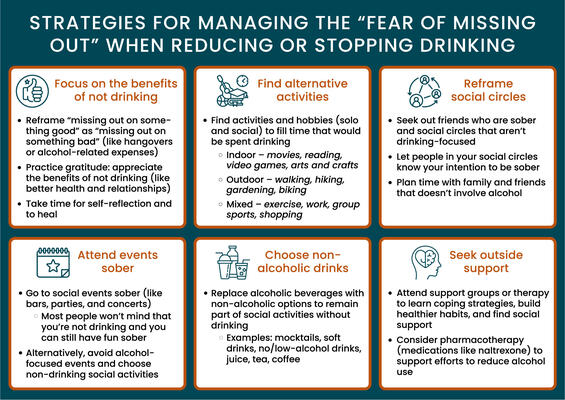
Image credit: Image provided courtesy of Cambridge Health Alliance Brief Addiction Science Information Source (BASIS)
If you are thinking about reducing or stopping your drinking, you may worry about “missing out” on experiences that others are having. Below are some suggested strategies that help with managing this worry.
Focus on the benefits of not drinking
- Reframe “missing out on something good” as “missing out on something bad” (like hangovers or alcohol-related expenses)
- Practice gratitude: appreciate the benefits of not drinking (like better health and relationships)
- Take time for self-reflection and to heal
Find alternate activities
- Find activities and hobbies (solo and social) to fill time that would be spent drinking
- Indoor – movies, reading, video games, arts and crafts
- Outdoor – walking, hiking, gardening, biking
- Mixed – exercise, work, group sports, shopping
Reframe social circles
- Seek out friends who are sober and social circles that aren’t drinking-focused
- Let people in your social circles know your intention to be sober or that you want to cut back on your drinking
- Plan time with family and friends that doesn’t involve alcohol
Attend events sober
- Go to social events sober (like bars, parties, and concerts)
- Most people won’t mind that you’re not drinking and you can still have fun sober or when you are drinking less
- Alternatively, avoid alcohol-focused events and choose non-drinking social activities with friends or on dates
Choose non-alcoholic drinks
- Replace alcoholic beverages with non-alcoholic options to remain part of social activities without drinking
- Examples: mocktails, soft drinks, no/low-alcohol drinks, juice, tea, coffee
Seek outside support
- Attend support groups or therapy to learn coping strategies, build healthier habits, and find social support
- Consider pharmacotherapy (medications like naltrexone) to support efforts to reduce alcohol use
Read more from BASIS about the “Fear of Missing Out” when reducing alcohol use.
Alcohol symptom checklist for people who drink at high risk
This checklist can help you and your provider see how alcohol may be affecting your health. Think about the past 12 months. For each question, answer yes or no. Give yourself 1 point for every “yes.”
In the past year:
- Did the same amount of alcohol not affect you as much as it used to, or did you need to drink more to feel the same effect?
- When you were not drinking or tried to cut back, did you feel sick to your stomach, sweaty, shaky, or nervous? Did you drink alcohol or take something to help those feelings go away?
- Did you ever drink more or drink longer than you planned to?
- Did you want to cut back or stop drinking, but couldn’t?
- Did you spend a lot of time getting alcohol, drinking, or dealing with a hangover?
- Did you keep drinking even though you thought it might be causing health or mental health problems, or making them worse?
- Did drinking make it hard to keep up with your responsibilities at work, school, or home?
- Did you do dangerous things, like drive or use machinery, more than once after drinking?
- Did you keep drinking even though it was causing problems with family or other people?
- Did you have strong urges or cravings to drink alcohol?
- Did you spend less time working, doing hobbies, or being with others because of your drinking?
TOTAL:
Note: Total scores can range from 0 to 11
- A score of 2 or 3 indicates symptoms of mild alcohol use
- A score of 4 or 5 indicates symptoms of moderate alcohol use
- A score of 6 to 11 indicates symptoms of severe alcohol use
Take this quiz and your answers to your medical provider. Share your alcohol consumption and scores and ask how you can lower your alcohol risk. Call, text, or chat with the MA Substance Use Helpline to get connected with more information and services.
Source: Matson TE, Lee AK, Oliver M, Bradley KA, Hallgren KA. Equivalence of alcohol use disorder symptom assessments in routine clinical care when completed remotely via online patient portals versus in clinic via paper questionnaires: psychometric evaluation. J Med Internet Res 2024; 26: e52101.