
- How is drought determined in Massachusetts?
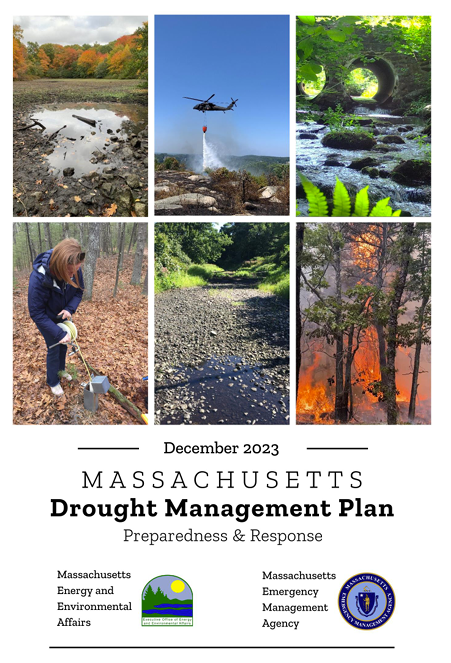
Massachusetts manages drought through a statewide Drought Management Plan (DMP) that guides how drought conditions are monitored, assessed, declared and addressed. The plan is designed to minimize impacts to water supplies, agriculture, ecosystems, public health, and wildfire risk by improving coordination among state agencies, strengthening drought monitoring and early warning systems, and outlining preparedness, response, and recovery actions for communities and other affected groups. Because drought conditions can vary widely across the state, Massachusetts monitors drought at various spatial scales such as drought regions (Western, Connecticut River Valley, Central, Northeast, Southeast, Cape Cod, and Islands), counties and major basins.
To determine drought conditions, the state collects data and calculates six indices for each region rather than relying on rainfall alone. These indices include precipitation (rain and snow), streamflow, groundwater, lakes and impoundments, wildfire danger/soil moisture, and evapotranspiration (the loss of water from soil and plants to the atmosphere). Together, these indices provide a more complete picture of both short-term and long-term conditions.
The Commonwealth’s Drought Management Task Force (DMTF), made up of state and federal agencies and professional organizations, reviews the drought indices along with weather forecasts and reports of impacts such as agricultural, water supply, and environmental. The DMTF then recommends drought levels to the Secretary of the Executive Office of Energy and Environmental Affairs (EOEEA), who issues the official drought declarations for Massachusetts. During droughts, the DMTF meets bi-monthly or monthly depending on how fast conditions change.
- When we receive rainfall, why are we still in a drought?
Droughts happen when there’s not enough rain or snow over an extended period of time relative to expected amounts. In Massachusetts, our current drought began in September 2024 across most of the state and in November 2024 on Cape Cod and the Islands. Several months of very little rain led to very low groundwater levels, low lake and stream levels, and very dry overall conditions that contributed to a record high wildfire season. This was followed by less-than-average rain and snow over the winter of 2025.
From March 2025 through April 2026, we experienced variable rain and snow with some months around normal and some below normal. Throughout this time, impacts to streamflow and groundwater continued. The combination of normal precipitation in March 2026 plus snowmelt from the winter lead to significant recovery in that month. However, April once again had below normal precipitation and saw a reversal of gains from March. This includes significantly below normal streamflow across the state. These significant low flows may not appear dire (e.g., when there is little to no flow) but relative to flows that are normal in the Spring, conditions are low. Other drought effects that are harder to see also remain, like low groundwater levels and drier soil below the first several inches. Groundwater helps provide water to streams when it is not raining and so is important for healthy streamflow and full recovery after a drought.
Overall, the cumulative below normal rain and snow since September 2024 is the reason that drier than normal conditions are still being seen in the state. Spring normally has the highest streamflow and groundwater levels of the year but this year that is not the case. Therefore, relative to normal Spring conditions, the water available in the streams and groundwater are not what we normally see and count on.
- Do droughts only occur in the summer?
Droughts can happen any time of year, whenever there are several months in a row of much lower-than-normal rain or snow. The 2024/26 drought was caused by very low rainfall during the fall of 2024, followed by less-than-normal snow and rain over the winter of 2025, and generally less-than-normal snow and rain in 2026. Despite a few large snowstorms in 2026, they did not yield much water equivalent given the very low temperatures. As a result, the state has still been in a drought through the winter and into spring of 2026.
- Why are the current outdoor watering restrictions necessary and why are some communities enforcing water restrictions that they never used to before?
State regulations require many water suppliers to enact restrictions on outdoor watering during droughts. The idea is to make sure we always have enough water for drinking, cooking, cleaning, firefighting, running our businesses, and other essential purposes, even during drought. Using water efficiently is always good practice. It is especially important to do so until we are confident that the streams and groundwater that feed our reservoirs and wells have returned to normal.
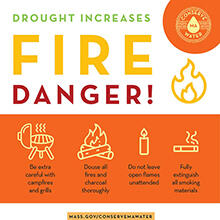
We also know that pumping from our reservoirs and wells can lower the levels of nearby streams and wetlands, and we want to minimize these effects during drought, when the plants and animals that depend on them may already be struggling. We also want to make sure that we have enough water supply and water pressure to fight fires, which increase and are more prolonged during a drought.
What will it take for the drought to end?
If we get a lot of long, deep-soaking rains, we could come out of the drought fairly soon. Short, intense storms do less to replenish the system, because much of the rain runs off into the streams and out to the ocean before it has time to soak into the ground.
If all the drought conditions improve enough – the ones we can easily see, like stream and reservoir levels, and the ones that are harder to see, like groundwater levels and soil moisture – the drought will be declared over, and restrictions may be reduced or lifted. However, in recent years droughts have been happening more often and intensifying more quickly, so drought conditions could return if sustained rainfall does not continue. In fact, parts of Massachusetts have been in a drought in at least part of the year for nine of the last eleven years.
What types of outdoor water use may be allowed during drought?
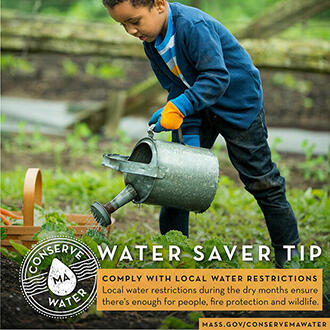
Although your water supplier might require additional restrictions, this is a basic list of water uses that may be allowed during drought.
Water used for:
- health and safety, including drinking water, fire protection, public facilities such as swimming pools and splash pads, and washing boats to prevent saltwater damage or prevent transferring invasive aquatic species among lakes and ponds
- growing food, including vegetable gardens
- maintaining livestock
- businesses such as
- plant nurseries
- golf courses to maintain greens and tees, and limited fairway watering
- venues used for weddings and special events that water using hand-held hose or drip irrigation to maintain gardens and ornamentals
- professional washing needed to apply paint, preservatives, stucco, pavement, or cement during construction or renovation work
- watering public parks and recreation fields before 9:00 a.m. and after 5:00 p.m.
- watering shade trees in public spaces
- watering new lawn as needed to stabilize soil over new construction or following repair or replacement of a Title 5 system.
For more information on the details of what uses may be allowed during drought, check with your individual Public Water Supplier.
- What water use restrictions can I expect during droughts?
Although your local water supplier might require additional restrictions if your water supplies are particularly stressed and running low, this chart shows the state restrictions on non-essential outdoor water use when a drought is declared. “Non-essential outdoor uses” are all outdoor uses except those listed in Question 5, above.
| Level 1 – Mild Drought |
|
|---|---|
| Level 2 – Significant Drought |
|
| Level 3 – Critical Drought |
|
| Level 4 – Emergency Drought |
|
What should I do about my landscape?
Consider adapting your landscapes to need less to no irrigation. There are ways you can make them “drought-resilient” and beautiful all year round. Check out the Native Plant Palette for ideas.
- Why am I seeing my water department sending so much water out of the hydrants if I am required to restrict water use?
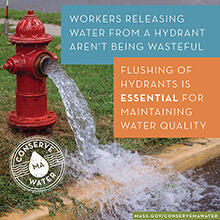
When you see a water department using a high volume of water from a hydrant, they are flushing the distribution system to maintain drinking water quality. This is an important maintenance activity that many water systems conduct during the spring and fall, after water main breaks, or to clear up dirty water throughout the year.
For additional information please see: