
Overview
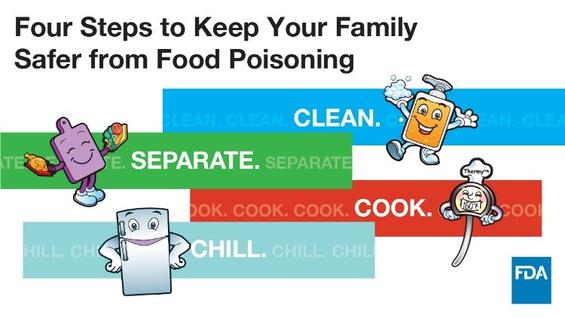
There are four main pieces of food safety: Clean, Separate, Cook, and Chill.
1. Clean
Wash your hands and the surfaces you use for preparing food often. Use warm water and soap for at least 20 seconds to clean your hands before you start preparing any food. Be sure to wash your hands during the following moments:
- After using the restroom.
- Before beginning food prep, even if the food you are about to prepare will be cooked.
- After touching a pet or a toddler’s sticky hands.
- After handling raw meat, poultry, or seafood.
- After using cleaning supplies.
- Whenever you feel like your hands might need it!
Also, make sure your dishes, cutting boards, utensils, and other kitchen supplies are cleaned with hot soapy water. Keeping things clean is key to making sure the germs that can make you sick do not get into your food. Many foods also need to be cleaned. Fruits and vegetables, even those with peels or rinds we do not eat, should be scrubbed under running water. Note that raw meat and poultry do not need to be cleaned with water. Simply wipe or dab any extra fluid from meat with a paper towel before preparing it.
2. Separate
Keep raw meat, poultry, seafood, and eggs separate from all other foods. Be sure these are all cooked thoroughly before they come in contact with any other ready-to-eat foods. Chop your vegetables on a separate cutting board than your meat, and do not place fully cooked food back on a surface that was holding raw meat. Make sure everything stays separate in the refrigerator as well. Place raw meat in a leak-proof container in a separate compartment than fresh produce to be sure any potential drippings do not leak on fruits and veggies.
3. Cook
Foods need to be cooked to a safe temperature to be sure that any harmful bacteria are destroyed. Be sure to use a meat thermometer to check this temperature. Sight and smell are not reliable ways to know if a food is fully cooked.
4. Chill
After cooking and eating, store your leftovers safely. The general rule of thumb is that food should cool quickly within two hours to 70°F and then down to 40°F within the next four hours. Check your refrigerator’s temperature frequently to be sure that it is at or below 40° Fahrenheit and the freezer is 0° Fahrenheit or below. To be sure that food stays at safe temperatures, put food in the fridge within two hours of cooking or buying it. Lastly, always thaw frozen meat or poultry safely, never on the countertop. Thawing can happen in the fridge, in cold water, or in the microwave.
Food Storage
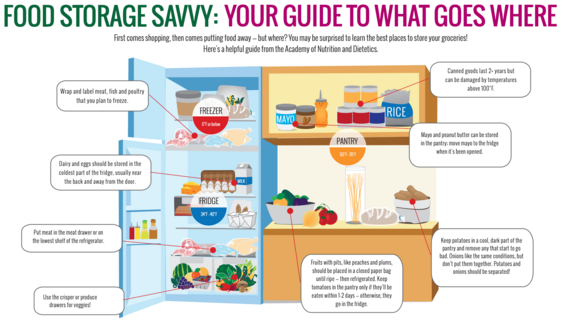
Credit: Academy of Nutrition and Dietetics
See the Kitchen Tips page to learn more about proper food storage. Certain foods thrive better in certain environments. Storing food the right way will help it last longer and stay safe.
Food Expiration Dates
Dates on packaged foods can sometimes be helpful but note that dates are not regulated by anyone. Only infant formulas have regulated expiration dates on their containers. All other packaged foods may have a variety of “Best-By,” “Use-By,” “Sell-By,” or other labels. While these are good indicators of a food’s quality, they are not firm expiration dates. Reduce food waste by knowing what food should look and smell like rather than relying on the date on the package. However, when in doubt throw it out—make sure you keep yourself and those around you safe! Here is a quick guide to date labels:
- Expiration and Use By Dates: These refer to food safety. Do not consume food past these dates.
- Sell-By Dates: These are references for retailers to let them know how long to display an item for sale. It is not a safety date.
- Best If Used By Dates: This is a guide to how long a product will retain peak quality and freshness. It is not a safety date.
Sometimes despite the best efforts, food goes bad. Do your best to clean, separate, cook, and chill, and when something spoils, throw it away. Look for things like mold, an off-putting odor, or a change in color to know that something is spoiled. For example, beef should be dark red and will turn grey when it is no longer safe to eat.
Foodborne Germs and Illnesses
There is a good chance you or someone you know has had a foodborne illness, what we often call “food poisoning.” Foodborne illnesses are caused by bacteria, viruses, and parasites. Sometimes toxins and chemicals can be present in contaminated foods. Once contaminated foods are consumed, most bodies cannot tolerate these substances even at small doses.
Symptoms of foodborne illness may include:
- Nausea
- Vomiting
- Stomach cramps
- Diarrhea
Older adults, young children, people with weaker immune systems, and pregnant people are at the greatest risk for severe reactions. You should seek immediate medical attention for these individuals. Otherwise, food poisoning usually improves without treatment within 48 hours. During this period, stay near a bathroom and drink plenty of fluids (water, broth, and electrolyte drinks). Electrolytes are minerals, such as sodium and potassium, that help regulate your heartbeat and control your body’s water levels. Another tip is to try ice chips if drinking is uncomfortable. Once you feel ready to eat, start with toast, rice, or crackers. Avoid dairy, caffeine, alcohol, carbonated drinks, and spicy/fatty foods. They will make you feel worse.