
Logging in for the first time
In your browser address line, enter www.masscourts.org. You see the Massachusetts Trial Court Electronic Case Access application, also known as eAccess.
-
Log in
In the upper-right corner, click Log On.
-
View the login screen
The login prompt should now be visible.
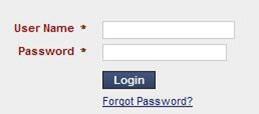
Figure 1. Attorney Portal login screen -
Enter your BBO email address
Click the Forgot Password hyperlink. When prompted, enter your BBO email address.
-
Confirm password reset
You see a message indicating that your password has been reset and that you should check your email. Close the window.
-
Check your email
Check your email for a message from public access. If you can’t find the message in your inbox, check your spam folder.
-
Return to the MassCourts website
In your browser address line, enter www.masscourts.org. You see the MA Trial Court Electronic Case Access application.
-
Select Log On again
Click Log On in the upper right corner. You see the login screen.
-
Enter your login credentials
Enter your user name (your BBO email address), and your new password.
-
View the change password window
The system prompts you to change your password.
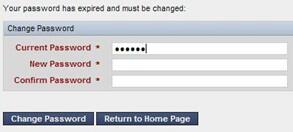
Figure 2. Change password window -
Change your password
Enter your new password and click the Change Password button.
-
Return to the home page
Click the Return to Home Page button.
Using the Attorney Portal Toolbar
After you have logged in, you see the Attorney Portal.
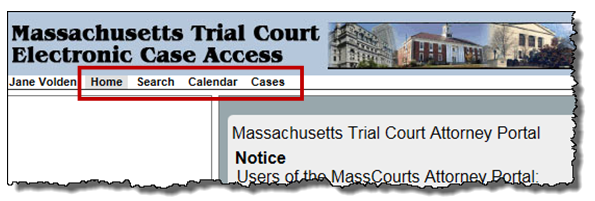
In the Attorney Portal Toolbar, highlighted in Figure 3 above, notice the tools (from right to left):
Tip: The Cases and Calendar tools are unique to the Attorney Portal.
- Cases
- Calendar
- Search
- Home
To start, click Cases.
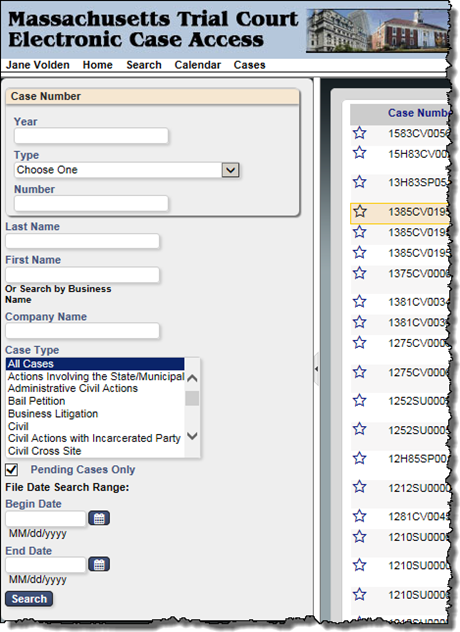
Cases
-
Review search options
When you click Cases, you see search options in the left panel, shown in Figure 6, and pending cases for which you are the active attorney in the main panel.
-
Refine your search (optional)
Use the search options to refine the search of your cases.
-
Sort the cases
In the main panel that shows your pending cases, you can sort the cases by clicking the column headers.
-
View total number of cases
At the bottom of the pending cases window, notice that the total number of cases appears in the lower-left.
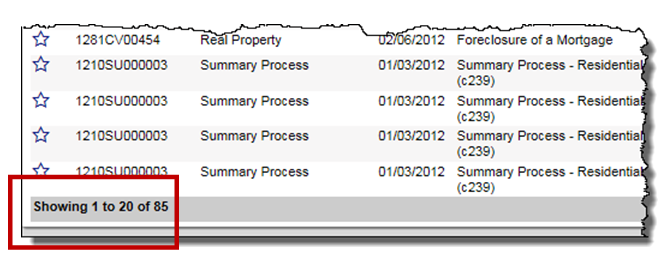
Figure 5. Attorney Portal Cases – Total number of cases In the lower-right, notice that you can navigate between pages.
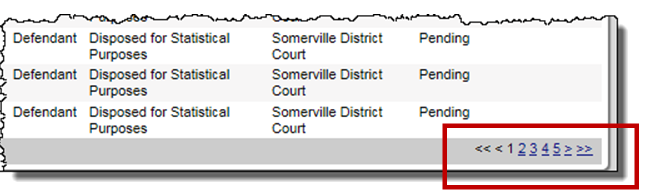
Figure 6. Attorney Portal Cases – Navigation on lower right -
Review a case
Click a case to open it. You see the detail screen.
-
Return to all cases
To return to the list of all of your cases, click Cases in the toolbar.
Calendar
-
Load the calendar
In the Attorney Portal Toolbar, click Calendar.
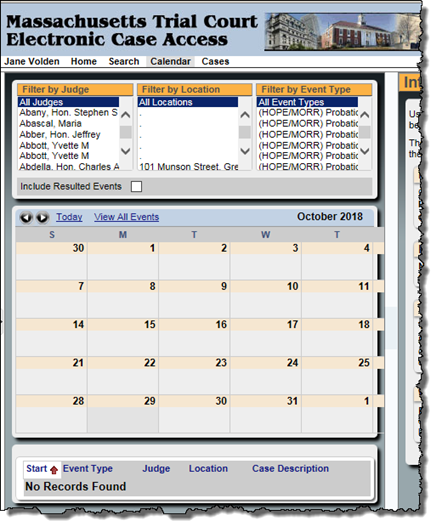
Figure 7. Attorney Portal Calendar (left side of the Calendar screen) -
Review calendar options
In the Calendar Screen, shown in Figure 7, you see the filters at the top, the calendar in the middle, and search results at the bottom.
-
Disregard the filters
They are not yet fully functional.
-
Display events
On the calendar, if you have events scheduled for the day, you see the number of events for each day. Click the number hyperlink to see the events.
-
Review events
The events appear underneath the calendar. You may need to scroll down to see them.
-
Review event details
Click an event to see details in the right half of the screen.
Search
-
Search all cases
In the Attorney Toolbar, click Search. This allows you to search all cases; not just your cases.
-
Pick a court department, division, and/or location
When prompted, select the court department.
- If you’re prompted to select a court division, select a court division.
- If you’re prompted to select a court location, select a court location.
-
Choose number of results
If desired, you can select the number of results from the drop-down Number of Results List.
-
Use the search tabs
Notice that you can search using four different tabs: Name, Case Type, Case Number, and Ticket/Citation #.
Search Name Tab (works for civil cases only)
-
Complete the following fields
- Last Name: Enter the last name, formatting it with an initial capital letter followed by lower case letters. The system requires two characters.
- First Name: Enter the first name, formatting it with an initial capital letter followed by lower case letters. The system requires one character
Company Name: If a company is involved, enter the company instead of the last name and first name of a party.
For the quickest search results, do not modify the optional parameters listed below.
- (Optional) Case Type: To limit the search by case type, select the case type from the Case Type selection box.
- (Optional) Case Status: To limit the search by case status, select the case status from the Case Status selection box.
- (Optional) Party Type: To limit the search by party type, select the party type from the Party Type selection box.
- (Optional) Date of Birth Search Range: Click the calendar icons to select dates.
- (Optional) Date of Death Search Range: Click the calendar icons to select dates.
- (Optional) File Date Search Range: Click the calendar icons to select dates.
-
Click Search
Click search to view your results.
Search Case Type Tab
-
Click the Case Type Search tab
Proceed to the next step.
-
Complete the following fields:
- Begin Date field: Click the calendar icon to select the desired starting date.
- End Date field: Click the calendar icon to select the desired ending date. The date range cannot exceed one month.
- Case Type: In the Case Type selection box, select the desired case type.
- City/Town: In general, leave “All Cities” as the selection. Land Court users can optionally select a city or town.
-
Click Search
Review your results.
Search Case Number Tab
-
Click the Case Number Search tab
Proceed to the next step.
-
Complete the Case Number field
If you enter this number, it must be an exact match, with correct capitalization, spacing, and leading zeros. For example:
Click the hyperlinks to see more examples of case numbers for each court.
-
Click Search
Review your results.
Troubleshooting
Problem: When I log in, I get this error message: “Invalid email address.”
Did you use your BBO email address as the user name?
The user name and password are case sensitive. Use upper-case and lower-case letters as required.
Have you updated your BBO information and changed your email address? You will need a new account. To get a new account, email e.access@jud.state.ma.us.
Problem: I can’t find the case from the name search.
Is the party a company? Companies need to be entered in the Company field and not in the Last Name/First Name fields.
Have you spelled the name correctly? Try entering only the first few letters of the name in the Last Name/First Name fields.
Converted data is not 100% accurate. Try searching by case number instead of by name.
Problem: I can’t find the case with the case number search.
Case numbers are case sensitive and space sensitive. Did you capitalize the letters in the case number as required?
Did you include required spaces?