
The Real ID deadline was approaching
The RMV had a major challenge: it needed to help as many constituents as possible get Real IDs before the federal deadline on May 7, 2025. This was no small task. The RMV needed to explain what Real IDs were, why you might need one, and how to get one. Website traffic and calls to the call center surged as people tried to understand what they needed to do. Which documents could you use to prove your identity? What about proving you lived in Massachusetts? What should you do if you were a resident but not a U.S. citizen?
The RMV needed a way to meet the growing demand for information and support. The Real ID transition presented an opportunity to help improve the experience for constituents, which is exactly the kind of challenge the Commonwealth Digital Roadmap was designed to address.
The RMV teamed up with Massachusetts Digital Service (Mass Digital) to help people get the information they needed before the REAL ID deadline. Mass Digital also saw a chance to build an AI assistant that other state organizations could use. The RMV was not the only state organization with this challenge, but it was the biggest. If the approach worked for the RMV, it could work for others too. The platform was built in a way that it could also be used by other state organizations. A shared platform could save other organizations the time and cost of finding and building their own solutions.
Designing a generative AI tool to help people get answers
The RMV already had a chatbot, which was managed by a vendor. It used older technology and could only give prewritten answers. It only had a few dozen answers, but people asked about a half a million questions each year. The joint team saw an opportunity to build a more useful tool that the Commonwealth could own and improve overtime. Owning the technology could make updates easier and less costly. It could also save money as more state organizations begin to use it.
The team designed using a constituent-centered design approach. They worked with RMV leaders and subject matter experts, tested the chatbot with real people, and iterated. The work also showed where RMV webpages needed improvement, and the team updated those pages as part of the project. Generative AI depends on clear, accurate and up-to-date information. So, the team updated the webpages, documents, and other information the chatbot used. They also put processes in place to make sure it would stay up to date and accurate in the future. These changes also helped people who found the same information through search, social media, and other channels.
Launching a successful AI assistant
In just 83 days, the team launched the Virtual Assistant, the Commonwealth’s first public-facing generative AI tool. It was available 24 hours a day in English, Spanish, and Portuguese.
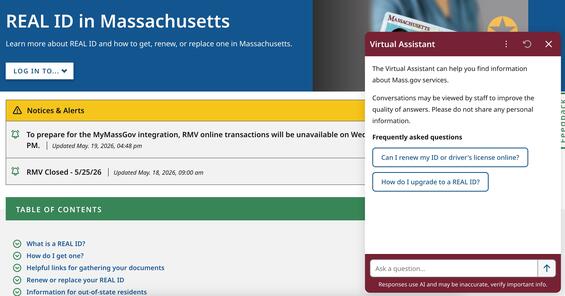
In the first month it was live, it handled 1,500 conversations per day and helped tens of thousands of people get accurate answers about Real ID. Negative feedback on RMV webpages dropped by 60%, and there was a 40% drop in people leaving the site without finishing their task. The RMV even surpassed their goal for how many people in Massachusetts converted to a Real ID by the deadline.
Building an AI assistant that scales across the executive branch
This project helped establish GenAI as a reusable digital service capability for Massachusetts. It makes government information easier to find and understand. It also forms the foundation for a more connected, personalized constituent experience.
The project also showed the value of teams working together to build technology that state organizations can share. Instead of each organization buying or building its own solution, teams can develop tools internally for broad use across the Commonwealth. This approach can save time and money and make it easier to expand successful tools to more organizations
This project also showed the value of working across teams. It succeeded because of collaboration between executive leaders, engineers, project managers, policy staff, and writers. The team focused on small, quick changes and rapid delivery.
Today, the AI Assistant is live across dozens of organizations’ websites. It provides fast, accurate answers for the people we serve. It shows that government can take a more efficient, innovative approach to digital services.