
- Scientific name: Liparis liliifolia (L.) Rich. ex Lindl.
- Species of Greatest Conservation Need (MA State Wildlife Action Plan)
- Threatened (MA Endangered Species Act)
Description

The flowers of lily-leaf twayblade have a distinctive labellum with reddish-purple veins. Photo by Jennifer Garrett.
Lily-leaf twayblade, Liparis liliifolia, is a small (10-30 cm tall; 3.9-11.8 in) member of the orchid family (Orchidaceae) found in dry to moist, maturing forests. The name Liparis is derived from the Greek word for “greasy” or “oily” and refers to the appearance of the leaves of species in this genus; the species epithet liliifolia refers to the lily-shaped leaves. Two basal leaves (one in sterile plants) grow from a pseudobulb, and a scape (naked flowering-stalk) has 5 to 30 pale-purple flowers. Lily-leaf twayblade has elliptic to ovate basal leaves that are 4-18 cm (1.6-7.1 in) long and 2-8.5 cm (0.8-3.3 in) wide, growing from an underground daughter pseudobulb. Dried stalks and leaves from the previous year may persist on the parent pseudobulb. The flowers are arranged in a raceme. Each flower is borne on a long (8-15 mm; 0.3-0.6 in), purplish pedicel and subtended by a small bract. The flowers are 8-12 mm (0.3-0.5 in) long and 6-10 mm (0.24-0.39 in) wide. Two lateral petals are narrow to filiform and curved. The labellum is obovate, with an apiculate tip and erose margins. The two narrow lateral sepals project forward, and sometimes cross under and can be seen through the translucent labellum. The third sepal is in an upward position. The winged column (united filaments and style) is 3-4 mm (0.12-0.16 in) long. The capsules are ellipsoid, approximately 15 mm (0.6 in) long and 5 mm (0.2 in) wide, with slight wings along the veins. The pedicels are longer than the capsules.
Lily-leaf twayblade can be differentiated from green twayblade (L. loeselii) by flower color, overall size, and habitat. Green twayblade has green flowers with a shorter column (2-3 mm; 0.08-0.12 in), and pedicels shorter than the fruit. It is found in cool, moist habitats such as bogs, fens, and peaty or sandy edges of wetlands.
Life cycle and behavior
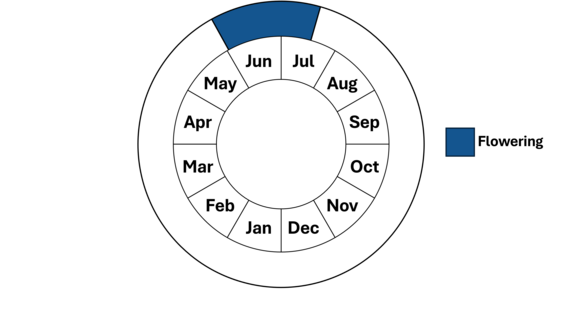
Plants reach reproductive maturity in 4 to 15 years. Lily-leaf twayblade has a specific fungal associate important for plant growth and seed germination. The brownish-purple labellum (lip) of the flower has a network of reddish-purple veins attractive to flies of decaying vegetable and animal matter. Cross-pollination with different plants is needed for seeds to be viable. Capsules mature in August and have dust-like seeds numbering in the tens of thousands. Seeds are known to be viable for at least four years.
Population status
Lily-leaved twayblade is listed under the Massachusetts Endangered Species Act as threatened. All listed species are protected from killing, collecting, possessing, or sale and from activities that would destroy habitat and thus directly or indirectly cause mortality or disrupt critical behaviors. There are currently 12 populations in the state that have verified since 1999 found in Berkshire, Franklin, Hampden and Hampshire Counties. Of those, only 2 populations are sufficiently large enough to have long-term viability. Thirteen occurrences have not been observed in the past 25 years including occurrences in Essex, Middlesex, Norfolk, and Plymouth Counties.
Distribution and abundance
Lily-leaf twayblade occurs from Quebec and Vermont west to Ontario, Minnesota south to Oklahoma and Mississippi. It is found along the eastern coastal plain to Georgia. It is considered rare in many states and provinces at the edge of its range, but secure in the middle and is considered globally secure. In New England, it is not known from Maine or New Hampshire. It is considered critically imperiled in Connecticut, Rhode Island and Vermont, and imperiled in Massachusetts.

Distribution in Massachusetts. 2000-2025. Based on records in the Natural Heritage Database.
Habitat
Lily-leaf twayblade grows in young to maturing woodlands with filtered light, often on gentle, east to southeast-facing slopes. It is often associated with intermittent or vernal seeps, on soils of varied pH. Several populations occur on sites with basaltic bedrock, in oak–hickory–hop hornbeam woodlands with relatively open canopies, few shrubs, and abundant herbaceous cover. Woody associates include chestnut oak (Quercus montana), red oak (Q. rubra), black oak (Q. velutina), hickories (Carya spp.), white ash (Fraxinus americana), sugar maple (Acer saccharum), and hop hornbeam (Ostrya virginiana). Herbaceous associates include Pennsylvania sedge (Carex pensylvanica), ebony spleenwort (Asplenium platyneuron), rue-anemone (Thalictrum thalictroides), early saxifrage (Micranthes virginiensis), and wand bush-clover (Lespedeza violacea). Associated rare species include glaucescent sedge (Carex glaucodea), green rock-cress (Boechera missouriensis), and violet wood-sorrel (Oxalis violacea). Populations also occur in mesic forests with sugar maple, white pine (Pinus strobus), yellow birch (Betula alleghaniensis), pink lady slipper (Cypripedium acaule), and sharp-leaved goldenrod (Solidago arguta).
Healthy habitats are vital for supporting native wildlife and plants. Explore habitats and learn about conservation and restoration in Massachusetts.
Threats
Invasive species have become major threat to Lily-leaved twayblade and many populations are now being impacted by the shading and competition from them. Other threats to lily-leaved twayblade include canopy closure, and small populations that might disappear due to stochastic events. Plants are self-incompatible, meaning that they need pollen from a non-related plant in order to produce viable seed. Browsing by deer and other mammals is also a major threat.
Conservation
To prevent loss from browsing by deer or small mammals, exclosures or cages around individual plants may be needed. Where populations occur near active recreational trails, trails should be re-routed to avoid trampling. Rapid growth of weedy species after disturbance may contribute to the decline of some populations and may prevent new colonies from becoming established. Several invasive species occur near known populations of lily-leaf twayblade (e.g., Morrow's honeysuckle, Lonicera morrowii; swallowwort, Cynanchum spp.; oriental bittersweet, Celastrus orbiculatus; burning bush, Euonymus alatus; and Japanese barberry, Berberis thunbergii). Removal of invasive species may reduce competition and provide habitat for germination and establishment of lily-leaf twayblade. Caution and monitoring are needed, however, to ensure that invasive species removal is successful and that these species do not re-establish and threaten populations of rare species. All active management of state-listed plant populations (including invasive species removal) is subject to review under the Massachusetts Endangered Species Act and should be planned in close consultation with the MassWildlife’s Natural Heritage & Endangered Species Program.
References
Magrath, L.K. 2002. Liparis. In: Flora of North America Editorial Committee, eds. Flora of North America North of Mexico, Vol. 26. Oxford University Press, NY.
Mattrick, C. 2004. Liparis liliifolia (L.) L.C. Rich. ex Lindley (lily-leaved twayblade) Conservation and Research Plan for New England. New England Wild Flower Society, Framingham, MA.
Contact
| Date published: | April 30, 2025 |
|---|