
- Scientific name: Coleataenia longifolia (Torr.) Soreng ssp. longifolia
- Species of Greatest Conservation Need (MA State Wildlife Action Plan)
- Threatened (MA Endangered Species Act)
Description
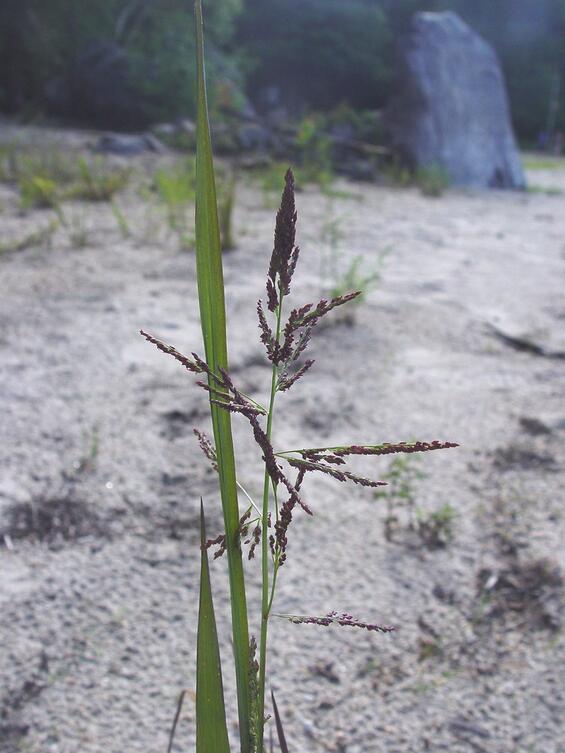
Long-leaved panic-grass (Coleataenia longifolia spp. longifolia).Photo by Don Cameron.
Long-leaved panic-grass (Coleataenia longifolia spp. longifolia) is a coarse, tufted perennial in the grass family (Poaceae) that grows in clumps up to 1.5 m tall (~4.5 ft). The panicle is either pyramidal or narrow, and 10-30 cm (4-12 in) in height. It blooms from summer to fall and has distinctive dark red inflorescences that may be slightly branched, ascending, or clumped in an ascending spike. The wind-pollinated lance-ovoid spikelets are 1.8-3.5 mm (0.07-0.14 in) long, borne on pedicels 0.5-1.5 mm (0.02-0.06 in) in length and are secund (appearing to all arise from one side). The narrow leaf blades grow primarily from the base of the plant and are 20-40 cm (7.9-15.7 in) long on a mature specimen. Two species of Coleataenia are known in Massachusetts: flat-stemmed panic-grass (C. rigidula ssp. rigidula) is widespread throughout the state, while long-leaved panic-grass (C. longifolia spp. longifolia) is rare and listed as threatened.
Numerous panic-grass species are similar in appearance. This genus has recently had several taxonomic updates so a recent technical manual, such as Weakley 2020, must be used to properly identify the species and subspecies. A strongly compressed leaf sheath and short pedicels with the florets differentiate long-leaved panic-grass from other panic-grass species. The two species of Coleataenia can be distinguished by differences in the length and pubescence of the ligules (a membranous appendage attached at the leaf blade juncture with the leaf sheath). In the rare Coleataenia longifolia spp. longifolia, the ligule is 0.5-3 mm (0.02-0.12 in) long and finely pubescent, whereas in C. rigidula ssp. rigidula, the ligule is glabrous (has no hairs) and 0.3-1 mm (0.01-0.04 in) long. Additionally, the leaf blades of C. rigidula ssp. rigidula are usually wider than those of C. longifolia spp. longifolia (5-12 mm [0.12-0.47 in] vs. 2-7 mm [0.08-0.28 in]).
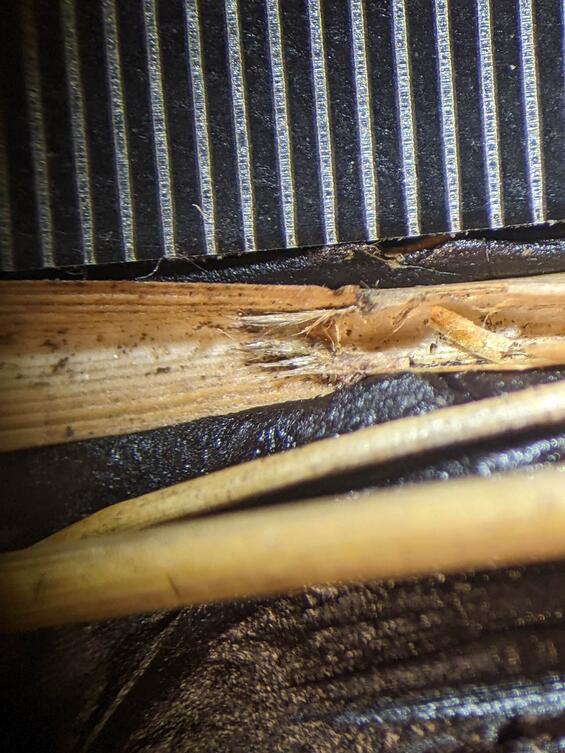
Pubescent ligule. Photos by Robert Wernerehl.

Leaf measurement
Life cycle and behavior
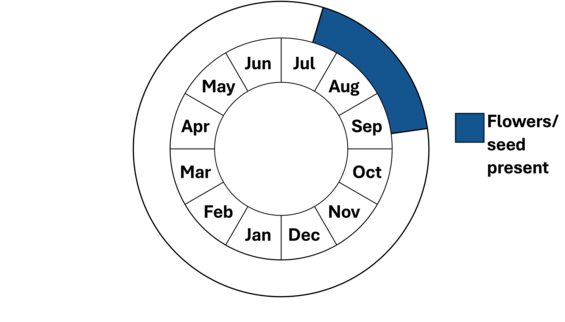
Long-leaved panic-grass flowers and fruits from mid-July through mid-September. Flowers or fruits are needed to identify the species.
Population status
Long-leaved panic-grassis listed as a Threatened species in Massachusetts. All listed species are protected from killing, collecting, possessing, or sale, and from activities that would destroy habitat and thus directly or indirectly cause mortality or disrupt critical behaviors. Population sizes of long-leaved panic-grass range from a few plants to thousands of individuals. The scarcity of this species in Massachusetts results in part from its restricted habitat. The species depends on periodic natural disturbances such as fluctuating water levels of coastal plain pond shores or anthropogenic disturbances such as periodic mowing and vegetation clearing along power line corridors. In Massachusetts, Coleataenia longifolia spp. longifolia occurs only in the southeastern portion of the state. It is currently known from 8 populations in Bristol, Plymouth and Worcester Counties (last observed since 1999), and it historically occurred in Dukes County. Seven populations have not been observed within the past 25 years.
Distribution and abundance
Long-leaved panic-grass is known from Nova Scotia to Florida, west to Texas and Michigan. It is considered rare in Pennsylvania, Indiana, Arkansas, and Nova Scotia and is thought to be extirpated from New Hampshire.
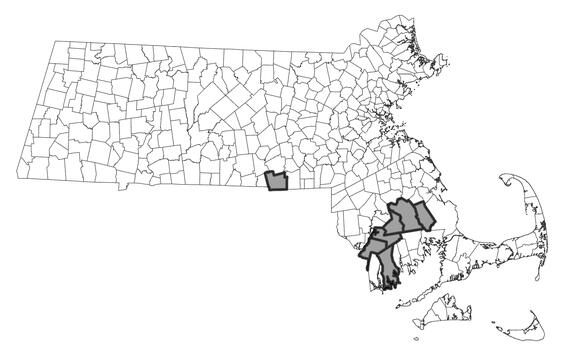
Distribution in Massachusetts
1999-2024
Based on records in the Natural Heritage Database
Habitat
Long-leaved panic-grass typically grows in moist, sandy or peaty soil in full sun. Habitats include coastal plain pondshores, bog edges, borders of basin marshes, vernal pools, and moist to wet depressions in utility corridor rights-of-way. Species associated with long-leaved panic-grass include colic-root (Aletris farinosa), turk’s-cap lily (Lilium superbum), northern muhly (Muhlenbergia uniflora), warty panic-grass (Panicum verrucosum), and brown beak-sedge (Rhynchospora capitellata). In coastal plain pond habitats, it is found with slender-leaved flat-topped goldenrod (Euthamia caroliniana), three-way sedge (Dulichium arundinaceum), Plymouth gentian (Sabatia kennedyana), yellow-eyed grasses (Xyris spp.), and other pondshore species.
Healthy habitats are vital for supporting native wildlife and plants. Explore habitats and learn about conservation and restoration in Massachusetts.
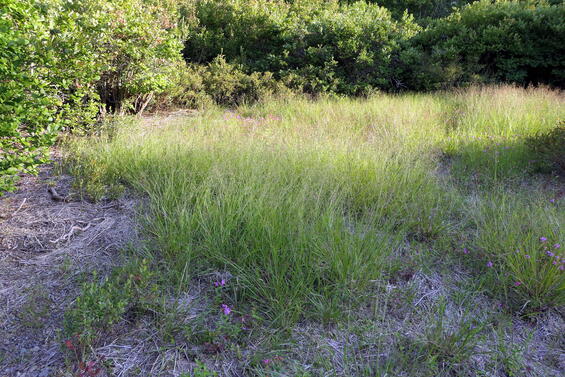
Coleataenia longifolia ssp. longifolia population in habitat. Photo by Doug McGrady.
Threats
Natural succession is a major threat to Coleataenia longifolia spp. longifolia, especially where the species occurs in isolated patches surrounded by woody vegetation. Severe disturbance and soil compaction associated with off-roads vehicles and mountain bikes can destroy populations of this species.
Conservation
Survey and monitoring
Survey for the populations not observed recently should be conducted to try to relocate the populations. The best time to survey for long-leaved panic-grass is mid-July through mid-September.
Management
All active management of rare plant populations (including invasive species removal) is subject to review under the Massachusetts Endangered Species Act and should be planned in close consultation with MassWildlife's Heritage & Endangered Species Program. Off-roads vehicles and mountain bikes which should be restricted to prevent soil compaction and damage to populations. Selective clearing and maintenance of cleared areas may be needed to ensure sufficient habitat for this species.
Research needs
It is not known how long the seed from long-leaved panic-grass is viable and as attempts are made to restore populations. This is needed information. Research is needed to determine whether this plant can be grown in a nursery or garden setting for purposes of reintroductions. If habitat degradation accelerates losses of current populations, this strategy could prove useful to long-term conservation of this species.
References
Haines, Arthur. Flora Novae Angliae. New England Wild Flower Society, Yale University Press, New Haven, CT. 2011.
Gleason, Henry A., and Arthur Cronquist. Manual of Vascular Plants of Northeastern United States and Adjacent Canada, Second Edition. Bronx, NY: The New York Botanical Garden, 1991.
NatureServe. 2025. NatureServe Network Biodiversity Location Data accessed through NatureServe Explorer [web application]. NatureServe, Arlington, Virginia. Available https://explorer.natureserve.org/. Accessed: 1/7/2025.
POWO (2025). "Plants of the World Online. Facilitated by the Royal Botanic Gardens, Kew. Published on the Internet; https://powo.science.kew.org/ Retrieved 06 January 2025."
Soreng, R.J. 2010. Coleataenia Griseb. (1879): the correct name for Sorengia Zuloaga & Morrone (2010) (Poaceae: Paniceae). Journal of the Botanical Research Institute of Texas 4(2): 691-692.
Weakley, A.S. 2020. Flora of the southeastern United States. University of North Carolina Herbarium, North Carolina Botanical Garden
Contact
| Date published: | April 10, 2025 |
|---|