
Origins and Spread of the Manila Clam
The native range of Ruditapes philippinarum includes the Northwest Pacific Ocean waters of Japan, China, Korea, and Russia. Given that this species is not actually found in the Philippines, “Manila clam” is a misleading common name—but currently the most widely used common name in Massachusetts. “Asari clam,” which is used in Japan, is another option, along with “Japanese littleneck” or “Japanese carpet shell.”
The Manila clam has been widely introduced across the world. Some highlights of the spread are provided below:
- In the early 1900s, Manila clams were first reported on the Pacific Coast of North America in areas where Pacific oysters had been planted. Its range has since expanded north to British Columbia and south toward the U.S.-Mexico border.
- In the 1970s, France intentionally introduced the Manila clam to diversify its aquaculture industry following a collapse in oyster production. Since then, the species has been intentionally introduced or has dispersed naturally to many European coastal waters, including north to Sweden and south to Turkey.
- The Manila clam has also been intentionally introduced along the coasts of the Hawaiian archipelago at various points in the early and mid-1900s.
The Manila clam is used as an aquaculture species in both its native and introduced ranges. It is one of the most economically productive clam aquaculture species globally, surpassing $8 billion in value and 4 million tons in 2022.
The Move to the Massachusetts Coast
A bulleted timeline highlighting the discovery and documentation of the Manila clam in Massachusetts follows. For more about this emerging bioinvasion in the Bay State, see “Completing the journey in the global north: the Manila clam (Ruditapes philippinarum) (Bivalvia: Veneridae) arrives in the Northwest Atlantic Ocean,” a research paper published on July 4, 2026, in the journal Biological Invasions. Co-authored by a collaborative team of researchers, resource managers, and shellfish harvesters, including CZM, this publication documents the establishment of the Manila clam in the Northwest Atlantic Ocean and solidifies evidence of reproducing populations. Publication contributors include Antioch University, Center for Coastal Studies, Chatham Shellfish Division, Fisheries and Oceans Canada, Massachusetts Bays National Estuary Partnership, Massachusetts Institute of Technology (MIT), MIT Sea Grant, Northeastern University, Salem Sound Coastwatch, Smith College, University of Massachusetts (UMass) Amherst, University of Rhode Island, Williams College, and Woods Hole Oceanographic Institute (WHOI) Sea Grant/Cape Cod Cooperative Extension.
- 2023 - The first observations of the non-native clam were reported in Chatham by fishers, shellfish harvesters, and shellfish management and research organizations on Cape Cod, including the Cape Cod Cooperative Extension (CCCE), Chatham Shellfish Department, and Center for Coastal Studies (CCS).
- 2024 - CCCE and CCS received reports of Manila clams found in dredge hauls from Wellfleet. They continued to receive reports from harvesters in Chatham, as well as new reports from Barnstable and Yarmouth. Also this year, the same unfamiliar clams were first identified in Boston Harbor at Squantum Point Park in Quincy. The clams were discovered at this site by MIT Sea Grant during routine monitoring (see On the Lookout for Non-Native Species: Investigating Manila Clams page) and by a Northeastern University professor during geological mapping (see There Is a New Clam in Town! [PDF]).
- 2025 - These observations across Massachusetts Bay were recorded in 2025:
- Shellfishers on Cape Cod continued reporting Manila clam observations to resource managers and researchers. Reproductively active females were identified among these clams.
- A recent graduate of the University of Rhode Island spotted an unusual clam at Calf Pasture Park in Boston and contacted researchers in the region, alerting them to be on the lookout for the non-native species.
- On a Boston Harbor Ecosystem Network field trip to Spectacle Island, about 40 Manila clam shells were found in the span of a few minutes.
- MIT Sea Grant and UMass Amherst began conducting monthly intertidal monitoring at Calf Pasture Park in Boston. Their research confirmed the presence of live and juvenile clams, indicating reproduction is occurring in Boston Harbor.
- On the North Shore, live and dead clams were found by Salem Sound Coastwatch and CZM in Beverly and Salem.
- While a few iNaturalist observations were reported in Massachusetts between 2022-2024, observations on the platform increased to over 200 in 2025 and early 2026.
- 2026 - As of July, live individuals have been found from Beverly to Cape Cod.

How to Identify the Manila Clam
These tips can help you tell a Manila clam from other species found on the Massachusetts coast:
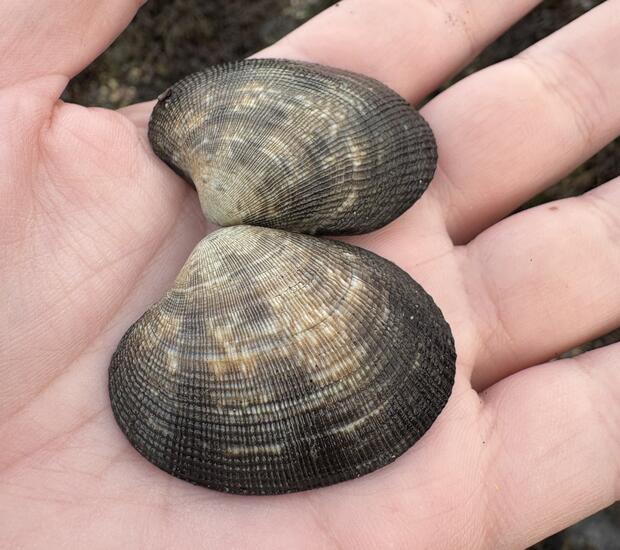
- Manila clam shells have crosshatched, raised ridges that are not present on any native clams in the region.
- The shells are roughly oval shaped, cream or gray in color, and often have dark lines, chevrons, streaks, or other patterns.
- The shell can be up to 3 inches long.
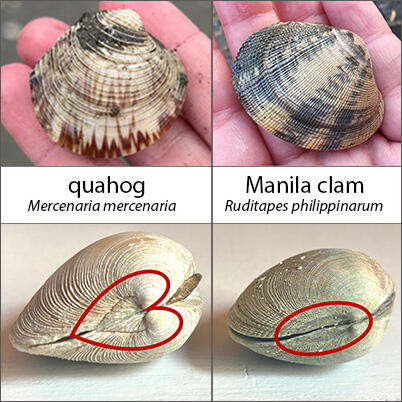
- Manila clams can look similar in shape, size, and color to native quahogs (Mercenaria mercenaria), but quahogs do not have the same crosshatched, raised ridges.
- If you are still unsure, compare the lunule (which is the depression where the shells come together). The lunule on a quahog is heart-shaped, but the Manila clam lunule is oval-shaped.
Check out the Bivalve Mollusks identification card (PDF) from the Marine Invader Monitoring and Information Collaborative (MIMIC) for more helpful tips.
I Found a Clam – What Now?
Researchers have been monitoring iNaturalist for observations of Manila clams submitted in the region.
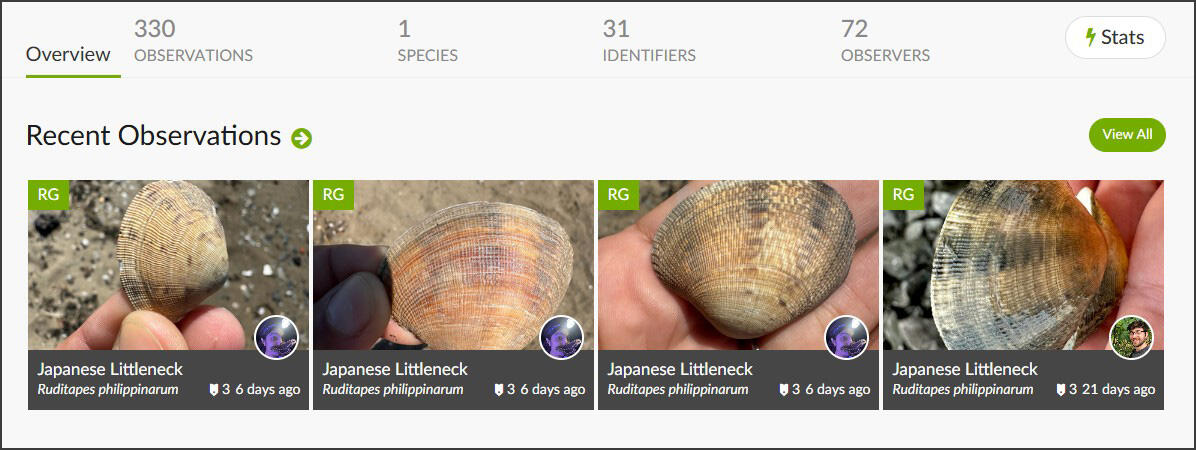
If you find a Manila clam in Massachusetts, please take a photo and add it to iNaturalist. Manila clam iNaturalist observations in New England will automatically be added to the Lookout for Non-Native Species: Investigating Manila Clams in New England project, which was developed by members of the Manila Clam Working Group.
You may also join the MIMIC iNaturalist project to share your observations of the species with members of the MIMIC community.
The Manila Clam Working Group
The effort to document the distribution and establishment of the Manila clam in Massachusetts has been supported by many organizations across the Commonwealth and the greater Northwest Atlantic region. To sustain this collaboration, the Manila Clam Working Group was formed. The Working Group meets monthly to stay connected on ongoing research, monitoring, and reported sightings and to discuss outreach, future research questions, and management implications.
The Manila Clam Working Group currently includes members from:
- Antioch University
- Barbara Warren Environmental Consulting
- Cape Cod Cooperative Extension
- Center for Coastal Studies
- Chatham Shellfish Division
- Fisheries and Oceans Canada
- Massachusetts Division of Marine Fisheries
- Massachusetts Bays National Estuary Partnership
- Massachusetts Institute of Technology
- MIT Sea Grant
- Neponset River Watershed Association
- Northeastern University
- Salem Sound Coastwatch
- Save the Harbor/Save the Bay
- UMass Amherst Northeast Climate Adaptation Science Center
- UMass Boston Stone Living Lab
- University of Rhode Island
- Williams College
- WHOI Sea Grant
Contact Information
For questions about the Manila clam, to report a sighting, or to learn more about the Manila Clam Working Group, contact:
- Lexie Neffinger - Coastal Habitat and Water Quality Specialist
alexis.neffinger@mass.gov
(617) 890-9119
References
Albayrak, S. (2011). Alien marine bivalve species reported from Turkish seas. Cahiers de Biologie Marine, 52, 107-118.
Carlton, J. T. & Eldredge, L. G. (2009). Marine Bioinvasions of Hawai‘i: The Introduced and Cryptogenic Marine and Estuarine Animals and Plants of the Hawaiian Archipelago. Bishop Museum Bulletin in Cultural and Environmental Studies, 4, 1-202.
Cordero, D., Delgado, M., Liu, B., Ruesink, J., & Saavedra, C. (2017). Population genetics of the Manila clam (Ruditapes philippinarum) introduced in North America and Europe. Scientific Reports, 7, 39745.
de Montaudouin, X., Arzul, I., Caill-Milly, N., Khayati, A., Labrousse, J.-M., Lafitte, C., Paillard, C., Soudant, P., & Gouletquer, P. (2016) Asari clam (Ruditapes philippinarum) in France: history of an exotic species 1972 – 2015. Bulletin of Japan Fisheries Research and Education Agency, 42, 35-42.
Food and Agriculture Organization of the United Nations (2025). Fishery and Aquaculture Statistics Yearbook 2023. FAO Yearbook of Fishery and Aquaculture Statistics. Rome.
Greeve, Y., Lindegarth, M., Panova, M., & Strand, A. (2025) First report of the non-native Manila clam Ruditapes philippinarum on the Swedish Skagerrak coast. Estuarine, Coastal and Shelf Science, 325, 109487.
Humphreys, J. (2025). Revisiting the indigenous distribution of the “Manila clam” Ruditapes philippinarum: Mechanisms of persistent error. Estuarine, Coastal and Shelf Science, 314, 109152.
Humphreys, J., Choi, K.-S., & Watanabe, S. (2025). Ruditapes philippinarum: The $7 billion mollusc. Estuarine, Coastal and Shelf Science, 325, 109481.
Putnam, A. B., Bastidas, C., Nichols, O. C., Clements, J. C., Fernekees Hartshorn, E., Chin, D. W., Frye, A., Gagne, R., Geiger, M. L., Hutchinson, R., Rivera Leon, V., Neffinger, A. J., Reistma, J., Tucker, T., Yeung, I. C., & Carlton, J. T. (2026). Completing the journey in the global north: the Manila clam (Ruditapes philippinarum) (Bivalvia: Veneridae) arrives in the Northwest Atlantic Ocean. Biological Invasions, 28, 163.
Talley, D. M., Talley, T. S., & Blanco, A. (2015) Insights into the Establishment of the Manila Clam on a Tidal Flat at the Southern End of an Introduced Range in Southern California, USA. PLoS ONE, 10(3), e0118891.