
- Scientific name: Eleocharis ovata
- Species of Greatest Conservation Need (MA State Wildlife Action Plan)
- Endangered (MA Endangered Species Act)
Description
In Massachusetts, the ovate spike-sedge (Eleocharis ovata) is a low (5-15 cm [2-6 in]), tufted, annual herb with straight, ascending, deep-green stems. Although the ovate spike-sedge and the other spike-sedges (also called spike-rushes) superficially resemble the group of plants called “rushes,” they do not belong to the rush family, and are actually members of the sedge family (Cyperaceae). The spike-sedges have a single, tight cluster of inconspicuous flowers (a “spike”) at the apex of each stem. The stems of spike-sedges appear leafless, and in fact these plants do not have leaf blades (the expanded part of the leaf), only leaf sheaths (the part which surrounds the stem).
To positively identify the ovate spike-sedge and other spike-sedges (genus Eleocharis), a technical manual should be consulted. It is usually necessary to look at the tiny fruits of the plant under magnification to distinguish the species of spike-sedge. Members of this genus possess a type of fruit called an “achene,” which is hard and nut-like and does not split open to release its single seed. Achenes in the spike-sedges are topped by a protuberance (called a “tubercle”), which varies in shape, size, and texture among species.
It should be noted that Eleocharis ovata (syn. E. obtusa var. ovata) is a member of a taxonomically controversial complex within the genus Eleocharis. Some authors (i.e., Gleason and Cronquist 1991) have not recognized Eleocharis ovata as a separate entity from the more common Eleocharis obtusa. There is yet additional controversy as to whether another taxon, E. diandra, is a separate entity from E. ovata. Currently, based on the recent Flora of North America treatment, the MassWildlife’s Natural Heritage & Endangered Species Program recognizes E. ovata as a distinct species from both E. obtusa and E. diandra.
There are many common spike-sedges that could be confused with the ovate spike-sedge, and a technical manual should be consulted when trying to distinguish members of this genus. Of particular concern is separating this spike-sedge from its close relative, the soft-stemmed spike-sedge (Eleocharis obtusa), which can be difficult. In the soft-stemmed spike-sedge, the tubercle is relatively short and squat with a wide base covering almost the entire top of the achene. The base of the tubercle in the ovate spike-sedge is usually narrower, not quite covering the entire summit of the achene. Technically, a tubercle 0.5-0.8 mm (0.02-0.03 in) wide is found in the soft-stemmed spike-sedge, while a tubercle 0.3-0.5 mm (0.01-0.02 in) wide is found in the rare ovate spike-sedge.
Eleocharis diandra is a rare spike-sedge known only from a few local areas in the Northeastern U.S. and Ontario, Canada. It is distinguished from E. ovata by its lack of “perianth bristles,” a whorl of bristles emanating from the base of the achene in most species of Eleocharis. In contrast, E. ovata usually has six or seven perianth bristles which overtop the achene and tubercle.
Life cycle and behavior
The achene of the ovate spike-sedge matures in mid to late summer and is olive to light brown to dark brown in color. It is two-sided (like a tiny lentil), smooth, and glossy. The tubercle hugs the top of the achene closely (there is no constriction separating it from the achene).
Population status
The ovate spike-sedge is listed under the Massachusetts Endangered Species Act as endangered. All listed species are protected from killing, collecting, possessing, or sale and from activities that would destroy habitat and thus directly or indirectly cause mortality or disrupt critical behaviors. The MassWildlife’s Natural Heritage & Endangered Species Program has 16 records from 6 counties: Barnstable, Essex, Franklin, Hampshire, Plymouth, and Worcester. Eight of these records have been observed within the last 25 years.
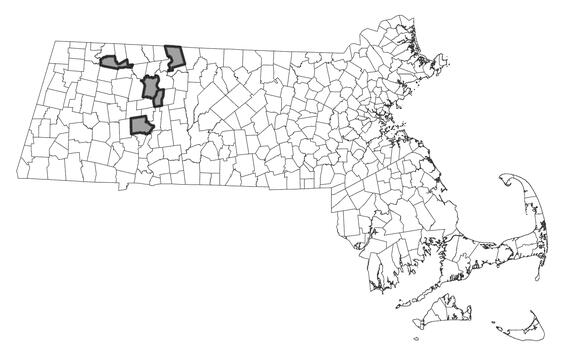
Distribution in Massachusetts. 1999-2024. Based on records in the Natural Heritage Database.
Distribution and abundance
The ovate spike-sedge occurs from Newfoundland, south to Connecticut, west to New York and Indiana, north to Minnesota.
Habitat
The ovate spike-sedge can be found growing on sandy freshwater margins, including lake, pond and river shores. It has been documented to occur with the following species in Massachusetts: soft-stemmed spike-sedge (Eleocharis obtusa), threeway sedge (Dulichium arundinaceum), buttonbush (Cephalanthus occidentalis), soft rush (Juncus effusus), wool-grass (Scirpus cyperinus), and common bur-reed (Sparganium americanum).
Healthy habitats are vital for supporting native wildlife and plants. Explore habitats and learn about conservation and restoration in Massachusetts.
Threats
Threats to the species include nutrient enrichment of freshwater bodies, which is likely to encourage growth of weed species, and permanent flooding.
Conservation
As for many rare species, exact needs for management of ovate spike-sedge are not known. The following comments are based primarily on observations of populations in Massachusetts. Since the ovate spike-sedge inhabits relatively open, sandy, freshwater margins, it is important to maintain these conditions where populations exist.
Contact
| Date published: | May 7, 2025 |
|---|