
- Scientific name: Persicaria puritanorum (Fernald) Sojàk
- Species of Greatest Conservation Need (MA State Wildlife Action Plan)
- Special Concern (MA Endangered Species Act)
Description

Close-up view of flowers and fruits. Image by Douglas McGrady.
Pondshore smartweed (Persicaria puritanorum) is a globally rare, trailing annual wildflower of the buckwheat family (Polygonaceae), found on the upper shores of coastal plain ponds of the Northeast.
Pondshore smartweed is a prostrate to ascending plant, with a stem 10 to 60 cm (4–24 in.) in length, which is somewhat branching at the base. The leaves are alternate, lance-shaped, 3 to 10 cm (1.2–4 in.) long, and up to 1.5 cm (0.6 in.) wide; they have short-petioles or are nearly sessile. The ochrea (the sheath at base of the leaf characteristic of buckwheats) are cylindric, with a fringe of straight hairs. The flowers are rose-pink, and very small, borne on very dense, stalked, axillary spikes. Flowers are present from midsummer to early fall. The fruits, or achenes, are black, smooth, and shiny, and 2 mm (0.08 in.) long.
Pondshore smartweed closely resembles lady’s thumb (Persicaria maculosa), an exotic species that occupies a wide variety of disturbed habitats throughout the state. Unlike pondshore smartweed, lady’s thumb has a distinctive dark blotch on each leaf; further, it is a more erect plant than pondshore smartweed, and has larger achenes. Pondshore smartweed may occasionally have marks on the leaves as well, but is always prostate.
Life cycle and behavior
This is an annual plant that will grow and flower once water levels in the coastal plain pond have receded sufficiently. The seeds can remain submersed for many years and will remain viable. As coastal plain ponds can have several years with high water, this strategy means that when water levels are again low during a drier year, the plants will again sprout and grow. This species has a long flowering period as it depends on when water levels are appropriate. It can be observed in flower as early as July and as late as November, if water level in the pond has not covered it for the year.
Population status
Pondshore Smartweed is listed under the Massachusetts Endangered Species Act as special concern. All listed species are protected from killing, collecting, possessing, or sale and from activities that would destroy habitat and thus directly or indirectly cause mortality or disrupt critical behaviors. There are currently 35 populations occurring in Barnstable and Plymouth counties.
Distribution and abundance
Pondshore smartweed is regionally endemic, ranging from Nova Scotia and Maine to southeastern Massachusetts and Rhode Island. It is thought to no longer occur in Rhode Island (historical).
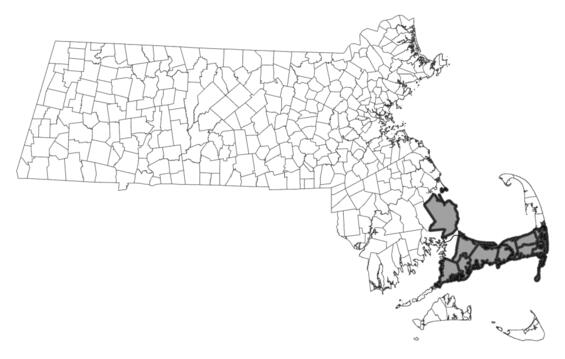
Distribution in Massachusetts. 1999-2024. Based on records in the Natural Heritage Database.
Habitat
In Massachusetts, pondshore smartweed inhabits the sandy, peaty, or cobble upper shores of acidic, low-nutrient coastal plain ponds. It requires pronounced water level fluctuation, acidic, nutrient-poor water and substrate, and an open, exposed shoreline, free from major soil disturbance. Associated species include dwarf bulrush (Lipocarpha micrantha; Threatened), golden hedge-hyssop (Gratiola aurea), hyssop hedge-nettle (Stachys hyssopifolia, watch-list), Plymouth gentian (Sabatia kennedyana; Special Concern), rose coreopsis (Coreopsis rosea, watch-list), slender-leaved goldenrod (Euthamia tenuifolia), and toothed flatsedge (Cyperus dentatus).
Healthy habitats are vital for supporting native wildlife and plants. Explore habitats and learn about conservation and restoration in Massachusetts.
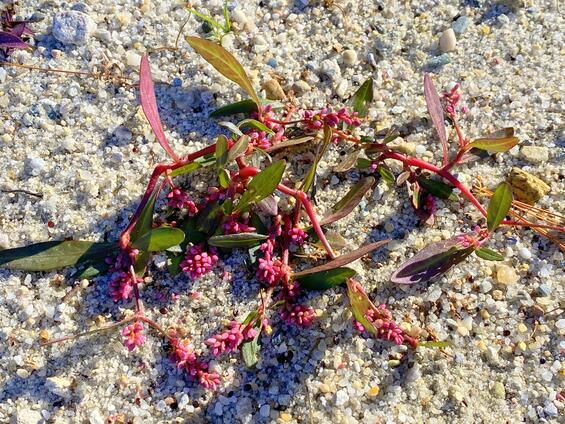
Sprawling habit of pondshore smartweed. Image by Douglas McGrady.
Threats
Threats include any activities that change the natural hydrology, water quality, or soil integrity of its habitat. Examples include water table drawdown from local wells, eutrophication resulting from nutrient inputs from septic systems and lawns, and trampling and soil disturbance due to recreational use of pondshores (i.e., hiking, sunbathing, swimming, fishing, boat-launching, and raking or digging).
Conservation
Preservation of pondshore smartweed requires protection of the natural hydrology, water quality, and soil integrity of its habitat. Like other coastal plain pondshore plant species, it requires pronounced water-level fluctuations, and acidic, nutrient-poor water and substrate, free from major soil disturbance.
Pondshore smartweed populations should be monitored regularly to identify possible threats. Protection of pondshore smartweed may require exclusion of new wells and septic systems, prohibitions on fertilizer use, and restrictions on recreational use of the pondshores. Recreational activities such as swimming, fishing, and boat-launching should be diverted from plant population locations by providing alternative locations for these activities.
Also, habitat should be monitored for exotic plant species invasions. The nature of coastal plain ponds makes them generally inhospitable to many exotic plants, but they can become established at sites that have major soil disturbance or heavy nutrient inputs. Exotic species that could establish along the shoreline of coastal plain ponds include common reed (Phragmites australis ssp. australis), gray willow (Salix cinerea), and purple loosestrife (Lythrum salicaria).
All active management of rare plant populations (including invasive species removal) is subject to review under the Massachusetts Endangered Species Act and should be planned in close consultation with the Massachusetts Natural Heritage & Endangered Species Program.
References
Fernald, Merritt Lyndon.1970. Gray's Manual of Botany, Eighth (Centennial) Edition - illustrated. D.Van Nostrand Company. New York, New York.
Haines, A. 2011. Flora Novae Angliae – a Manual for the Identification of Native and Naturalized Higher Vascular Plants of New England. New England Wildflower Society, Yale Univ. Press, New Haven, CT.
Kim, S.-T., S.E. Sultan, and M.J. Donohue. 2008. Allopolyploid speciation in Persicaria (Polygonaceae): insights from a low-copy nuclear region. Proceedings of the National Academy of Sciences of the United States of America 105: 12370-12375.
POWO (2025). Plants of the World Online. Facilitated by the Royal Botanic Gardens, Kew. Published on the Internet; https://powo.science.kew.org/ Accessed: 3/19/2025.
Schneider, R. 1994. The role of hydrologic regime in maintaining rare plant communities of New York's coastal plain pondshores. Biological Conservation 68: 253-260.
Sorrie, B. A. 1987. Notes on the Rare Flora of Massachusetts. Rhodora 89:113-196.
Sorrie, B.A. 1994. Coastal Plain Ponds in New England. Biological Conservation 68: 125-33.
Swain, P.C. and J. B. Kearsley. 2001. Classification of the Natural Communities of Massachusetts (draft). Massachusetts Natural Heritage and Endangered Species Program, Dept. of Fish and Game, Westborough, MA.
Zaremba, R. and E. Lamont. 1993. The status of the coastal plain pondshore community in New York. Bulletin of the Torrey Botanical Club. 120 (2): 180-187.
Contact
| Date published: | August 20, 2025 |
|---|