
- Scientific name: Ludwigia sphaerocarpa Elliott
- Species of Greatest Conservation Need (MA State Wildlife Action Plan)
- Endangered (MA Endangered Species Act)
Description
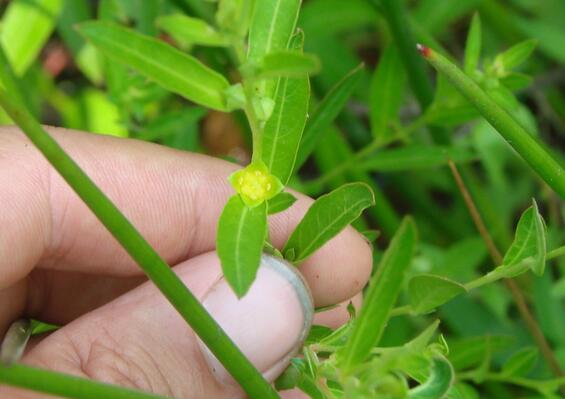
Round-fruited seedbox in flower. Image by Bryan Connolly.
Round-fruited seedbox (Ludwigia sphaerocarpa) is an erect, branching, finely pubescent, shrub-like perennial of coastal plain pond shores that stands 0.3-1 m (1-3 ft) tall. It is in the evening primrose family (Onagraceae). Leaves are alternate, lanceolate, and narrowed at both ends. Flowers are produced singly at the leaf bases and are greenish and inconspicuous, but the triangular sepals are readily apparent, and it has no petals. The dry fruits are rounded, softly hairy capsules. When submerged or standing in water, the stem bases become spongy and thickened with round-fruited seedbox is an erect, branching, finely pubescent, shrub-like perennial that stands 0.3-1 m (1-3 ft) tall. Leaves are alternate, lanceolate, and narrowed at both ends. Flowers are produced singly at the leaf bases and are greenish and inconspicuous, but the triangular sepals are readily apparent. The dry fruits are rounded, softly hairy capsules, and may be tinged pink. When submerged or standing in water, the stem bases become spongy and thickened with aerenchyma tissue which has openings filled with air to keep the plant from drowning.
The seedbox genus is represented by several local species that inhabit wet places. All are similarly erect and branched except for water-purslane (Ludwigia palustris), a very common species, easily identified by oval leaves and prostrate stems. Seedbox (L. alternifolia) has conspicuous yellow petals and square capsules, while L. sphaerocarpa has no petals. Many-fruited seedbox (L. polycarpa, endangered) is very similar but has smooth capsules and inhabits floodplain swamps along the Connecticut River.
Life cycle and behavior
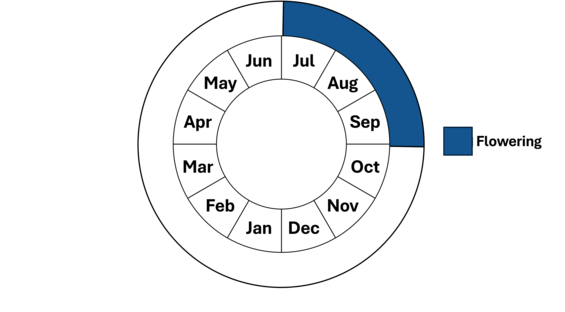
This is a perennial species that flowers July to September. Except for the semi-woody base, the plant dies back each winter. It forms underground stolons 20-90 cm (8-35 in.) which are sometimes branched and producing multiple stems.
Population status
Round-fruited seedbox is listed under the Massachusetts Endangered Species Act as endangered. All listed species are protected from killing, collecting, possessing, or sale and from activities that would destroy habitat and thus directly or indirectly cause mortality or disrupt critical behaviors. Round-fruited seedbox is known from Bristol and Plymouth counties and occurred historically in Middlesex county. There are currently 4 known populations.
Distribution and abundance
Round-fruited seedbox is an Atlantic coastal plain species locally distributed from Massachusetts south to central Florida and Texas with disjunct populations in northwest Indiana and southwest Michigan. Massachusetts marks the northeastern limit of its range. It is listed as rare in Connecticut, Rhode Island, New York, Virginia, Tennessee, Indiana, Louisiana, North Carolina, and Michigan, and as extirpated in Pennsylvania.
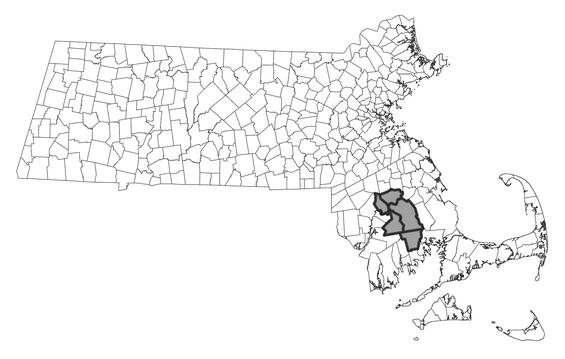
Distribution in Massachusetts. 2000-2025. Based on records in the Natural Heritage Database.
Habitat
This plant is found on nutrient-rich, muddy, sandy to peaty shores and in shallow water of freshwater ponds and slow-moving rivers with fluctuating water levels. The habitat requirements are not well-known or well-documented in this state for this easily overlooked species. Its associates include Plymouth gentian (Sabatia kennedyana), common threesquare (Schoenoplectus pungens), golden pert (Gratiola aurea), marsh rush (Juncus canadensis), and bayonet rush (Juncus militaris).
Healthy habitats are vital for supporting native wildlife and plants. Explore habitats and learn about conservation and restoration in Massachusetts.
Threats
Round-fruited seedbox is threatened by any activity that changes the hydrologic regime including water quality and soil integrity of the coastal plain pond it inhabits. Region-wide, coastal plain ponds are imperiled due to shoreline development, water table drawdown (from wells), eutrophication (resulting from fertilizers and septic systems), and soil disturbance from heavy recreational use (ORV, horse, and foot traffic; camping; boat-launching; raking and digging).
Conservation and management
Management of round-fruited seedbox requires protection of the hydrology, water quality, and soil integrity of its habitat. Like many other coastal plain pondshore plant species, round-fruited seedbox requires pronounced water-level fluctuations; acidic, nutrient-poor water and substrate; and an open, exposed shoreline, free from major soil disturbance. The hydrologic regime is particularly important; coastal plain pond shore species often require low water years for reproduction, but their persistence at a site depends on high water years to keep dense woody vegetation from taking over the shoreline. Protection of round-fruited seedbox habitat may require regulation of new wells, exclusion of septic systems, prohibitions on fertilizer use, and restrictions on recreational use of the site. Recreational activities such as swimming, hiking, horseback riding, and ORV use should be diverted from the plant population location by re-routing trails, installing fences, and providing alternative locations for the activities. Populations should be monitored to identify threats such as over-shading, invasive plant establishment, and soil disturbance.
Contact
| Date published: | April 30, 2025 |
|---|