
- Scientific name: Linum intercursum Bickn.
Species of Greatest Conservation Need (MA State Wildlife Action Plan)
Description
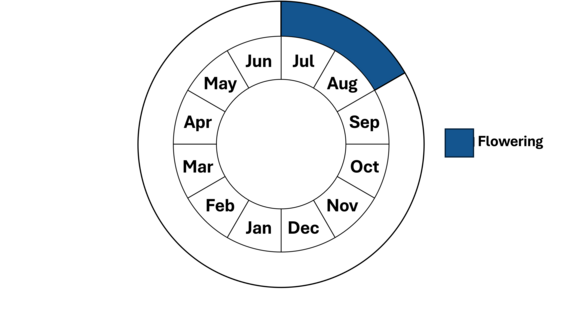
Sandplain flax, Linum intercursum, is a slender perennial herb in the flax family (Linaceae), growing 25-51 cm (10-20 in) tall. The stem is stiff and usually unbranched below the inflorescence. Its leaves are narrowly elliptic, 12-20 mm (0.47-0.79 in) long and 2-4 mm (0.08-0.16 in) wide, and are borne on slender, stiff, ascending branches. Flowering occurs from July to August. The seed capsules are round with a short but distinct conical cap.
Two species of flax resemble sandplain flax in Massachusetts. Wild flax (Linum virginianum) has branches that are more widely spread than those of L. intercursum and a similar seed capsule but without the pointed cap. Small stiff yellow flax (L. medium) has narrower leaves and a similar seed capsule, also lacking the pointed cap.
Life cycle and behavior
This is a perennial species.
Population status
Sandplain flax is a species of greatest conservation need and is now maintained on the plant watch list. It is at the northern edge of its range in Massachusetts. The species' rarity is due in part to this geographic position, as well as the the succession of many open habitats to forests. There have been 42 populations verified since 1999 in Barnstable, Dukes, Nantucket and Plymouth Counties.
Distribution and abundance
Sandplain flax is known from Massachusetts south to Georgia, and west to New York, Tennessee and Alabama. A disjunct population occurs in northwestern Indiana. It is rare in most states where it occurs. In New England, it is only known from Massachusetts where it is considered vulnerable, Rhode Island where it is critically imperiled and Connecticut where it is possibly extirpated.
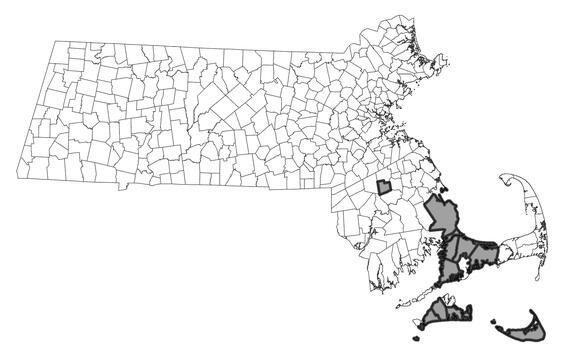
Distribution in Massachusetts. 2000-2025. Based on records in the Natural Heritage Database.
Habitat
Sandplain flax inhabits dry, open sandplain grasslands or moors, sand barrens, swaths under powerlines, and mown fields, usually in small colonies. Co-occurring species include little bluestem (Schizachyrium scoparium), ticklegrasses (Agrostis spp.), pinweeds (Lechea spp.), black huckleberry (Gaylussacia baccata), and rockroses (Crocanthemum spp.).
Healthy habitats are vital for supporting native wildlife and plants. Explore habitats and learn about conservation and restoration in Massachusetts.
Threats
The primary threats are off-road vehicle use, urban development, habitat succession, invasive species and fire suppression.
Conservation
Surveys of known populations are needed to establish numbers and gather data on associated species, soil conditions and former or current management practices on all populations.
Management should consist of dormant season mowing where possible to control shrub and invasive species. Prescribed fire should be considered to maintain open habitat.
Research should focus on germination and reproduction, and whether this can be grown for seed for restoration purposes.
References
NatureServe. 2025. NatureServe Network Biodiversity Location Data accessed through NatureServe Explorer [web application]. NatureServe, Arlington, Virginia. Available https://explorer.natureserve.org/. Accessed: 5/23/2025.
POWO (2025). Plants of the World Online. Facilitated by the Royal Botanic Gardens, Kew. Published on the Internet; https://powo.science.kew.org/ Accessed: 3/4/2025.
Contact
| Date published: | April 30, 2025 |
|---|