
- Scientific name: Sphenopholis nitida(Biehler) Scribner
- Species of Greatest Conservation Need (MA State Wildlife Action Plan)
Threatened (MA Endangered Species Act)
Description
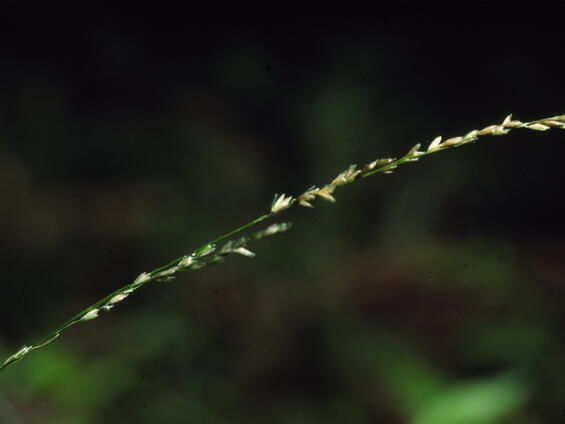
Photo credit: Bruce Sorrie
Shining wedgegrass (Sphenopholis nitida) is a slender perennial grass (family Poaceae). It grows in small tufts, reaching 30-80 cm (1-2.6 ft) tall. Plants are usually leafy at the base. Leaves are dark green and often have short soft hairs on the blade surface. The main leaf blades are 2-5 mm (0.08-0.2 in) wide and 2-15 cm (0.8-6 in) long; sheaths are hairy. The sheath of the uppermost stem leaf is three to five times longer than the blade. The culm, or flowering stem, is shiny and erect. The slender and somewhat spreading flower panicle is 6-20 cm (2.4-8 in) long. The panicle is composed of spikelets, or flowering branchlets, which are few-flowered, set far apart, and generally 2.5-5 mm (0.1-0.2 in) long. Shining wedgegrass gets its name from the Greek sphen, meaning wedge, and pholis, meaning scale, in reference to the shape of the second glume. Nitida is Latinfor shining or smooth, in reference to the stem.
At the base of each spikelet, there are two small scales or bracts called the first and second glumes. The glumes are mostly smooth with a few tiny hairs along their upper outer margins. The glumes are not quite equal in length, measuring 1.5-3.5 mm (0.06-0.14 in). The first glume is slightly longer than the second. It is one-third as wide as it is long and at least one-third as wide as the second glume. The second glume is broad at the top, somewhat wedge-shaped, and more than half as wide as long. The rest of the spikelet is made up of florets arranged in alternating rows on a central stalk or rachilla. Each floret has an outer scale, or lemma, an inner scale, or palea, and a tiny flower between them. The lemmas of shining wedgegrass are oval, 2-4 mm (0.08-0.16 in), long and usually do not have awns. The lowest lemma is smooth toward the base and slightly rough toward the tip. The second lemma is strongly scabrous or rough. The lemmas above may be scabrous on the sides and very rarely are awned. Shining wedgegrass flowers in May; mature florets are present through June. Plants begin to senesce in early July.
Shining wedgegrass is similar in appearance to slender wedgescale (Sphenopholis intermedia) and prairie wedgescale (S. obtusata). Shining wedgegrass has somewhat blunt and wider first glumes than the latter two grasses. Also, the second lemma of shining wedgegrass is strongly scabrous. The second lemma is smooth in slender wedgescale and only slightly scabrous to papillose in prairie wedgescale. Also, slender wedgegrass is differentiated from shining wedgegrass by its relatively shorter anthers (0.3-0.7 mm [0.012-0.028 in] versus 1.2-1.6 mm [0.05-0.06 in]).

Photo credit: Peter M Dziuk, MinnesotaWildflowers.info
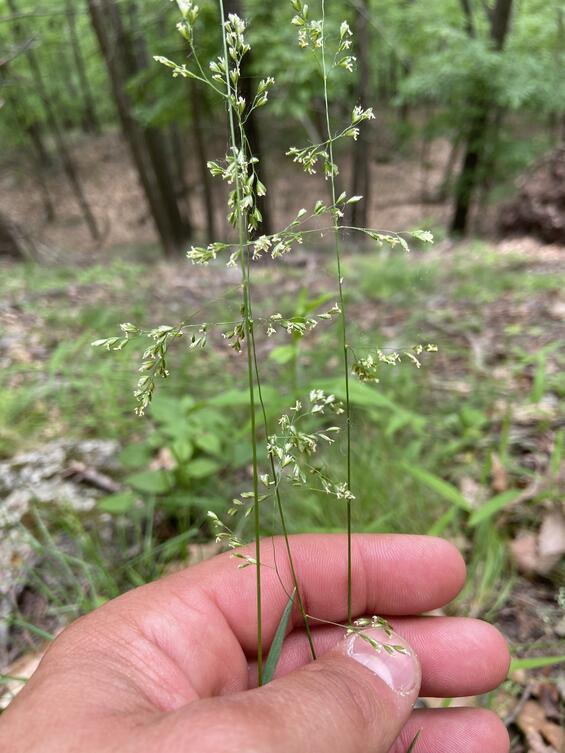
Photo credit: Peter M Dziuk, MinnesotaWildflowers.info
Life cycle and behavior
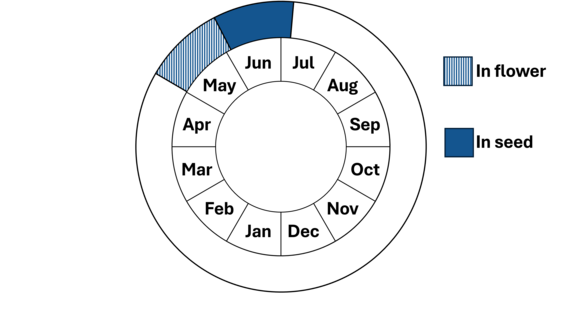
Shining wedgegrass is a perennial grass and is wind pollinated. It flowers in May; mature florets are present through June. Plants begin to senesce in early July. The flowering branches are held close to the stem when the plant is not in bloom. When in bloom, the inflorescence spreads wide to let the wind pick up and deposit pollen. Once pollination is complete, the flowering branches again are pulled close to the stem (see photos of flowering spike).
Population status
Shining wedgegrass is listed under the Massachusetts Endangered Species Act as threatened. All listed species are protected from killing, collecting, possessing, or sale and from activities that would destroy habitat and thus directly or indirectly cause mortality or disrupt critical behaviors. There are currently 14 occurrences of shining wedgegrass in the state verified since 1999. Shining wedgegrass is currently known from Berkshire, Franklin, Hampden, Hampshire, andWorcester Counties, and is historically known from Middlesex, and Norfolk Counties. Five of the known populations have been ranked as doing well, with good numbers, healthy plants, and few invasives.
Distribution and abundance
Shining wedgegrass ranges from Southern Ontario, Vermont, and Massachusetts, south to Florida, and west to Illinois, Missouri, Arkansas, and Texas. It is considered rare only at its northern extent, including critically imperiled in Vermont and Ontario, imperiled in Massachusetts and vulnerable in Illinois. In other New England states, it is not known to occur in Maine, New Hampshire, or Rhode Island and it has not been assessed in Connecticut.
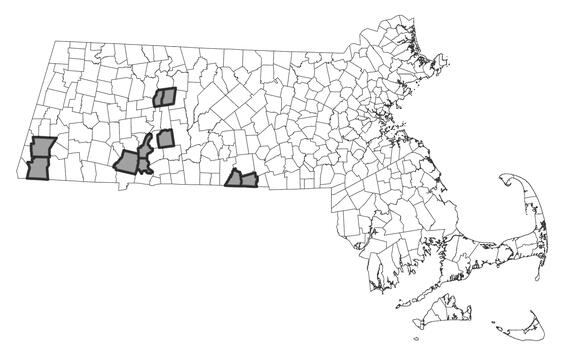
Distribution in Massachusetts. 1999-2024. Based on records in the Natural Heritage Database.
Habitat
Shining wedgegrass inhabits dry, rocky fertile soils derived from base-rich bedrock such as basalt and marble. It typically occurs on steep upper slopes and ridge crests, in deciduous forests characterized by hickory (Carya spp.), hop hornbeam (Ostrya virginiana), white ash (Fraxinus americana), and various oaks (Quercus spp.). Common associates in the herbaceous layer include Pennsylvania sedge (Carex pensylvanica), ebony sedge (Carex eburnea), bashful club-sedge (Trichophorum planifolium), downy false foxglove (Aureolaria virginica), four-leaved milkweed (Asclepias quadrifolia), bluestem-goldenrod (Solidago caesia) and blunt-lobed hepatica (Hepatica americana). Many sites show evidence of past fire, grazing, or other small-scale disturbances.
Healthy habitats are vital for supporting native wildlife and plants. Explore habitats and learn about conservation and restoration in Massachusetts.
Threats
Habitats are vulnerable to development, especially in the eastern half of the state. Lack of small-scale disturbances such as wind-throw or occasional fire may limit the ability of shining wedgegrass to compete with other species and germinate in bare soil areas. Habitats are susceptible to exotic plant invasions from species such as swallowworts (Cynanchum spp.), Morrow’s honeysuckle (Lonicera morrowii), Japanese barberry (Berberis thunbergii), Canada bluegrass (Poa compressa), Asiatic bittersweet (Celastrus orbiculatus), and common buckthorn (Rhamnus cathartica). Invasive plants can out-compete native plants for nutrients and light, excluding them over time.
Conservation
Shining wedgegrass should be surveyed at least every five years, and its habitat evaluated for potential threats, including shading from dense canopy, invasive species, and other unknown threats. The best time to survey for the species is in May and June; though ripe seed has been observed during July.
Research and monitoring aimed at understanding the natural history, biology, and population dynamics of shining wedgegrass are important. This species is known to respond favorably to fire management in other parts of its range. Carefully timed prescribed burns may reduce canopy closure and competition from other plants, and expose mineral soils required for shining wedgegrass germination and establishment. Shining wedgegrass habitat should be monitored for exotic invasive species. If exotic plants are invading shining wedgegrass habitat, a plan for control should be constructed. All active management within the habitat of a rare plant population (including invasive species removal) is subject to review under the Massachusetts Endangered Species Act and should be planned in close consultation with MassWildlife’s Natural Heritage & Endangered Species Program.
References
Gleason, Henry A., and Arthur Cronquist. Manual of Vascular Plants of Northeastern United States and Adjacent Canada, Second Edition. Bronx, NY: The New York Botanical Garden, 1991.
Haines, Arthur. Flora Novae Angliae. New England Wild Flower Society, Yale University Press, New Haven, CT. 2011.
Hitchcock, Albert Spear. Manual of the grasses of the United States. 1935. USDA Misc. Pub. 200. pp. 278 – 281.
Magee, Dennis W. Grasses of the Northeast. University of Massachusetts Press. Amherst and Boston. 2014, pp. 90 93.
NatureServe. 2025. NatureServe Network Biodiversity Location Data accessed through NatureServe Explorer [web application]. NatureServe, Arlington, Virginia. Available https://explorer.natureserve.org/. Accessed: 3/18/2025.
POWO (2025). "Plants of the World Online. Facilitated by the Royal Botanic Gardens, Kew. Published on the Internet; https://powo.science.kew.org/ Retrieved 3/18/2025."
Contact
| Date published: | May 8, 2025 |
|---|