
- Scientific name: Carex lenticularis Michx.
- Species of Greatest Conservation Need (MA State Wildlife Action Plan)
- Threatened (MA Endangered Species Act)
Description
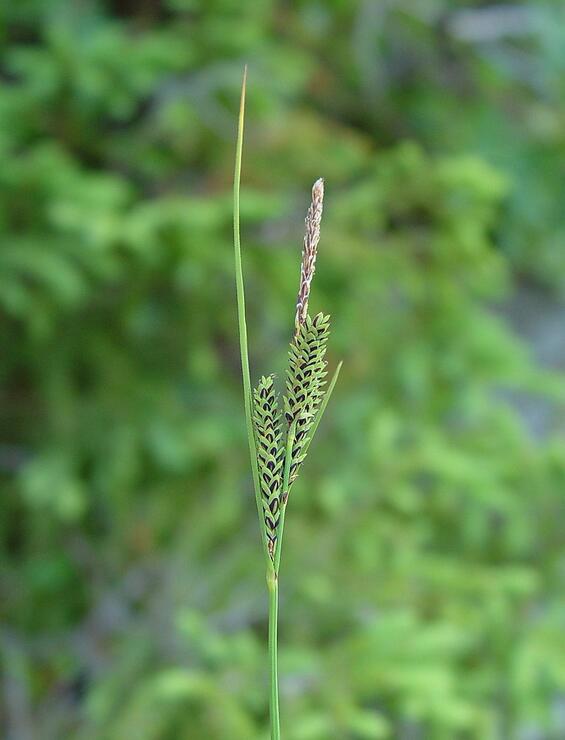
Shore sedge (photo credit: Arthur Haines, Native Plant Trust)
Shore sedge, Carex lenticularis, is a grass-like perennial herbaceous plant in the sedge family (Cyperaceae) that grows in 20-60 cm (8-24 in) tall dense, vase-shaped clumps. The numerous, pale-green leaves are long and very slender (1-3 mm; 0.04-0.12 in), considerably overtopping the culms (stems) and flower spikes. The flowering culms are slender, upright and sharply three-angled; each bears a single, terminal staminate (male) spike and 3 to 8 cylindrical pistillate (female) spikes. Both types of spikes are 1.5-3 cm (1/2-1 in) long, and are usually bunched together. The flower spikes are composed of overlapping scales distinctively colored dark brown with bold green midstripes. The lens-shaped achenes (dry, 1-seeded fruits) are enclosed in egg-shaped perigynia (seed sacs) which, in this species, are gray-green. Flowering occurs from July to August.
To positively identify members of the genus Carex, a technical manual should be consulted. The genus Carex is large and complex (ca. 160 species in Massachusetts) and two close relatives of shore sedge, tussock sedge (Carex stricta) and twisted sedge (Carex torta), may be found growing with it. Both resemble shore sedge in growth habit and leaf but are much leafier and usually form denser tussocks. Tussock sedge has duller brown scales and longer, more widely spaced flower spikes that stand above the leaves. The spikes of twisted sedge are also less crowded and noticeably arching or drooping. Neither possesses the conspicuously raised nerves that are found on the perigynia of the shore sedge.
Population status
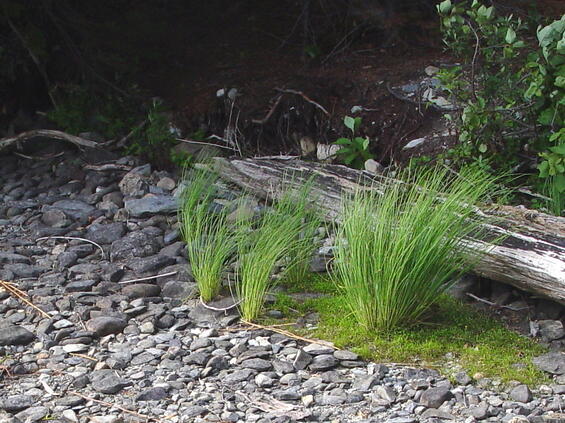
Shore sedge (photo credit: Don Cameron)
Shore sedge is listed as a threatened species in Massachusetts. There are 3 populations that have been verified since 1999, and 7 previously recorded sites not observed in the last 25 years. Shore sedge is primarily a northern species that reaches its southernmost range limit in Massachusetts. Here it is confined to a dynamic and unpredictable habitat, in populations that are small or isolated.
Distribution and abundance
Shore sedge is distributed across North America from Newfoundland, Labrador and Hudson's Bay to Alaska, south into the mountains of California, Colorado, Utah, Nevada, across to Minnesota, Michigan, and Massachusetts.
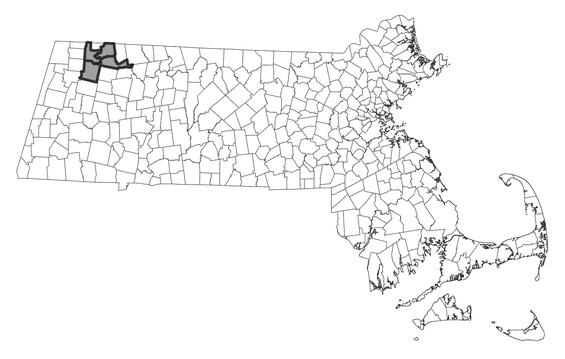
Distribution in Massachusetts
1999-2024
Based on records in the Natural Heritage Database
Habitat
In Massachusetts, shore sedge appears to be restricted to wet, sandy or gravelly beaches of cold ponds and lakes; or to the exposed rock cobble on islands of large rivers. In the latter case, the cobble bars are flooded and submerged every spring and uncovered when the water level drops in summer. Co-occurring species include reed-bentgrass (Calamagrostis canadensis), prairie-dogbane (Apocynum cannabinum), spike-sedges (Eleocharis spp.) and the aforementioned sedges.
Healthy habitats are vital for supporting native wildlife and plants. Explore habitats and learn about conservation and restoration in Massachusetts.
Threats
Severe alterations to its habitat, by river damming or diversion, or by pondshore development, are likely threats to shore sedge.
Contact
| Date published: | April 9, 2025 |
|---|