
- Scientific name: Rhynchospora nitens(Vahl) A. Gray
- Species of Greatest Conservation Need (MA State Wildlife Action Plan)
- Threatened (MA Endangered Species Act)
Description
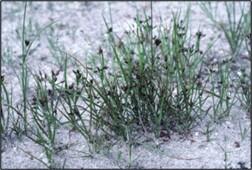
Culms have terminal and axillary flower clusters on glabrous stalks subtended by leafy bracts. Photo credit: Bruce Sorrie
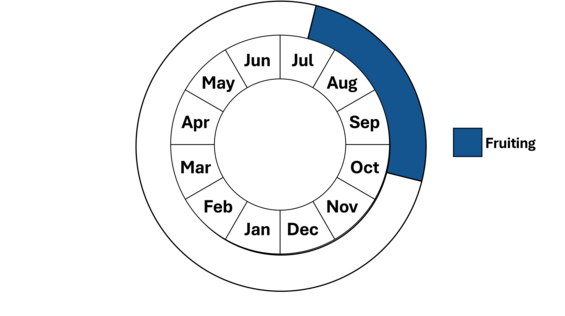
Short-beaked beaksedge (Rhynchospora nitens) is a tufted annual species in the sedge family (Cyperaceae). In Massachusetts, plants are typically short, often under 15 cm (5.9 in) tall. The leaves are linear, proximally flattened, and 1-5 mm (0.04-0.2 in) wide. The flowering stem (or culm) is nearly rounded and many ribbed. Terminal and axillary umbel-like inflorescences are comprised of 1 to 5 diffuse flower clusters on glabrous stalks subtended by leafy bracts. Spikelets are many-flowered, dark brown to nearly black, ovoid, and 3-7 mm (0.12-0.28 in) long. Achenes (dry, one-seeded fruits) are likely shed close to the parent plants. The seeds are long-lived and require drying and exposure of moist pond shore substrate for successful germination. Short-beaked beaksedge was formerly placed within the genus Psilocarya by some botanists.
The spikelets of short-beaked beaksedge are many-flowered and subtended by spirally imbricate one-nerved scales (~3 mm; 0.12 in). The achenes are slightly wider than long, 0.7-1.3 mm (0.03–0.05 in), and become dark brown or nearly black once mature. At the top of the achene is a very short and rather broad “horn” or tubercle, 0.1-0.3 mm (0.004-0.01 in) tall. The achene has a strongly ridged surface characterized by wavy rows of vertical raised cells.
Short-beaked beaksedge is similar in appearance and often confused with long-beaked beaksedge (Rhynchospora scirpoides), a species that is listed as special concern in Massachusetts. Both species are found in coastal plain pond habitats. The tubercle of long-beaked beaksedge is somewhat triangular in shape and is almost as long as the achene. The achene of long-beaked beaksedge has raised pale margins and is rather weakly ridged in comparison with the strongly ridged achene of short-beaked beaksedge.
Life cycle and behavior
This is an annual species.
Population status
Short-beaked beaksedge is listed under the Massachusetts Endangered Species Act as Threatened. All listed species are protected from killing, collecting, possessing, or sale, and from activities that would destroy habitat and thus directly or indirectly cause mortality or disrupt critical behaviors. Short-beaked beaksedge occurs in Plymouth and Barnstable Counties; extant populations are small, consisting of a few hundred plants or fewer.
Distribution and abundance
Short-beaked beaksedge is known from southeastern Massachusetts south along the coastal plain to Florida, then west to Texas. There are disjunct populations in Indiana and Michigan where it is considered critically imperiled in both states. It is only known from Massachusetts in New England where it is considered imperiled.
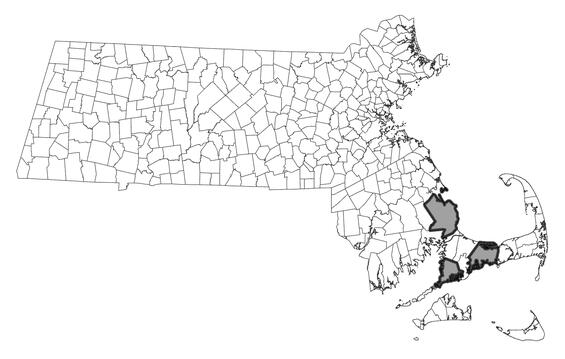
Distribution in Massachusetts
1999-2024
Based on records in the Natural Heritage Database
Habitat
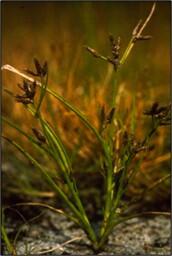
Short-beaked Beaksedge grows on the exposed sand of coastal plain pondshores. Photo credit: Bruce Sorrie
Short-beaked beaksedge is an obligate wetland species found on the moist sandy shores of shallow freshwater coastal plain ponds. These ponds are highly acidic and water levels naturally rise and fall in relation to seasonal and yearly changes in the water table. Seeds of short-beaked beaksedge require a period of drying and exposure to germinate and may remain dormant in the soil seed bank for many years until conditions are appropriate for germination.
Typical associates of short-beaked beaksedge include Canadian St. John’s-wort (Hypericum canadense), dwarf St. John’s-wort (H. mutilum), spatulate-leaved sundew (Drosera intermedia), northern meadow-beauty (Rhexia virginica), warty panic-grass (Panicum verrucosum), pondshore flatsedge (Cyperus dentatus), autumn fimbry (Fimbristylis autumnalis), reticulate nut-sedge (Scleria reticularis), and long-beaked beaksedge (Rhynchospora scirpoides).
Healthy habitats are vital for supporting native wildlife and plants. Explore habitats and learn about conservation and restoration in Massachusetts.
Threats
Artificial withdrawal of water and other changes in ground and surface water hydrology may alter the specialized cycle of flooding and drawdown required by short-beaked beaksedge. Short-beaked beaksedge may be damaged by off-road vehicles, raking and clearing of shoreline vegetation for beach use, loss of habitat for storage of boats, and conversion of wetland habitats for cranberry cultivation.
Conservation
Extant populations should be monitored to gain a better understanding of population dynamics, cycles of flooding and drawdown, and current threats. Sites that supported short-beaked beaksedge historically should also be surveyed periodically, as this species may persist in the seed bank for many years until drawdown conditions are suitable for germination. Conversion of habitat should be prohibited in coastal plain pond shore habitats. Best management practices should be implemented to prevent or reduce nutrient enrichment from lawn fertilizers, faulty septic systems, and flocks of grazing ducks or geese. Monitoring for invasive species is needed for early detection and control. All active management of rare plant populations (including invasive species removal) is subject to review under the Massachusetts Endangered Species Act and should be planned in close consultation with the MassWildlife’s Natural Heritage & Endangered Species Program.
References
Clark, F.H. 2003. Rhynchospora nitens (Vahl) A. Gray, Short-beaked Beaksedge, a Conservation and Research Plan for New England. Prepared for the New England Plant Conservation Program of the New England Wild Flower Society, Framingham, MA.
Fernald, M.L. 1950. Gray’s Manual of Botany,8th edition. American Book Company, Boston, MA.
NatureServe. 2025. NatureServe Network Biodiversity Location Data accessed through NatureServe Explorer [web application]. NatureServe, Arlington, Virginia. Available https://explorer.natureserve.org/. Accessed: 5/27/2025.
Reznicek, A.A., J.E. Fairey, and A.T. Whittemore. 2002. Rhynchospora. R. Kral. Pages 200-217 in Flora of North America Editorial Committee (Editors), Flora of North America north of Mexico, Volume 23. Cyperaceae. Oxford University Press, NY.
Contact
| Date published: | May 7, 2025 |
|---|