
Overview of the Visitors Film
The John Adams Courthouse Visitors Film serves as a springboard for discussions about vital issues of justice. Dynamic documentary footage shows the modern appellate courts in action. Archival images and the words of John Adams highlight key segments of “Thoughts on Government” (1776) and the Massachusetts Constitution (1780). The film travels back in time to the Massachusetts Supreme Judicial Court's [SJC’s] origins, and continues through some of its most famous and infamous decisions. Interviews of former SJC Chief and Associate Justices ground us in the modern significance of historic decisions and ask audiences to consider their broader implications.
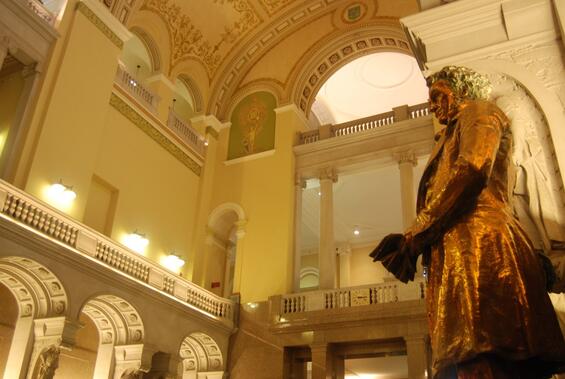
Statue of Rufus Choate in the Great Hall of the John Adams Courthouse[1]
Key topics in the Film
- The establishment of an independent judiciary
- Principles of justice that guided John Adams in drafting the Mass Constitution
- The SJC’s conclusion that slavery was incompatible with the newly ratified State Constitution
- Miscarriages of justice prevalent in the Roberts v. City of Boston and Sacco & Vanzetti cases
- The impact of the landmark Goodridge v. Department of Health (same-sex marriage) case
The film explores how the history of the Massachusetts SJC is tied to that of our nation.
Before viewing the Film
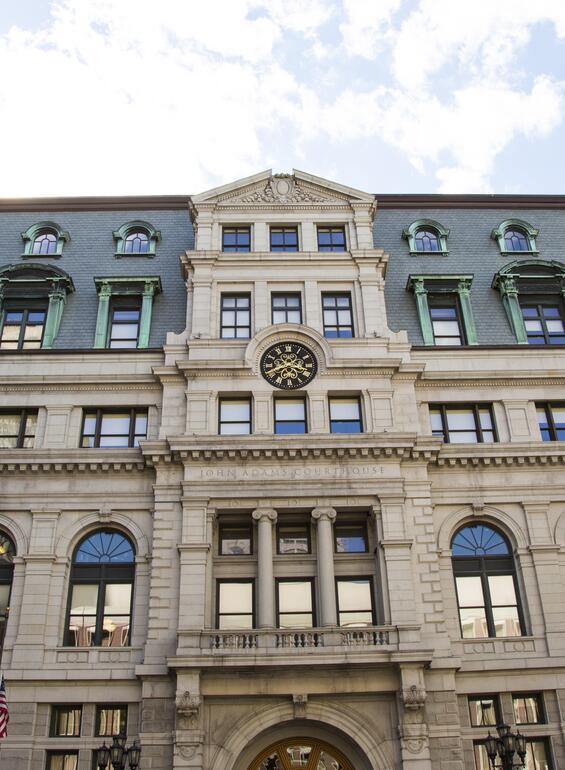
John Adams Courthouse exterior
Mission of the Massachusetts Supreme Judicial Court (SJC)
The SJC’s mission statement, its seal, and the seal’s origins are below.
- Share the Massachusetts SJC’s mission statement, seal, and its origins with the class.
- Ask for volunteers to read both the statement and the English translation of the seal’s maxim. Discuss specific words that are new to students.
- In pairs, students share both their thoughts about the meaning of what they read, and questions they have.
- Ask the pairs to write brief notes about their thoughts and questions.
- Prior to the lesson, attach 3 pieces of large/flip chart paper on a wall of your classroom, where they can stay for a post-film activity. Write one of the following headings on each piece of large paper:
- “What We Know”
- “What We Think We Know”
- “What We Want to Know”
- Provide color markers to students. Ask each pair to write comments and questions about the SJC on the paper, where they think they belong.
- This step can be done all at once or a few pairs at a time, depending on the number of students in your class.
- Let students know that if they discover any of their comments and questions have already been written by their peers, to draw a star next to them. There is no limit to the number of stars next to any one comment or question.
- If they have doubts about a comment that has been written in columns #1 or #2 by another pair, instruct them to place a question mark next to it.
- Ask students to read (silently) the comments and questions.
- Save these large papers for a post-film activity.
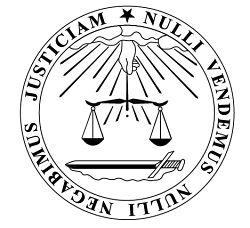
SJC Mission Statement and Seal
To promote the rule of law and foster public trust by leading an independent judiciary that assures every person equal access to the fair, timely and impartial resolution of disputes in courts managed with efficiency and professionalism.
The SJC's modern mission statement derives from the court's historic seal of 1785, which contains a promise made in the Magna Carta – Nulli Vendemus Nulli Negabimus Justiciam. An English translation of this Latin text is"We sell justice to no one; we deny justice to no one".
Vocabulary used in the Film
Below is a list of words, phrases, and concepts included in the John Adams Courthouse Visitors Film that may be new to your students.
- Select the words, phrases, and concepts that you think are particularly important for students to comprehend, and will enrich your curriculum.
- Assign each student two or three key words, phrases, or concepts.
- Homework or in-class assignment: Ask students to research assigned words, phrases, and/or concepts, and prepare a brief presentation based on what they discovered.
- Students share what they’ve learned with the rest of the class.
| Key words, phrases, concepts included in the Film | |
|---|---|
|
|
Courts mentioned in the Film
- Homework Assignment
- Ask students to research each court listed below. Instruct them to take notes on how each court functions and the different roles they play in the administration of justice.
- Dedham Superior Court
- Massachusetts Appeals Court
- Massachusetts Supreme Judicial Court
- United States Supreme Court
- Ask students to research each court listed below. Instruct them to take notes on how each court functions and the different roles they play in the administration of justice.
- Lead a class discussion based on what students discovered from their research.
- What types of cases are typically heard in a Superior Court as opposed to a District Court?
- What are the differences between a lower court and an appellate court?
- How do cases reach each court?
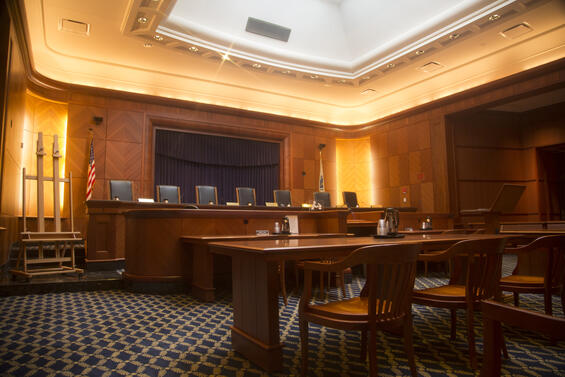
Seven Justice Courtroom, John Adams Courthouse
Contact
Phone
Hours: Mon. - Fri., 8:30 a.m. - 4:30 p.m.
Hours: Mon. - Fri., 8:30 a.m. - 4:30 p.m.
Hours: Mon.-Fri. 8:30 a.m.- 4:30 p.m.