
- Scientific name: Sphenopholis pensylvanica(L.) Hitchcock
- Species of Greatest Conservation Need (MA State Wildlife Action Plan)
- Threatened (MA Endangered Species Act)
Description
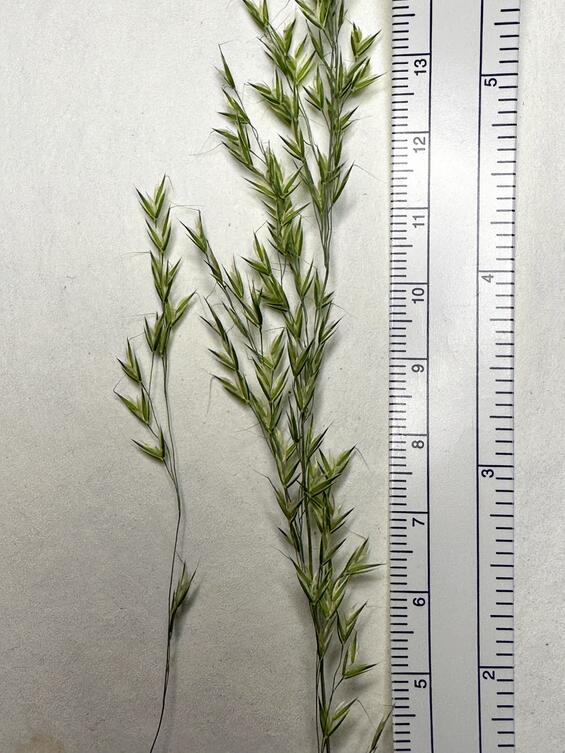
Photo credit: Doug McGrady
Swamp oats, Sphenopholis pensylvanica, is a perennial member of the grass family (Poaceae) found in acidic, springy ground. It has a cespitose (tufted) growth form, reaching 30-120 cm (11.8-47.2 in) tall, with narrow, loosely branched panicles. The scientific name is derived from Greek: spheno, a wedge, and pholis, a scale, describing the obovate, wedge-shape of the second glume (a floral scale at the base of a spikelet).
A technical manual and hand lens or microscope are needed for the identification of this and other grass species. Spikelets are 4.5-9.5 mm (0.18-0.37 in) long with 2 to 3 florets that disarticulate below the glumes. The two glumes differ in size and shape; the lower one is narrower, and the upper one is elliptical to obovate. The florets above the glumes have bifid (2-cleft) lemmas. The upper lemma has a distinct, long awn (3.5-7 mm; 0.14-0.28 in). Leaves are 4-10 cm (1.6-3.9 in) long, narrow (2-8 mm; 0.08-0.31 in), and evenly distributed along the culm (stem).
Swamp oats is the only species of Sphenopholis in Massachusetts that has long awns on the upper lemmas. It can be differentiated from other Sphenopholis species by this characteristic, including prairie-oats (S. obtusata) and slender-oats (S. intermedia), both of which occur in moist habitats. Shining wedgescale (S. nitida; Threatened) is a species of dry, upland habitats that is awnless, or rarely short-awned. A hybrid, S.x pallens (S. pensylvanica x S. obtusata), has awns on the lemmas that are much shorter (0.1–4 mm) than those of swamp oats.
Life cycle and behavior
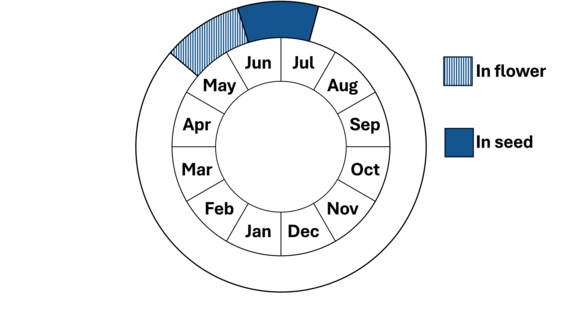
Swamp oats is a perennial tufted grass species and is wind pollinated. It produces flowers in May and will have mature fruit in June to mid-July. This wetland species has awns on its seed that will catch in fur or feathers of passing animals, spreading the seed. In addition, seed that falls near the parent plant is likely spread partially by flowing water.
Population status
Swamp oats is listed under the Massachusetts Endangered Species Act as threatened. All listed species are protected from killing, collecting, possessing, or sale, and from activities that would destroy habitat and thus directly or indirectly cause mortality or disrupt critical behaviors. Swamp oats has been verified in 6 populations since 1999 and currently occurs in Barnstable, Franklin, and Plymouth Counties, with historical records from Bristol, Essex, Hampden, Middlesex, Norfolk, and Nantucket Counties.
Distribution and abundance
Swamp oats occurs in the eastern United States from Massachusetts and New York south to Florida and Louisiana, west to Ohio. It also occurred in one location in eastern Missouri but now is possibly extirpated from that state. It reaches its northeastern range limit in Massachusetts and New York, where it is listed as critically imperiled. It is known from all counties in Connecticut but is possibly extirpated from Rhode Island. It has not been found in Maine, New Hampshire, or Vermont. It is also considered critically imperiled in Kentucky and Mississippi.
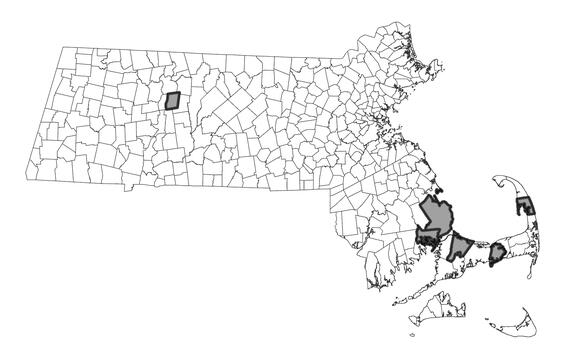
Distribution in Massachusetts. 1999-2024. Based on records in the Natural Heritage Database.
Habitat
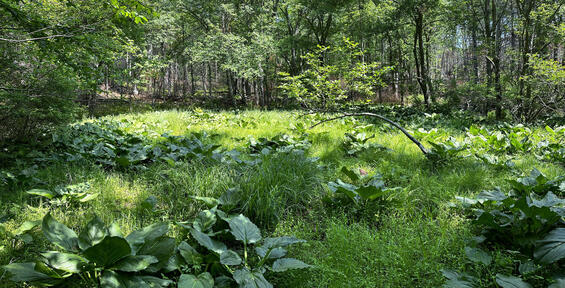
In Massachusetts, swamp oats has been found in acidic, often cool, springy ground and seepage areas in shrubby woodlands, on sphagnum-covered hummocks and logs in red maple swamps, and at the mucky edges of floating sphagnum mats. In these areas, it may be found in part to full sun in small openings such as along streams or springs in wooded areas. The most common associates are red maple (Acer rubrum), sweet pepper-bush (Clethra alnifolia), swamp azalea (Rhododendron viscosum), spicebush (Lindera benzoin), highbush-blueberry (Vaccinium corymbosum), greenbriars (Smilax spp.), skunk cabbage (Symplocarpus foetidus), and Sphagnum mosses (Sphagnum spp.). In coastal areas, swamp oats also may occur in Atlantic white cedar (Chamaecyparis thyoides) bogs.
Healthy habitats are vital for supporting native wildlife and plants. Explore habitats and learn about conservation and restoration in Massachusetts.
Threats
Changes in wetland hydrology should be avoided at sites with known populations of swamp oats. Caution is needed when operating logging or other equipment near known occurrences, as springy seeps associated with woodland brooks may be particularly sensitive to damage. Several invasive species (e.g., common reed, Phragmites australis; multiflora rose, Rosa multiflora; and purple loosestrife, Lythrum salicaria) have been found growing with swamp oats and may shade it out. Climate change may alter wetland hydrology with increased rain events and increased drought events (Staudinger et al. 2024). It is not known how swamp oats will respond to these conditions within its wetland habitats.
Conservation
There are only 6 known current populations of swamp oats in Massachusetts. It is likely that there are so few partially due to a lack of survey effort. This species is often found in shrubby wetlands making passage through the population difficult. However, with so few populations, it is important that it be surveyed regularly and that any potential threats to the populations are noted. Swamp oats is best surveyed in late June to early July when the spikelets are mature.
Within the swamp oats populations, monitoring and control of invasive species may help to reduce competition. If the plants are becoming too shaded even by native species, some cutting may be necessary to keep the habitat more open. All active management of state-listed plant populations (including invasive species removal) is subject to review under the Massachusetts Endangered Species Act and should be planned in close consultation with MassWildlife’s Natural Heritage & Endangered Species Program.
The exact ecological needs of swamp oats are not well understood. It is not known how long seed will remain in the soil in a viable condition, or how plants will respond to long drought conditions. Research is needed to determine whether this plant can be grown in a nursery or garden setting for purposes of reintroductions. Questions about seed germination and seed storage over winter will need to be answered. As sea-level rise may create new habitat while at the same time isolating current populations, this strategy for reintroductions could prove useful to long-term conservation of this species.
References
Britton, N.L., and A. Brown. 1913. An Illustrated Flora of the Northern United States, Canada and the British Possessions. 3 vols. Charles Scribner's Sons, NY.
Fernald, M. L. 1950. Gray’s Manual of Botany, Eighth (Centennial) Edition—Illustrated. American Book Company, New York.
Gleason, H. A., and A. Cronquist. 1991. Manual of Vascular Plants of Northeastern United States and Adjacent Canada, 2nd edition. The New York Botanical Garden, Bronx, NY.
Haines, A. 2011. Flora Novae Angliae – a Manual for the Identification of Native and Naturalized Higher Vascular Plants of New England. New England Wildflower Society, Yale Univ. Press, New Haven, CT.
Hitchcock, Albert Spear. Manual of the grasses of the United States. 1935. USDA Misc. Pub. 200. pp. 278 – 281.
Magee, Dennis W. Grasses of the Northeast. University of Massachusetts Press. Amherst and Boston. 2014, pp. 90 93.
NatureServe. 2025. NatureServe Network Biodiversity Location Data accessed through NatureServe Explorer [web application]. NatureServe, Arlington, Virginia. Available https://explorer.natureserve.org/. Accessed: 3/18/2025.
POWO (2025). "Plants of the World Online. Facilitated by the Royal Botanic Gardens, Kew. Published on the Internet; https://powo.science.kew.org/ Retrieved 3/18/ 2025."
Staudinger, M.D., A.V. Karmalkar, K. Terwilliger, K. Burgio, A. Lubeck, H. Higgins, T. Rice, T.L. Morelli, A. D'Amato. 2024. A regional synthesis of climate data to inform the 2025 State Wildlife Action Plans in the Northeast U.S. DOI Northeast Climate Adaptation Science Center Cooperator Report. 406 p. https://doi.org/10.21429/t352-9q86
Contact
| Date published: | May 8, 2025 |
|---|