
- Scientific name: Rotala ramosior
- Species of Greatest Conservation Need (MA State Wildlife Action Plan)
- Endangered (MA Endangered Species Act)
Description
Toothcup is a small, wetland herb belonging to the loosestrife family and is the only species of the genus Rotala found in the Northeast. This delicate, inconspicuous annual is smooth, diffusely branched, and only 15 cm (6 in) high, with upright stems that become semi-reclining later in the season. The closely spaced, oppositely paired leaves are narrowly lance-shaped or linear, smooth-edged, and taper at the base to short petioles (leafstalks) without stipules (small, leaf-like growths). Leaf dimensions average 1-3 cm (0.4-1.2 in) long and 1-6 mm (up to 0.24 in) broad, but inland and in the west, larger-leaved forms are more common.
In late summer, from the majority of the leaf axils appears a single, tiny (about 2 mm), stalkless (sessile) flower, which blooms for only a brief period, but nevertheless is distinctive. The flower parts are minute and attached to the rim of a hemispherical or squarish floral tube (hypanthium). There are four translucent, crumpled, pinkish white petals, four slightly smaller, tooth-like lobes of the calyx (the outer, commonly green parts of the flower), and between the calyx lobes, four similar but more triangular green appendages. Two bracteoles (small, modified leaves) on opposite sides of the base of the floral tube are also diagnostic of toothcup.
The fruit is a many-seeded, four-chambered capsule, 2-4 mm by 2 mm (0.1 in), enclosed by the floral tube at maturity. In early autumn, the stems and capsules turn bright deep red and are very conspicuous, even long after the leaves have completely dropped. This is when toothcup inventories are most effective.
When not in fruit, toothcup may be easily overlooked due to its small size and inconspicuous appearance. There is, however, only one species in Massachusetts which bears a superficial resemblance to toothcup: Ludwigia palustris (water purslane), which differs by the absence of appendages between the calyx teeth, by fusion of the calyx tube to the ovary, and by much broader, elliptical leaves. Furthermore, water purslane normally grows prostrate.
Life cycle and behavior
This is an annual species.
Population status
Toothcup is listed in Massachusetts as an Endangered species. Massachusetts Natural Heritage & Endangered Species Program database has 15 records from 7 counties across the state, not including Barnstable, Dukes, Plymouth, Suffolk, and Franklin. Six of those records are within the last 25-year period. In some states, it has only recently been discovered for the first time and continued searches for toothcup in new areas throughout its range are expected to uncover new populations. In Massachusetts, on the other hand, historic occurrences of toothcup are well documented, indicating that earlier botanists were aware of its presence and actively searched for it. Recent searches at its historic sites have shown this species to be extirpated from much of its former habitat and other potentially suitable habitats do not seem to support this species, either. In most cases, its decline in Massachusetts is clearly a result of recreational, commercial, and residential development.
Distribution and abundance
Toothcup is found over a wide geographical range that extends from its northeastern limit in Massachusetts, south to Florida and continuing to the West Indies, Central and South America. Inland, it reaches to Minnesota, Arkansas, Oklahoma, and Texas. Another distribution center occurs in the Pacific Northwest from British Columbia to northern Mexico. Toothcup has apparently suffered a decline or was always scarce in the northern part of its range. It is listed as rare by 17 states, including Massachusetts
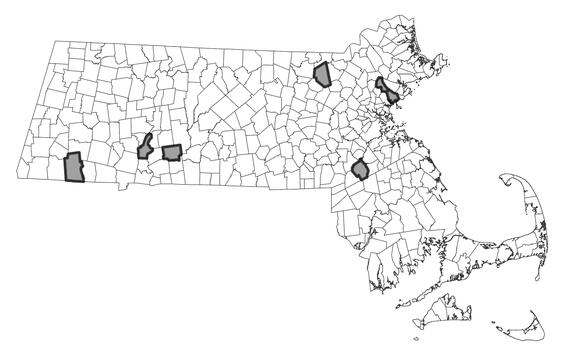
Distribution in Massachusetts
1999-2024
Based on records in the Natural Heritage Database
Habitat
In Massachusetts, toothcup historically occurred on the exposed shores of freshwater lakes and ponds similar to coastal plain ponds. Shorelines of certain water bodies with a low gradient transition from upland to water tend to become exposed during later summer as the water recedes from hot dry summer weather. This can open up a long but very narrow habitat of exposed mud, peat, or sand. The amount of exposure varies considerably from year to year.
At one of its six Massachusetts sites, it is abundant at natural ponds and pondlets dissected by dikes and maintained as a water supply. The plants are interspersed among gravel or cobblestones in the sandy to peaty substrate of the mid-shore zone where it experiences changing water levels from seasonal flooding. This may indicate that at some stage of its life cycle, it requires a draw-down of the water table to dry out the substrate.
Associated with toothcup are Coleataenia rigidula (stiff panic-grass), Agrostis scabra (ticklegrass), Leerzia oryzoides (rice cutgrass), Fimbristylis autumnalis (autumn fimbry), Juncus pelocarpus (pondshore rush), Cyperus dentatus (bulblet umbrella-sedge), Lindernia dubia (false pimpernel), and Hemicarpha micrantha, a rare sedge. Many of these are coastal plain pond shore species. In other states, habitat for toothcup is more varied: moist meadows and weedy fields; wet open swales, pools, ditches, and tanks; and in Michigan, dried-out, recently burned-over marshes.
Healthy habitats are vital for supporting native wildlife and plants. Explore habitats and learn about conservation and restoration in Massachusetts.
Threats
As for many rare species, exact needs for management of toothcup are not known. Because this species grows on narrow shorelines, any alteration of hydrological conditions, water quality, or erosion and sedimentation rates could impact extant populations. Competition from invasive species such as gray willow and purple loosestrife may also reduce theavailable habitat of toothcup. Exposed shorelines may become heavily used by all-terrain vehicles which can destroy most herbaceous plant life on pond edges. Trampling by hikes and dog walkers may also impact vegetation, as well as mechanical or non-specific chemical controls of invasive species.
Conservation
Survey and monitoring
Due to its short stature and similarity to a more common shoreline species, as well as very late summer phenology, it very likely this species is under-surveyed. Surveys of past known locations and new potential sites are needed. The best time to survey for it is when it is in fruit from early July through very early August.
Management
As exposed shorelines are essential for this species, maintenance or restoration of the hydrologic regime is essential. Hand-pulling of invasive species is recommended around populations of rare species. Limiting and shoreline disturbance by hikers or all-terrain vehicles is important. All active management of rare plant populations (including invasive species removal) is subject to review under the Massachusetts Endangered Species Act and should be planned in close consultation with the MassWildlife’s Natural Heritage & Endangered Species Program.
Research needs
The exact ecological needs of this species are not well understood. As this plant is under-surveyed, standard information is needed such as lists of associated species, comments on water and habitat quality and threats, and assessments of soil conditions and phenology. Research is needed to determine whether this plant can be grown in a greenhouse or garden setting for purposes of reintroductions. If habitat degradation accelerates losses of current populations, this strategy could prove useful to long-term conservation of this species.
Contact
| Date published: | May 8, 2025 |
|---|