
- Scientific name: Juncus biflorus Elliott
- Species of Greatest Conservation Need (MA State Wildlife Action Plan)
- Threatened (MA Endangered Species Act)
Description
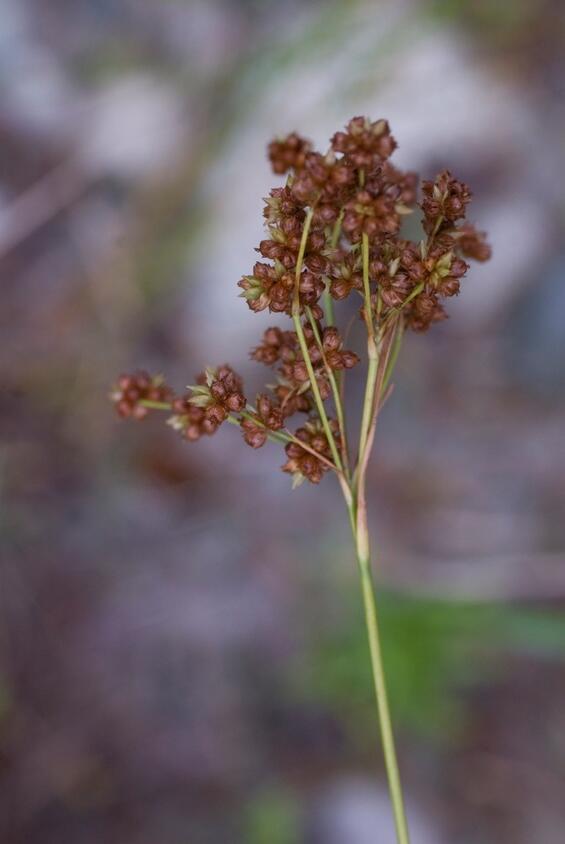
Two-flowered rush. Image credit: Louise Barteau
Two-flowered rush, Juncus biflorus, is a grass-line, perennial herb in the rush family (Juncaceae). It ranges in height from 0.5-1.2 m (1.5-3.5 ft).The stout, round stems thicken at the base and are attached to short thick rhizomes (underground stems). Stems arise singly from the rhizome, close to one another, but not in dense clusters. Unlike many rushes, this species has flat leaf blades, which are 4-6 mm (0.25 in) wide, with 5 veins.
To identify two-flowered rush and other members of the genus Juncus, a technical manual should be consulted. Rushes in the genus Juncus are distinguished by their small brown or green flowers, which have six tepals (three sepals and three petals that all look alike). They are also characterized by having dry fruit (a capsule) that splits open along three sutures. The two-flowered rush belongs to a group of rushes which have flat leaf blades and flowers borne in small clusters (glomerules) at the top of their stems.
Other characters to use to identify two-flowered rush include a pair of small bracts at the base of the flower clusters or glomerules. These small bracts are ovate with a sharp tip, compared to those on grass-leaved rush, a more common related species, which has lanceolate bracts which taper gradually to a sharp tip. The seed capsule is sub-globose (a little longer than it is around) and is often flecked with red.
Members of this genus are difficult to distinguish from one another, and the two-flowered rush superficially resembles other rushes. This species was previously considered to be a variant of a common species, grass-leaved rush (Juncus marginatus). In 2008, research by Knapp and Naczi indicated that it is a separate species. This species is larger all around compared to grass-leaved rush. It is taller and has wider leaves (See comparison table below). Several flowering stems can arise from the same rhizome of two-flowered rush.
| Characteristic | Two-flowered rush (Juncus biflorus) | Grass-leaved rush (Juncus marginatus) |
|---|---|---|
| Leaves flat, width | 2.6 to 5.4 mm (0.10 to 0.21 in) – (5 veins) | 1.3 to 3.5 mm (0.05 to 0.14 in) – (3 veins) |
| # of glomerules | 20 to 200 | 2 to 30 |
| Lowest leaf sheath length | 32 to 97 mm (1.26 to 3.82 in) | 17 to 47 mm (0.67 to 1.85 in) |
| Plant height | 27.2 to 100 cm (10.71 to 39.37 in) | 19.2 to 56.8 cm (7.56 to 22.36 in) |
| Anthers | exerted beyond tepals | concealed by tepals |
| Width at base of stem | 3.4 to 12 mm (0.13 to 0.47 in) | 0.4 to 6 mm (0.02 to 0.24 in) |
Life cycle and behavior
This is a perennial species.

Population status
Two-flowered rush is listedunder the Massachusetts Endangered Species Act as threatened. All listed species are protected from killing, collecting, possessing, or sale, and from activities that would destroy habitat and thus directly or indirectly cause mortality or disrupt critical behaviors. In Massachusetts, two-flowered rush is found only in the southeast in Barnstable and Nantucket Counties. It has not been observed in Dukes (Martha’s Vineyard), Bristol, or Plymouth counties and additional surveys are needed.
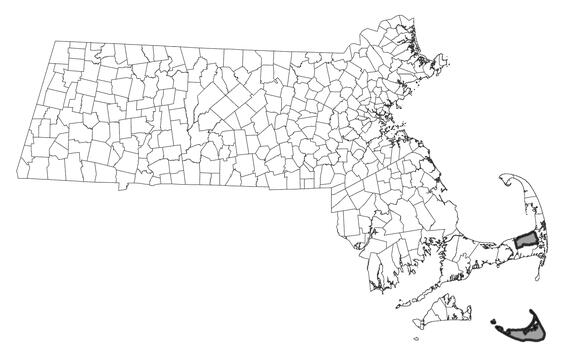
Distribution in Massachusetts
1999-2024
Based on records in the Natural Heritage Database
Distribution and abundance
Massachusetts is the only state in New England with two-flowered rush, where the species reaches its northeastern extent. It extends south to Florida and west to Texas and Missouri, and northwest to Ontario.
Habitat
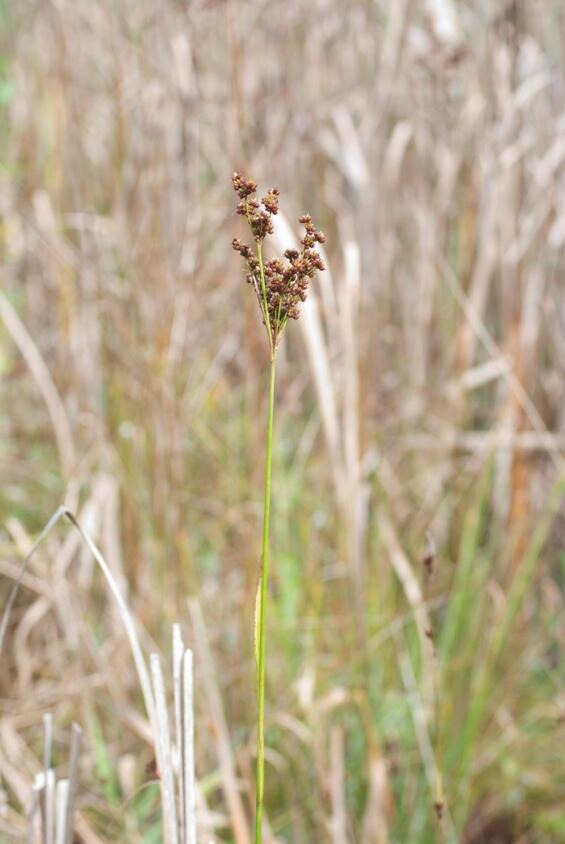
Two-flowered rush. Image credit: Louise Barteau
Two-flowered rush is found in association with coastal plain pondshores and abandoned cranberry bogs. It is currently known only in Barnstable and Nantucket counties. The plants require the fluctuating water levels, such as in coastal plain ponds, to maintain their habitat sufficiently open. The preferred substrate is often wet peaty soil but often includes sand as well. Plants in this habitat often grow more vigorously during years when water levels are lower. Several years with high water may depress the population.
Associated species include those typical of coastal plain pondshore communities, including: Canada rush (Juncus canadensis), soft rush (J. effusus), sallow sedge (Carex lurida), northern meadow-beauty (Rhexia virginica), woolgrass (Scirpus cyperinus), Sphagnum spp., Canada bluejoint grass (Calamagrostis canadensis), slender-leaved flat-topped goldenrod (Euthamia caroliniana), swamp-candles (Lysimachia terrestris), devil’s pitchforks (Bidens frondosa), boneset (Eupatorium perfoliatum), and poison ivy (Toxicodendron radicans).
This species has also been observed in association with other rare plant species, including redroot (Lachnanthes caroliniana), Wright’s panic-grass (Dichanthelium wrightianum), plymouth gentian (Sabatia kennedyana), terete arrowhead (Sagittaria teres), long-beaked beaksedge (Rhynchospora scirpoides), pondshore knotweed (Persicaria puritanorum) and maryland meadow-beauty (Rhexia mariana). Watch-listed coastal plain pondshore plant species may also occur with two-flowered rush.
Healthy habitats are vital for supporting native wildlife and plants. Explore habitats and learn about conservation and restoration in Massachusetts.
Threats
Potential threats for all coastal plain pond plant species include potential destruction by anthropogenic activities: trampling, altering the hydrology of the ponds, addition of non-native species to the pond, etc. Another threat is the growth of dense shrubs and trees to the edge of the water, shading out potential habitat for the herbaceous coastal plain pond species such as two-flowered rush. These may include native species such as tupelo (Nyssa sylvatica), highbush blueberry (Vaccinium corymbosum), northern arrowwood (Viburnum dentatum), sweet pepperbush (Clethra alnifolia), water-willow (Decodon verticillatus), common greenbrier (Smilax rotundifolia), and smooth alder (Alnus serrulata). Invasive plants are also a concern, particularly gray willow (Salix cinerea), which tolerates high water for long periods, and glossy buckthorn (Frangula alnus), multiflora rose (Rosa multiflora), common reed (Phragmites australis), and cattails (Typha spp.) Climate change and wide swings in the water levels of coastal plain ponds may depress or eliminate populations.
Conservation
The exact ecological needs of two-flowered rush are not known. All active management of rare plant populations (including invasive species removal) is subject to review under the Massachusetts Endangered Species Act and should be planned in close consultation with MassWildlife’s Natural Heritage and Endangered Species Program.
Contact
| Date published: | April 25, 2025 |
|---|