
- Scientific name: Eleocharis diandra
- Species of Greatest Conservation Need (MA State Wildlife Action Plan)
- Endangered (MA Endangered Species Act)
Description
Wright's spike-sedge is a densely tufted annual member of the sedge family (Cyperaceae), one of several short (2-25 cm [0.8-9.8 in]), annual Eleocharis species in New England. Wright’s spike-sedge has plump terminal spikelets with achenes that have short triangular caps (tubercles). This species emerges in the summer along the shores of large lakes and rivers after the spring floods recede.
The slender, soft stems are 0.3-1 mm (0.01-0.04 in) wide and often spreading or reclining. The leaf sheaths are pointed and sometimes toothed. The spikelets are ovoid, 2-7 mm (0.08-0.28 in) long, and many-flowered. Flower scales are orange to purple-brown, acute, and 1-1.5 mm (0.04-0.06 in) wide x 8 mm (0.31 in) long. Achenes (nutlets) are lens-shaped (obovoid) and 0.7-1.0 mm (0.03-0.04 in) long, with a short triangular tubercle. The achenes typically lack perianth bristles.
A technical manual should be consulted to identify Eleocharis species. Wright's spike-sedge, ovate spike-sedge (E. ovata) and bay spike-sedge (E. aestuum) are similar, all having ovoid spikelets. They can be distinguished by examining the floral scales, perianth bristles, and tubercles. The tips of the floral scales are rounded in E. aestuum andacute in the other two species. Both E. diandra and E. aestuum lack (or have reduced) perianth bristles, whereas E. ovata has bristles that typically exceed the length of the achene. The three species also have differing tubercle heights: E. ovata has the tallest tubercle (0.3-0.5 mm [0.01-0.02 in]), followed by E. aestuum (0.2-0.3 mm [~0.01 in]) and E. diandra (0.1-0.2 mm). While E. ovata occurs in a wide range of wetland types, E. diandra is found in non-tidal (or minimally tidal) habitats, and E. aestuum typically occurs along fresh-tidal shorelines.
Life cycle and behavior
This is an annual sedge.
Population status
Wright's spike-sedge is listed under the Massachusetts Endangered Species Act as endangered. All listed species are protected from killing, collecting, possessing, or sale, and from activities that would destroy habitat and thus directly or indirectly cause mortality or disrupt critical behaviors. The MassWildlife’s Natural Heritage & Endangered Species Program database has 2 records from 2 counties: Franklin and Hampshire. Both records have been observed within the last 25 years.
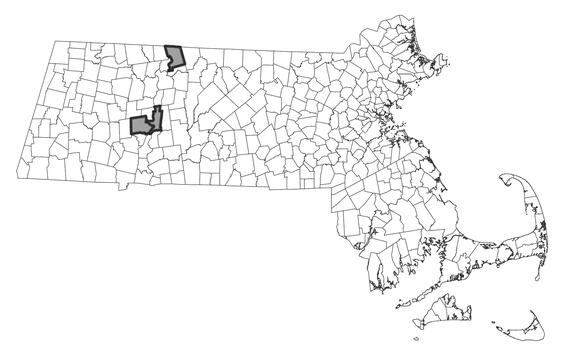
Distribution in Massachusetts. 1999-2024. Based on records in the Natural Heritage Database.
Distribution and abundance
Wright's spike-sedge has a limited range: it occurs from southern New York north to Ontario and Quebec. It has also been reported from Pennsylvania and New Jersey.
Habitat
Wright's spike-sedge is found along gently sloping freshwater shorelines and marshes. It commonly occurs in disturbed, saturated soils of river edges, often in small depressions. It is typically found in the zone along the water’s edge that undergoes spring flooding and is exposed in the summer. Associated species includewater purslane (Ludwigia palustris), rushes (Juncus spp.), sandbar-lovegrass (Eragrostis hypnoides), purple loosestrife (Lythrum salicaria), blunt spike-sedge (Eleocharis obtusa), and slender flatsedge (Cyperus bipartitus).
Healthy habitats are vital for supporting native wildlife and plants. Explore habitats and learn about conservation and restoration in Massachusetts.
Threats
One of the major threats to extant populations of Wright's spike-sedge is trampling by recreational users of shoreline habitat, including walkers, anglers, dogs, and occasional off-road vehicles. Populations should be monitored, and recreational use re-directed where trampling is likely. Wright's spike-sedge may also be threatened by shading of open shoreline habitat by woody species. Invasive species are present in some locations and should be monitored but may not pose an immediate threat because of periodic inundation of the habitat. Changes to water regimes could drastically alter the habitat for Wright's spike-sedge, and care should be taken to maintain hydrological conditions at documented populations. All active management of rare plant populations (including invasive species removal) is subject to review under the Massachusetts Endangered Species Act and should be planned in close consultation with MassWildlife’s Natural Heritage & Endangered Species Program.
References
Haines, A. 2001. Eleocharis aestuum (Cyperaceae), a new tidal river shore spikesedge of the Eastern United States. Novon 11: 45-49.
Haines, A. 2011. Flora Novae Angliae – a Manual for the Identification of Native and Naturalized Higher Vascular Plants of New England. New England Wildflower Society, Yale Univ. Press, New Haven, CT.
NatureServe. 2009. NatureServe Explorer: An online encyclopedia of life [web application]. Version 7.1. NatureServe, Arlington, VA.
Contact
| Date published: | May 7, 2025 |
|---|