
- Executive Office of Energy and Environmental Affairs
- Drought Management Task Force
Media Contact
Aisha Revolus, Communications Manager
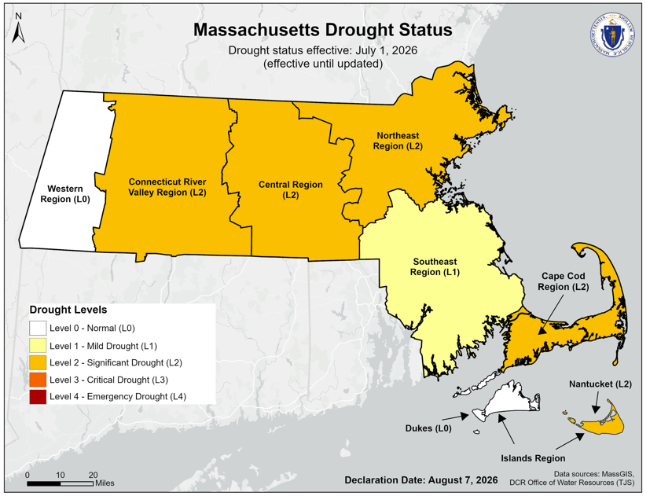
Boston — Today, Energy and Environmental Affairs (EEA) Secretary Rebecca Tepper declared the Western Region and Dukes County have returned to normal conditions after above-average rainfall in July improved drought conditions across much of Massachusetts.
The following regions remain in drought:
- Level 2 – Significant Drought: Cape Cod, Central, Connecticut River Valley, and Northeast, as well as Nantucket County
- Level 1 – Mild Drought: Southeast
“The rain we’ve seen over the past several weeks is a welcome relief, and it’s encouraging to see conditions improving in parts of the state. But it will take more precipitation to recover from two years of dry conditions,” said Secretary Tepper. “We all have a role to play, and continuing to conserve water will help protect our water supplies.”
Massachusetts received between 4.5 and nearly 9.5 inches of rain during July, with most of the state receiving more rain than is typical for the month. The rainfall helped replenish rivers, streams, and soil. Even with that improvement, drought conditions remain in parts of the state because groundwater, which supplies wells, rivers, and wetlands, recovers more slowly than rainfall. The greatest long-term precipitation deficits remain in eastern Massachusetts, particularly Nantucket, where groundwater levels continue to be well below normal despite recent rain.
The Drought Management Task Force will continue monitoring conditions over the coming weeks to determine whether the recent rain will lead to lasting improvements.
As outlined in the Massachusetts Drought Management Plan, communities in Level 2 – Significant Drought and Level 1 – Mild Drought should continue taking steps to conserve water. Although the Massachusetts Water Resources Authority’s (MWRA) water supply system is not currently experiencing drought conditions, it’s still important for residents and businesses served by the MWRA to conserve water.
State agencies continue coordinating drought response efforts with federal and local partners, including municipal officials and local Boards of Health (BOH). Massachusetts Department of Environmental Protection (MassDEP) is providing technical assistance and outreach to communities affected by drought conditions.
Residents are encouraged to report dry environmental conditions and upload photos through the Massachusetts Water Impact Reporter to help the state monitor drought impacts in real time. Private well owners experiencing problems such as dry wells should contact their local BOH, which is also asked to report local well conditions to the state.
Additional information, including drought FAQs, water conservation guidance, and resources for private well owners, is available online.
Below are actions communities and individuals living and working within Level 2 – Significant Drought and Level 1 – Mild Drought Regions can take, including those utilizing a private well. Residents and businesses are strongly encouraged to check with their local water system for any additional restrictions, as some communities may face more severe local water supply conditions.
For Regions in Level 2 – Significant Drought
Residents and Businesses:
- Minimize overall water use;
- Follow local water use restrictions;
- Fix indoor leaks, such as from toilets, faucets, and showers, which result in more than 60 percent of indoor use; and,
- For larger buildings and businesses, conduct water audits to identify areas of leaks and potential water conservation opportunities.
Immediate Steps for Local Governments:
- Limit or prohibit washing of hard surfaces (sidewalks, patios, driveways, siding), personal vehicle or boat washing; and,
- Establish water-use reduction targets for all water users, identify top water users and conduct targeted outreach to help curb their use.
Short- and Medium-Term Steps for Local Governments:
- Establish a year-round water conservation program that includes public education and communication, taking advantage of the state’s library of outreach materials;
- Provide timely information to local residents and businesses;
- Implement or establish drought surcharge or seasonal water rates;
- Check emergency inter-connections for water supply; and,
- Develop or refine a local drought management plan using guidance outlined in the state Drought Management Plan.
For Regions in Level 1 – Mild Drought
Residents and Businesses:
- Minimize overall water use;
- Limit outdoor watering to one day per week from 5:00 p.m. to 9:00 a.m., or less frequently if required by your water supplier;
- Plant only local and drought-resistant species;
- Fix indoor leaks, such as from toilets, faucets, and showers, which result in more than 60 percent of indoor use;
- For larger buildings and businesses, conduct water audits to identify areas of leaks and potential water conservation opportunities;
- Minimize lawn sizes; and,
- Consider installing a rain barrel to harvest rainwater for outdoor watering.
Communities/Municipalities:
- Establish a year-round water conservation program that includes public education and communication, taking advantage of the state’s library of outreach materials;
- Provide timely drought and water conservation information to residents and businesses;
- Check emergency inter-connections for water supply; and,
- Develop or refine a local drought management plan using guidance outlined in the state Drought Management Plan.
The DMTF will meet again on Thursday, August 20 at 10:00 AM. For further information on water conservation and what residents can do, visit the EEA’s drought and water conservation pages.
###
