
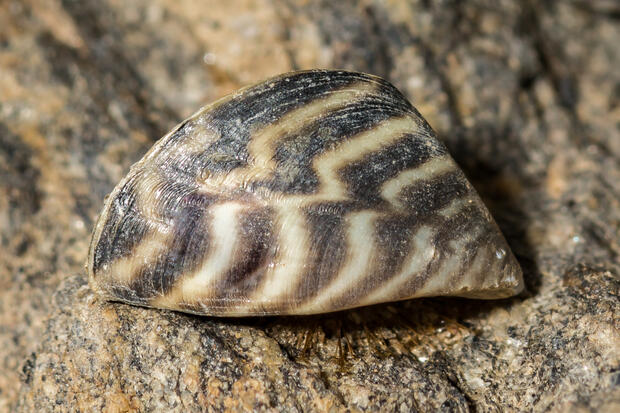
Description and Physical Characteristics
Zebra mussels are approximately 0.5 to 1.5 inches in length and have a traditional mussel ‘D’ shaped shell. Their shells have a flat bottom that allows them to sit flush with a solid surface. Unlike most freshwater mussels, zebra mussels grow in groups that contain numerous individuals. They get their name for the striped pattern of their shell; however, those patterns can vary significantly from having stripes or not, to being dark or light colored. In their larval stage, they are microscopic and known as veligers. Zebra mussels are filter feeders, and each individual can filter between 1-2 liters of water per day for feeding and respiration purposes.
Habitat
Zebra mussels are the only freshwater mollusk that can attach to solid objects, including rocks, logs, docks, boats and various water intake infrastructure and instruments. Younger zebra mussels will even grow on top of older zebra mussels. They are usually found in lakes, ponds, embayment’s and rivers. Ludyanskiy et al. (1993) reported that zebra mussels prefer water with salinity below 4 parts per thousand, summer water temperatures between 17-23°C, pH levels between 7.4 and 9.0, dissolved oxygen from 8-10 ppm, turbidity levels of 40-200 NTU, and a calcium concentration from 20-125 ppm. They can survive a range of environmental conditions, although pH and calcium concentration appear to limit the reproductive capacity of a population.
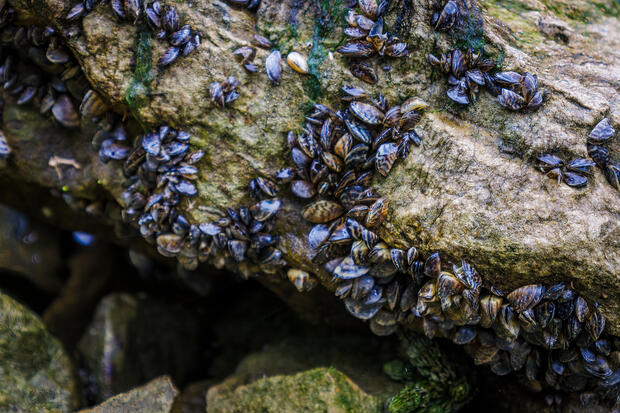
Distribution
Within Massachusetts, zebra mussels are well established within Laurel Lake (Lee and Lenox), Laurel Brook (the outlet stream from Laurel Lake) and the Housatonic River downstream from the Laurel Brook confluence. An individual live zebra mussel has previously been found in Onota Lake (Pittsfield) and environmental DNA (eDNA) for zebra mussels have been positively detected in Onota Lake, Pontoosuc Lake (Pittsfield and Lanesborough) and Lake Buel (Monterey).
Nearby, zebra mussels are present in western Connecticut, throughout New York, and in a few Vermont waterbodies. A list of New York waterbodies infested with zebra mussels can be found on the New York State iMapInvasives Waterbody Lookup Tool.
For zebra mussel distribution across the US, please visit the USGS interactive web map viewer for zebra mussel observations.
Zebra mussels have a high probability of spreading. Juvenile and adult mussels are transported by waterfowl and aquatic organisms that serve as suitable attachment hosts, such as turtles and crayfish. Eggs and swimming larvae (veligers) can be transported by water flow or in bait buckets, live wells, engine cooling water, scuba diving equipment, and by any transfer of water from an infested waterbody. There are few natural predators of the zebra mussel such as drum, yellow perch, sturgeon, crayfish and various diving ducks.
Life Span and Reproduction
Zebra mussels have short life spans, living between two to five years, and begin reproducing at age two. Optimal conditions for spawning occur when the water warms above 12°C. Female zebra mussels are very fecund and may produce over 30,000 eggs per reproductive cycle, translating to more than one million eggs per spawning season. Larvae, or veligers, are planktonic and eventually settle and attach to the bottom or hard substrate they land on.
Impacts
Zebra mussels are capable of environmental, ecological, economic, and recreational impacts when present within a waterbody. Because zebra mussels form such dense, populated colonies of growth, they often can prevent native mussels from feeding, reproducing or moving as needed. Zebra mussels’ fast reproductive cycle allows them to quickly infest a waterbody. Large populations can also quickly filter the water, which can cause changes in water quality. Their ability to filter large amounts of water increases clarity and thus increases the depth to which sunlight can penetrate for availability to aquatic plants. This available sunlight typically causes aquatic plant growth at deeper depths than before zebra mussels were present.
Economically, zebra mussels have a direct impact. These impacts are primarily related to the blocking of pipes and other infrastructure in facilities that draw water from infested lakes, such as water treatment plants, power plants, and others. The pipes and other infrastructure are the perfect habitat for zebra mussels as they have a hard surface to attach to, they are likely protected from potential natural impacts and provide a constant food supply with their continual water flow.
Recreationally, zebra mussels can attach to boat bottoms, docks, retaining walls, buoys, and boat engines (sometimes blocking cooling water intakes), all of which can limit potential users from enjoying the waterbody. Further, shoreline swimming areas can become dangerous when sharp opened zebra mussel shells wash up on shore. These areas can also have foul odors present from the mussels decomposing. These recreational impacts can subsequently cause economic impacts if a waterbody has visiting users frequently.
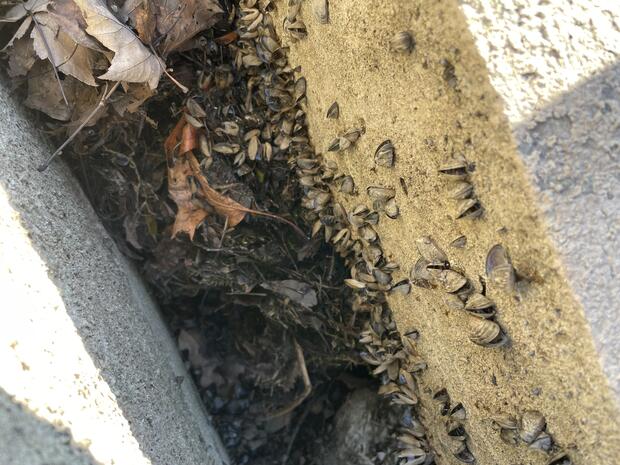
Management Methods
Once established, zebra mussels are difficult to eradicate. Preventing the introduction of zebra mussels is worth the effort to protect a waterbody. Below are potential control measures, however, these vary with the circumstances of each specific infestation site. There are also additional control measures that are more suitable for commercial and industrial applications but are not necessarily appropriate for use in a waterbody. Please note that all the measures listed below require coordination and possible permitting through the town conservation commission and MassDEP.
- Drawdown and exposure
- If the infestation is within a waterbody with water level control capability, drawdown may be a viable control technique. Removing all water from a lake or pond and allowing it to dry may eliminate the zebra mussel infestation; however, this technique involves many technical and biological challenges. A drawdown of the lake or pond could result in the eradication of many desirable plant and fish species. An effort could be made to capture and relocate desirable species, but this would be an expensive and lengthy undertaking. Waterbodies that are spring fed may be difficult to keep dry and the mussels may survive. The water would have to be filtered or otherwise treated to ensure no small eggs or larvae escape. Alternatively, it may be possible to hold the water in a separate basin or to dispose of the water in a way that limits risk of zebra mussel transfer (e.g., ground water infiltration). All these approaches are likely to be time consuming and expensive, if even practical.
- Physical removal
- Physical removal of the mussels using manual scraping and hand removal can be used on a small scale with success but are not likely to be successful for large infestations. If the infestation is believed to be limited to a few individuals or even a few patches of mussels, physical removal may be successful in removing the target organisms. Even with a few individuals, however, it may be difficult to determine if the eradication was 100% successful. One advantage of physical removal is minimal impact on native and desirable species, as these methodologies are localized and can be somewhat selective.
- Chemical application
- Industries and public utilities that experience problems due to zebra mussel biofouling may use chemicals to clear the fouling. Chlorine and various pesticides are effective and can be used with limited risk inside those facilities. However, the potential negative effects of chlorine and other chemicals on the aquatic environment may be great if applied in open water. Copper has a long history of antifouling properties in aquatic environments and has been shown to have relatively high toxicity to invasive mussels. Research has shown several copper-containing compounds typically used for algae and weed control have molluscicidal properties, such as EarthTec QZ. Additionally, there is a biopesticide (a type of pesticide derived from natural materials such as animals, plants, bacteria and certain minerals) that is registered for use on mussels, which is Zequanox.
If you believe you have found or observed a zebra mussel in a Massachusetts waterbody, immediately contact the DCR Lakes & Ponds Program by emailing dcr.lakesandponds@mass.gov with more information.
If you are looking for zebra mussel management guidance, please contact contact the DCR Lakes & Ponds Program by emailing dcr.lakesandponds@mass.gov.
Prevent the Spread!
Best practice is to always clean, drain and dry any equipment that has come into contact with lake or pond water during use. Following these three easy steps allows you to do your part in preventing the spread of aquatic invasive species. For more information on how to appropriately decontaminate your equipment, please visit our spread prevention webpage to learn more.
If you are a waterfront homeowner, and know your waterbody has the correct water quality parameters to be capable of potentially supporting a zebra mussel infestation, you can do your part to help! If you have a boat, dock, or other semi-permanent structure that you remove from the water each fall, consider conducting a thorough inspection of everything removed to ensure there are no zebra mussels attached anywhere. If you believe you have identified a zebra mussel, take photos and email them to the DCR Lakes & Ponds Program at dcr.lakesandponds@mass.gov. Do not try to remove any attached zebra mussels unless your structure has been fully removed from the water.
Other Resources About this Species
Summary of Phased Zebra Mussel Assessments across Massachusetts