

The Department of Unemployment Assistance (DUA), which falls under the Executive Office of Labor and Workforce Development (EOLWD), is responsible for administering the Commonwealth’s unemployment insurance (UI) program. DUA provides eligible individuals with temporary income assistance while they search for new employment. DUA also determines and collects employer contributions to UI, processes claims for UI, establishes UI eligibility, collects contributions to help fund certain health insurance programs in the Commonwealth,1 and provides resources and reemployment services to claimants through the MassHire Department of Career Services’ Career Centers2 to aid in their job search.
DUA’s main office is located at 100 Cambridge Street in Boston. DUA also has four regional offices in Boston, Brockton, Lawrence, and Springfield. The Boston regional office, located at 2 Avenue de Lafayette, is called the Boston Re-Employment Center and offers in-person meeting hours (available by appointment only). The other three regional offices do not offer in-person meeting services. DUA told us that it had approximately 570 employees during the audit period.
Federal and State UI Programs
The federal Social Security Act of 1935 created the UI program as a joint federal-state partnership, with each state responsible for designing its own program within broad federal guidelines. The US Department of Labor oversees the federal UI program, and each state administers its own program. In 1937, Congress passed the Federal Unemployment Tax Act, which authorized the Internal Revenue Service to collect an annual federal employer tax that is used to fund state workforce agencies and cover the costs of administering the UI program in all states. The federal government sets broad guidelines for coverage and eligibility, but states vary in how they determine eligibility. Within these federal constraints, individual states are allowed to establish their own UI payment requirements for employers and run their own programs.
Federal and Massachusetts Budget and Expenditures
Table 1 outlines the federal and Commonwealth UI fund expenditures for fiscal years 2023 and 2024, according to Massachusetts Statewide Single Audit Reports.3
Table 1. Commonwealth and Federal UI Expenditures
| Funds | 2023 | 2024 |
|---|---|---|
| Commonwealth UI Funds—Benefits | $1,743,540,616 | $2,104,820,336 |
| Federal UI Funds—Benefits | 7,362,637 | 6,336,737 |
| Federal UI Funds—Administration | 72,969,007 | 47,128,592 |
| COVID-19 Federal UI Funds—Benefits | 21,038,160 | 1,726,797 |
| COVID-19 Federal UI Funds—Administration | 3,898,026 | 2,993,301 |
| Total Expenditures | $1,848,808,446 | $2,163,005,763 |
DUA received federal appropriations of approximately $66 million in fiscal year 2023 and $46 million in fiscal year 2024. These appropriations were separate from the federal UI funds reported in Table 1.
Massachusetts UI Law
The Massachusetts UI law (Chapter 151A of the Massachusetts General Laws) governs all aspects of the Commonwealth’s UI program, including the following:
- employer contribution requirements and applicable contribution rates;
- liability and payment obligations for nonprofit organizations and public employers;
- filing requirements and collection of overdue payments;
- unemployment benefit claims, including eligibility, payment, and appeals;
- recordkeeping and reporting requirements;
- the establishment, powers, and duties of a state advisory council;
- the write-off of uncollectible amounts; and
- jurisdiction for actions to enforce the law.
Employer Contributions
According to DUA’s website, most employers in Massachusetts must pay UI contributions if they employ one or more individuals on a permanent, temporary, or part-time basis on one or more days in any 13 weeks during a calendar year, or if the employer pays wages totaling at least $1,500 in any calendar quarter. Employers of agricultural workers must pay UI contributions if they employ 10 or more individuals on any day during any 20 weeks in a calendar year, or if they pay wages of $40,000 or more in any calendar quarter.
Unemployment Insurance Trust Fund
According to Section 904(a) of the Social Security Act of 1935, the US Secretary of the Treasury receives UI funds from states and holds these funds in the federal Unemployment Trust Fund. These funds are collected and deposited by states and are derived from employer contributions under the Federal Unemployment Tax Act and the State Unemployment Tax Act. In Massachusetts, these contributions are collected in the Unemployment Insurance Trust Fund. This fund is used to pay Commonwealth UI benefits, while DUA’s administrative costs are paid through Federal Unemployment Tax Act contributions.
Employers in Massachusetts make contributions to the Unemployment Insurance Trust Fund. DUA calculates each employer’s contribution rate based on factors such as whether the employer is new4 or established, the employer’s account balance and activity over the previous 12 months, employee wages, and more. The types of contributions an employer makes depend on what kind of organization it is.
- Private, for-profit employers must make quarterly contributions to the Unemployment Insurance Trust Fund.
- Public and nonprofit employers may choose to either make quarterly contributions to the Unemployment Insurance Trust Fund or reimburse DUA for the full amount of UI benefits paid to their former employees. If these employers choose to reimburse DUA, then DUA sends the employer a bill for any month in which there were charges to the employer’s account from UI benefit claims made by any of the employer’s former employees.
UI Eligibility and Benefits
According to DUA’s website, individuals may apply for UI benefits if they meet all of the following monetary and nonmonetary eligibility requirements:
- Monetary
- The individual earned income in Massachusetts.
- The individual earned at least $6,300 in the past 12 months.
- Nonmonetary
- The individual either lost their job or their working hours have been significantly reduced through no fault of their own.
- The individual is authorized to work in the United States.
- The individual is able to work, available for work, and actively looking for work.
The Commonwealth provides a maximum weekly unemployment benefit of $1,105 for up to 30 weeks. Actual benefit amounts are based on an individual’s wages earned during the previous fiscal year.
Claimants may receive unemployment benefits while working or receiving income from self-employment, part-time employment, severance pay, vacation pay, sick leave, or pensions. However, benefit amounts may vary based on these sources of income; therefore, individuals must report all such income to DUA when filing an initial claim and when submitting continued claims (which are weekly certifications for benefits).
Ability to Work, Availability, and Active Job Searching
According to DUA’s website, to remain eligible for unemployment benefits, individuals must file weekly claims and certify that they are able to work, available for work, and actively seeking employment. Claimants are required to provide proof of at least three work search activities each week and disclose any changes in income, work status, ability to work, or availability to work.
Examples of eligible work search activities include the following:
- submitting an application, résumé, or letter of interest to an employer through the employer’s website or separately through an employment website, such as Indeed or the MassHire Department of Career Services’ website;
- making in-person visits with employers that might be hiring;
- attending a privately sponsored or a MassHire Department of Career Services’ Career Center–sponsored job fair, networking event, or employment workshop;
- interviewing with potential employers in person, by telephone, or online; or
- registering for work with private employment agencies or placement services.
There are cases where a claimant may not be eligible for a week of UI benefits, such as if a claimant certifies that they did not actively search for work; a claimant had earnings over their benefit rate;5 or a claimant refuses an offer of suitable work. Claimants may also be required to register with and participate in services offered by the MassHire Department of Career Services.
UI Claims Processing
According to DUA’s website, claimants can file unemployment claims online, by telephone, or in person (by appointment). Multilingual services and reasonable accommodations for accessibility are available upon request.
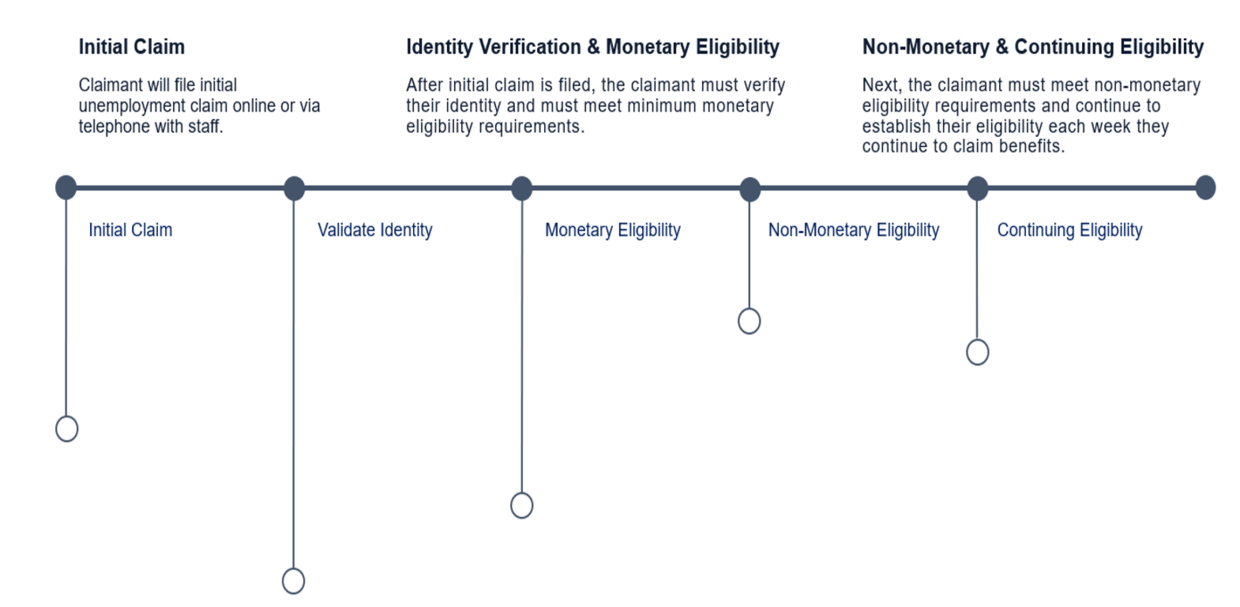
Claimants must verify their identity and meet minimum monetary eligibility requirements after filing a claim to establish their initial eligibility. Next, the claimant must meet nonmonetary eligibility requirements and certify eligibility each week they claim benefits. A DUA claims adjudicator may need to review separation information gathered from both the claimant and the employer to determine nonmonetary eligibility.
If DUA denies a claim at any stage of the eligibility process, then the claimant can appeal the decision. The claimant must file their appeal within 10 days of the denial. After DUA receives an appeal, it schedules a hearing. Claimants can request a hearing through DUA’s online portal6 or by mail.
If DUA approves a claim, then the claimant must continue to be able to work, be available to work, and be actively searching for work in order to maintain their UI eligibility.
Figure 1 outlines the roadmap for processing DUA UI claims, while Figure 2 shows the number of DUA claims that were approved, denied, and paid during the audit period.
Figure 1. Unemployment Claim Roadmap
Source: DUA management
Figure 2. Total Number of DUA Claims Approved, Denied, and Paid During Fiscal Years 2023 and 2024 Combined
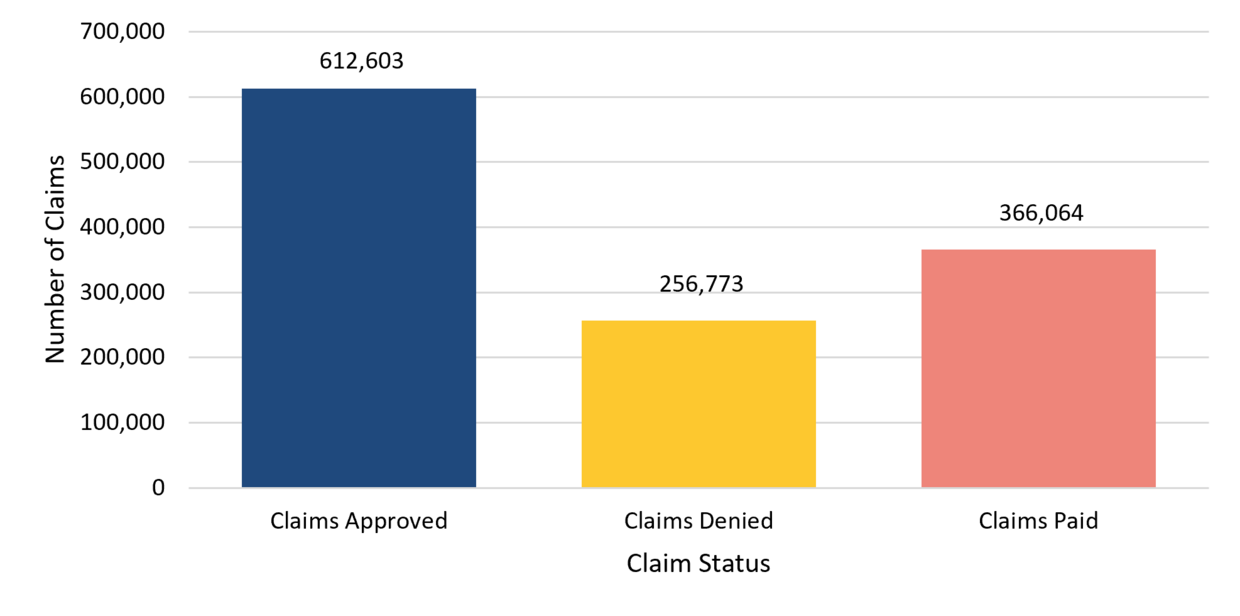
Note: According to DUA, claims may have been approved but not paid for various reasons. For example, one submitted claim could be associated with an approval only, and not a payment, because the claimant found employment after the claim was submitted but before the payment was disbursed.
Employment and Training Administration UI Core Measurements
The federal Employment and Training Administration (ETA) sets UI core measurements and acceptable levels of performance for the timely payment of UI benefits for both intrastate and interstate UI claims.7 These acceptable levels of performance function as minimum federal standards that states are expected to achieve.
ETA requires the following:
- Intrastate UI Claims: At least 87% of all first benefit payments should be made within 14 days of the week ending date of the first compensable week claimed, and at least 93% of all payments should be made within 35 days of the week ending date of the first compensable week claimed.
- Interstate UI Claims: At least 70% of all first benefit payments should be made within 14 days of the week ending date of the first compensable week claimed, and at least 78% of all payments should be made within 35 days of the week ending date of the first compensable week claimed.
Massachusetts has a one-week waiting period before benefits are paid, requiring that a claimant’s first benefit payment be made within 14 days of the week-ending date of the first compensable week claimed. See Table 4, found in Finding 2, for more information.
DUA Call Center
According to DUA’s website, one of DUA’s primary methods for providing customer assistance is through its call center. Customer service representatives assist claimants with filing new claims, managing existing claims, resolving payment issues, understanding eligibility requirements, and navigating the online portal. During the audit period, DUA’s call center was open from 8:30 a.m. until 4:30 p.m., Monday through Friday. Currently, DUA’s call center is open from 8:30 a.m. until 4:30 p.m., Monday through Thursday. Callers can select from DUA’s automated prompts to receive details and updates related to their accounts.
DUA told us during a walkthrough that, during the audit period, the call center received an average of approximately 12,000 calls per week. During the audit period, callers were assisted by approximately 75 call center agents (35 full-time staff members and 40 part-time staff members) and 88 contracted call center agents. During the audit period, contracted call center agents supported DUA from July through August 2022 and from April through July 2023. DUA did not use contracted agents from September 2022 through March 2023. DUA told us during a walkthrough that contracted support is deployed based on operational need and is not maintained continuously due to cost constraints. DUA officials told us that if the wait time to speak with a call center agent exceeds 30 minutes, then DUA increases the number of agents on call duty to help reduce the wait time and ensure timely assistance.
ETA encourages state workforce agencies, including DUA, to evaluate their online portals, telephone systems, and in-person services to enhance the customer experience. To support this, ETA developed a customer experience checklist (see Appendix) that outlines principles for improving customer interactions and suggests baseline operational, experience, and outcome metrics for agencies to consider.
Employment Modernization and Transformation Project
On June 14, 2022, EOLWD signed a contract with Fast Enterprises LLC to design, build, and implement a new online unemployment system as part of EOLWD’s Employment Modernization and Transformation (EMT) project, an initiative to replace the Commonwealth’s legacy UI system. The total contract cost is set at $163 million, including the dedicated support resource cost of $71 million and the base subscription fee of $92 million over a 15-year term.8 Phase 1 of the EMT project began in fall 2022 and included the implementation of tax functionality. Phase 1 went live for DUA on September 11, 2023, making the new EMT system available for use by employers. To ensure that the EMT system was functioning effectively, Fast Enterprises LLC established a postproduction support plan. Under this plan, DUA staff members monitored the EMT system through daily operations and customer interactions. DUA staff members reported any defects or new ideas using a ticketing application within the EMT system. The system automatically generated tickets based on these staff members’ inputs, along with notes from Fast Enterprises LLC during system monitoring. We determined during our audit that Fast Enterprise LLC employees documented and addressed these tickets.
When DUA users submit a ticket through the ticketing application within the EMT system to report a system defect or propose a new idea, the EMT production support team triages the ticket. After review, the EMT system automatically creates a solution request (SQR). Fast Enterprise LLC prioritized SQRs based on the ticket review’s issue priority level and discussions during meetings between itself and DUA. Fast Enterprise LLC would identify a solution for the SQR and test this solution in a staging environment. Once the SQR’s solution was successfully tested, Fast Enterprise LLC made changes in the EMT system to resolve the identified issue. Once a solution was successfully implemented, the SQR ticket was closed.
On May 6, 2025, Fast Enterprises LLC implemented Phase 2 of the EMT project, which entailed making the EMT system available for use by claimants.
DUA In-Person Assistance Requirements
According to the language of Section 62A(a) Chapter 151A of the General Laws that was in effect during the audit period,
The division of unemployment assistance shall provide a minimum level of in-person assistance at the following regional offices: Worcester, Milford, Dudley, Springfield, Gardner, Greenfield, Pittsfield, North Adams, New Bedford, Northampton, Taunton, Brockton, Boston, Lawrence and Framingham.
The language of Section 62A of Chapter 151A of the General Laws that was in effect during the audit period required DUA to maintain walk-in services at the above-specified regional offices, including providing general guidance, assistance with UI applications, UI claim-related information, and claimant orientation. This same section of the General Laws further required DUA to provide orientation to claimants within 15 days of their application and to provide claimants with an opportunity to meet with a DUA staff member in person. This orientation included information for claimants on the claim determination process and eligibility criteria, and claimants received contact information for DUA in order to have access to further services.
The language of this law was changed July 1, 2024, after the end of the audit period.
According to DUA officials, all the regional offices listed in the statute above were permanently closed before the audit period, except for the regional offices in Boston, Brockton, Lawrence, and Springfield. This made it impossible for DUA to provide in-person services at those regional offices. For the Boston, Brockton, Lawrence, and Springfield regional offices, which were open and operating during the entire audit period, all were staffed with at least one member of the MassHire Department of Career Services who was trained on the Commonwealth’s legacy UI system and/or the new EMT system to assist claimants with basic questions; however, the language of Section 62A(a) of Chapter 151A of the General Laws that was in effect during the audit period required that DUA itself, not the MassHire Department of Career Services, or another agency, provide this in-person assistance.
| Date published: | September 21, 2026 |
|---|