

DUA failed to meet ETA’s timeliness standards for claimant first benefit payments. Our analysis of 365,533 total claims paid, consisting of 352,644 intrastate UI claims and 12,889 interstate UI claims made during the audit period, revealed the issues described below.
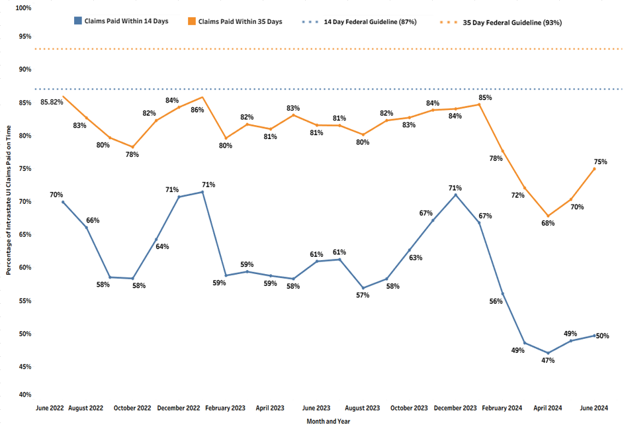
For intrastate UI claims, DUA did not consistently meet ETA’s standard in fiscal years 2023 and 2024. Specifically, DUA did not reach 87% of claims paid within 14 days in any month that we reviewed (see Table 4). Similarly, DUA did not meet the 93% standard for claims paid within 35 days (see Table 4), with timeliness calculated each month, during the same period. See Figure 7.
Figure 7. Percentage of DUA Intrastate UI Claims Paid Within 14 and 35 Days of Claimant Submission During Fiscal Years 2023 and 2024
For interstate UI claims payments, DUA did not meet the ETA standard in fiscal years 2023 and 2024. Specifically, DUA did not meet the standard of paying 70% of claims within 14 days in 23 out of the 24 months that we reviewed. Similarly, DUA did not meet the 78% standard for claims paid within 35 days for 5 out of the 24 months that we reviewed. See Figure 8.
Figure 8. Percentage of DUA Interstate UI Claims Paid Within 14 and 35 Days of Claimant Submission During Fiscal Years 2023 and 2024
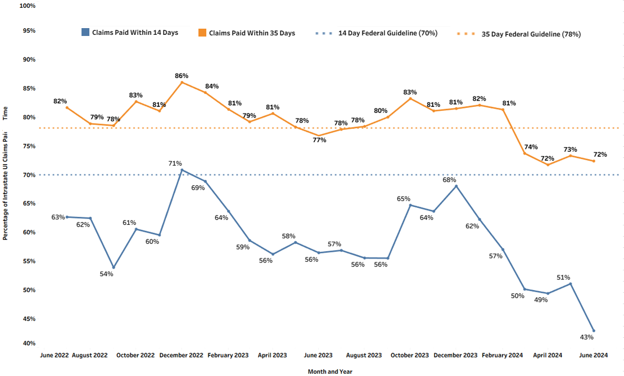
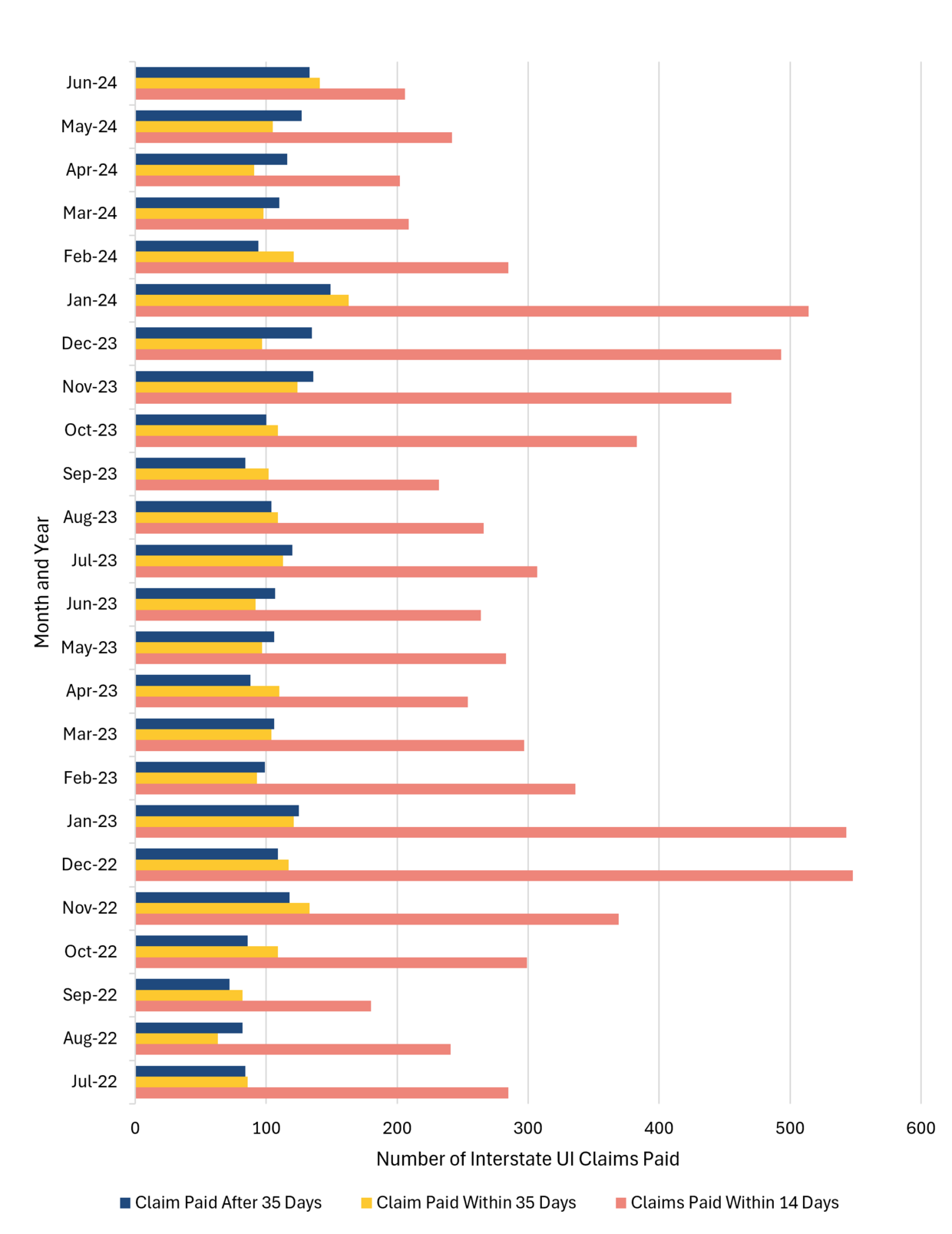
Figure 9 and Figure 10 show the number of intrastate and interstate UI claims paid by DUA during fiscal years 2023 and 2024.
Figure 9. Number of DUA Intrastate UI Claims Paid in Fiscal Years 2023 and 2024
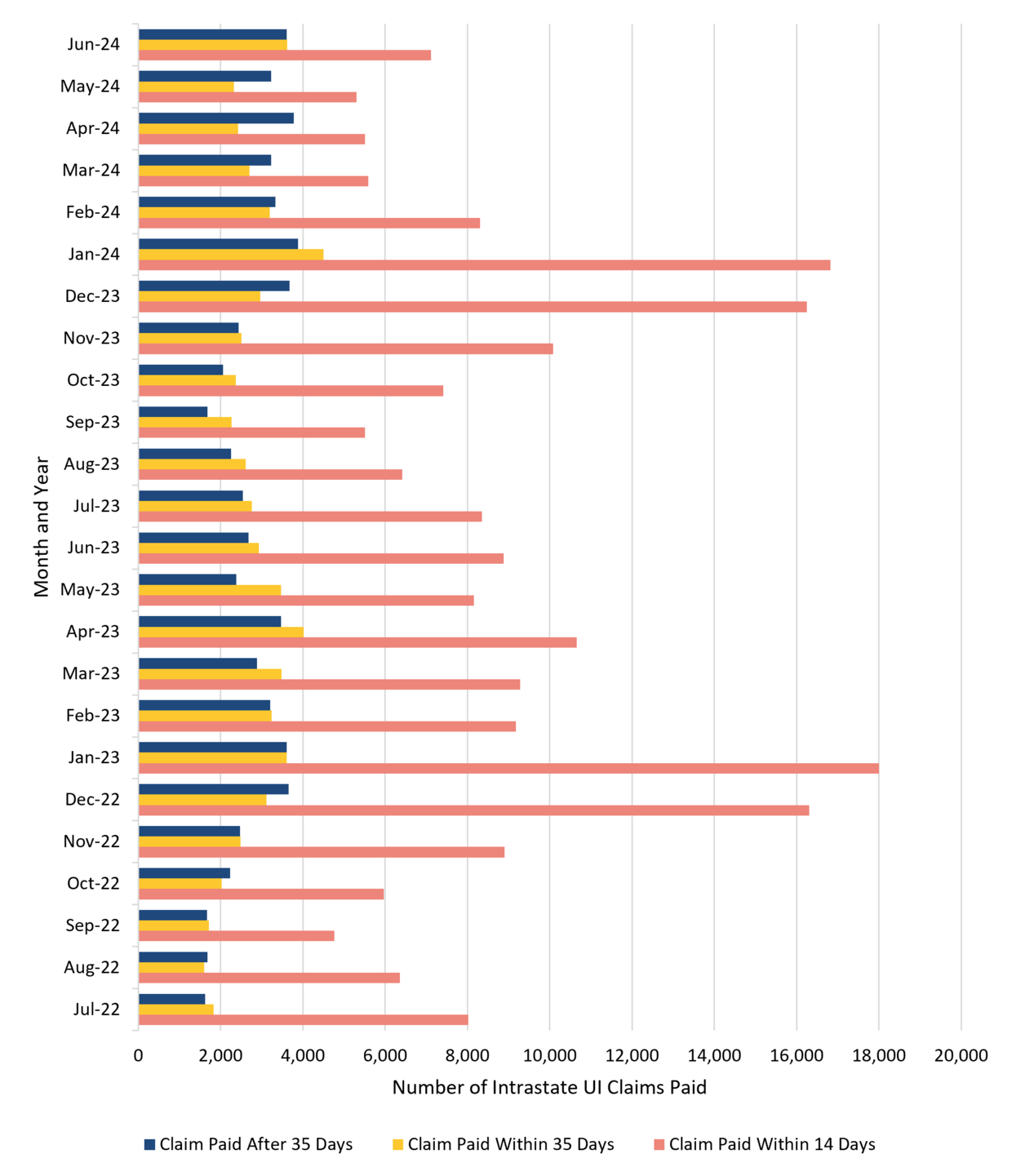
Figure 10. Number of DUA Interstate UI Claims Paid in Fiscal Years 2023 and 2024
Delays in first benefit payments can cause undue financial stress to claimants who rely on their benefit payments to pay everyday expenses. In addition, by not meeting ETA’s first benefit payment promptness standards, DUA risks losing federal funding for noncompliance, which would further affect its ability to effectively administer UI benefits. See Other Matters 1 and 2 for more information.
Authoritative Guidance
Table 4 outlines the performance level metrics required by ETA’s “UI PERFORMS Core Measures.”
Table 4. “UI PERFORMS Core Measures” and Acceptable Levels of Performance
| SECRETARY STANDARDS IN REGULATIONS | Acceptable Levels of Performance |
|---|---|
| First Payment Promptness (Regulation): % of all 1st payments made within 14/21 days: Intrastate, UI, full weeks | ≥87% |
| First Payment Promptness (Regulation): % of all 1st payments made within 35 days: Intrastate, UI, full weeks | ≥93% |
| First Payment Promptness (Regulation): % of all 1st payments made within 14/21 days: Interstate UI, full weeks | ≥70% |
| First Payment Promptness (Regulation): % of all 1st payments made within 35 days: Interstate, UI, full weeks | ≥78% |
Source: ETA—UI Performs Score Cards; https://oui.doleta.gov/unemploy/pdf/Core_Measures.pdf
Reasons for Issue
DUA officials informed us that the above performance challenges related to the delay in first benefit payments are due to a decline in federal funding over the years for the administration of UI benefits. DUA officials stated that these reductions have led to states lacking sufficient resources to adequately support operational needs. Although DUA officials stated that the agency has not received any notifications regarding potential consequences for its underperformance, they indicated that DUA is currently in discussions with the US Department of Labor for technical assistance on how to meet timeliness standards.
We completed further analysis of UI claim payments that were not made within 35 days during the audit period. From our sample of 25 of these UI claim payments, we identified several specific reasons for DUA not meeting the acceptable performance levels for UI payments, as follows:
- Six claims required additional documentation from claimants and/or their employers and needed further investigation and manual review, such as a failure to report earnings, claimants misreporting layoffs and/or discharges, and unreported wages.
- Two claims were delayed because there were insufficient staff members available to review the claims. (Claims flagged in the system require additional investigation.)
- Five claims were delayed because of identification verification issues, which required manual review.
- Four claims were delayed due to inconsistent revenue sources or nontypical income that are paid in unpredictable amounts or frequency, such as retirement, severance, tips, or other dividends, which can cause system misinterpretation, and require manual engagement from a claims specialist.
- Eight claims were delayed because of issues outside of DUA’s control, including but not limited to a claimant’s late submission of the application, termination due to misconduct, or not responding to an investigator or attending appeal hearings at DUA after a claim denial.
During our testing, DUA told us that several of the issues we identified are being addressed through the Phase 2 implementation of the EMT system, which was introduced on May 6, 2025.
Recommendations
- DUA must ensure that the EMT system includes real-time wage reporting from employers, thus eliminating the need for DUA staff members to perform manual wage verification.
- DUA should implement system alerts for any missing information from claimants during the submission of claims.
- DUA should identify the specific issues driving the delays in first benefit payment promptness and how these issues will be addressed.
- DUA should improve the processing of claim payments, which may include the need to hire additional staff members.
Auditee’s Response
DUA is committed to improving the customer experience and ensuring eligible claimants receive benefits in a timely manner. That is why DUA implemented a multi-month pilot in August 2025 to close the DUA call center on Fridays to allow staff to process claims more efficiently. DUA has also hired more adjudicators and seasonal staff to improve processes that may impede timeliness. These efforts build on the modernized EMT system and DUA remains focused on continued improvement.
[The US Department of Labor’s (USDOL’s)] Employment and Training Administration agency (“ETA”) sets timeliness standards for when benefits should be paid following an initial claim. The ETA timeliness standards for claimant first benefit payments are outdated and do not account for the complexity of processing unemployment claims in 2026, where sophisticated program integrity measures are necessary to safeguard against potential fraud. DUA has prioritized robust program integrity protocols to detect and prevent fraud, ensure investigations are completed properly, and that benefits are paid accurately. Recognizing the inherent tension between timeliness standards for claimant first benefit payments and fraud detection and prevention, DUA requested technical assistance from USDOL in December 2025. Discussions with USDOL and other states on how to balance these competing priorities and ensure DUA is following ETA best practices remain ongoing.
Additionally, the performance challenges identified during the audit period are attributable to a decline in federal funding, with a reduction of roughly $11.8M during the audit period. As a result, Massachusetts, like other states, is not receiving sufficient resources to adequately support operational needs. Additionally, there are several known reasons beyond DUA’s control that a claimant might file a claim and not receive timely first payment. For example, if after filing an initial claim, a claimant fails to certify, that individual’s claim would negatively impact DUA’s timeliness metric. Other examples include federal shutdowns or strikes where workers may file timely to preserve eligibility but not actually collect on a claim. The same can be true in the context of certain part-time work or seasonal employment.
Recommendations #1 and #2 suggest that DUA should ensure that its system includes real-time wage reporting from employers and that DUA should implement system alerts for any missing information from claimants during the submission of claims. The EMT system already includes both “real-time” wage reporting from employers and system alerts to claimants for missing information dating back to the launch of the EMT system in May 2025.
Recommendation #3 proposes that DUA identify the specific issues driving the delays in first benefit payment promptness and how these issues will be addressed. During the time frame covered by this Audit, DUA engaged with many stakeholders, including labor, legal advocates, and employers, and leveraged media and website updates to acknowledge the delays were driven by reduced funding, the learning curve experienced by both staff and returning users, new system prompts, and a backlog caused by the conversion of claims from the old system to the new system. For example, help language has been added to the EMT user portal to support certain occupations based on trends DUA noticed for users in navigating the new system. DUA continues to identify specific issues that may cause delays or confusion and remains focused on improving processing of claim payments.
Recommendation #4 proposes that DUA improve the processing of claim payments, which may include the need to hire additional staff. Improving customer service remains a top priority for DUA, and DUA continues to have active discussions to identify potential strategies to enhance customer service.
Other recent improvements include:
- In January 2025, call wait times exceeded two hours; today, the average call wait times range between 5 and 20 minutes (depending on various factors including day of the week, complexity of the issue, etc.).
- Since the beginning of the call center pilot in August 2025, DUA has eliminated its initial backlog, resolving more than 338,600 issues.
- The new call center hours allow DUA to process claims more efficiently, including those that have aged beyond the 21-day timeliness standard.
- In the summer and fall of 2025, approximately 53% of claims were processed within 30 days. In June 2026, nearly 70% of claims are processed within 30 days. (Note: this differs from first pay timeliness that USDOL publishes monthly as it covers all claims processed, including both claims that have been paid and claims that have been denied).
- Since August 2025, claims paid within 21 days and 28 days have improved, ranging between 37% and 43% improvement for both categories.
Ongoing improvements:
- DUA is always looking for opportunities to improve and consistently monitoring and reviewing its performance against internal and USDOL standards.
- DUA has an outstanding request to USDOL ETA for technical assistance to balance timeliness standards for claimant first benefit payment guidelines with sometimes competing program integrity priorities.
- Every claim is unique and the claimant journey can look different for everyone. DUA has identified common “speed bumps,” which can be operationally burdensome for staff or lead to delays in the processing of claims. DUA is working on solutions to eliminate these “speed bumps” and continue to improve claim processing times.
- DUA also launched a seasonal employee program in 2026, adding 150 new seasonal employees in a variety of roles specially identified to meet the needs of the department. These temporary staff are being onboarded in phases.
Auditor’s Reply
We acknowledge DUA’s efforts to attempt to improve operations; however, these initiatives that are said to have been implemented after the audit period, do not automatically resolve the issues raised in this finding. An April 30, 2026 article published by Commonwealth Beacon, titled “One year after implementing new system, Mass. continues to struggle in issuing unemployment benefits,” reported that nearly a year after the launch of the EMT system, which DUA touted in its response as having resolved several of the issues raised in this finding, claimants continue to face significant delays in the processing of their claims and receipt of their benefits. The EMT system has also contributed to significant delays in issuing payments and processing appeals, according to the same article, and performance remains uneven, leaving many claimants waiting months for decisions. Additionally, according to this Commonwealth Beacon article, lawmakers said that they continue to receive high volumes of constituent complaints. While the newly implemented EMT system may support performance improvements, we note that effective management of these systems and personnel is critically important. These issues are not resolved by implementation of a new technology alone.
During the audit period, DUA consistently failed to meet ETA’s required timeliness standards for first benefit payments. DUA’s assertion that the federal timeliness standards are outdated does not change the fact that they remain the applicable performance measures established by ETA. Unless and until ETA revises those standards, DUA is expected to meet them. The existence of fraud prevention requirements does not exempt DUA from complying with federal timeliness expectations. Other states face the same program integrity requirements and are evaluated against these same standards.
Similarly, DUA’s explanation regarding reduced federal funding, claimant behavior, seasonal employment, strikes, or other circumstances does not change our finding. These known factors within the UI program are faced by other states as well and do not invalidate the responsibility that DUA, itself, has to ensure that it achieves performance standards.
| Date published: | September 21, 2026 |
|---|