

To determine whether DUA’s BAM Unit verified that claimants met the weekly work search requirement, we reviewed a random sample of 50 completed BAM cases that were investigated during the audit period. A BAM investigator classifies each work search activity provided by a claimant as acceptable, unacceptable, or unverifiable based on the supporting documentation submitted by the claimant. If a claimant did not provide three work search activities for the week in question, then a BAM investigator should create a work search availability issue in the system.
Our review identified 6 cases in which BAM investigators correctly determined that claimants did not meet the weekly work search requirement. However, we identified an additional 13 cases in which BAM investigators determined that claimants met the work search requirement, but the determinations relied on unverifiable work search activities for which claimants did not provide sufficient evidence that the requirement was met. As an example, a DUA BAM investigator accepted a work search activity where the claimant provided an explanation over the telephone about a review of the local newspaper for work; however, there were no jobs available that the claimant was qualified for, and the claimant did not apply for any job postings at all.
We found that DUA’s BAM Unit rarely used work search verification as a basis for denying claims, even when claimants’ submitted activities could not be verified. Instead, determinations were often based on a combination of acceptable and unverifiable activities, resulting in claims being approved without sufficient supporting documentation. This increases the risk of improper payments and reduces integrity and compliance with eligibility requirements. It may also create an administrative burden for employers, particularly small businesses, when claimants report job search activities, such as submitting applications and scheduling interviews, but they do not subsequently attend those interviews.
DUA explained that, according to an email between the ETA administrator and DUA on March 20, 2019, a BAM investigator must prove—with clear and convincing evidence—that a claimant did not perform a work search activity before creating a work search issue. This email states,
If the best evidence is that the Claimant indicated they made a Work Search on the weekly [certification] (meaning that they answered “YES” on their weekly certification via phone or internet), you have to prove by clear and convincing evidence that they didn’t. As such, a failure to respond would be an ineligible going forward (if a state has that disqualification), but you haven’t proven an unverifiable work search. Therefore, a failure to return a BAM Claimant Questionnaire would not automatically make the claim ineligible due to lack of Work Search, according to Federal guidelines. Of course State Laws and Policies take precedence [emphasis added]. . . . I sincerely hope this helps you reduce your Improper Payment Rate when it comes to Work Search.
Under this guidance, DUA investigators considered the work search requirement met as long as claimants submitted at least three work search activities in a given week, regardless of whether all the activities could be verified. This practice contradicts the information on DUA’s website, which states that claimants must provide proof of at least three job search activities each week. Considering unverifiable activities to be sufficient documentation may result in overpayments to ineligible claimants, which reduces the effectiveness of work search verification as a control.
DUA should ensure that BAM investigators consistently follow DUA’s guidelines when evaluating work search activities and that they obtain sufficient documentation to support claimant eligibility. If current practice is considered acceptable by ETA, then DUA should update its policies and website guidance to accurately reflect the federal guidance for work search verification.
Auditee’s Response
As previously mentioned, the Audit period predates the complete implementation of the [Employment Modernization and Transformation (EMT)] system. During that time, BAM investigators evaluated work search activities in accordance with [the US Department of Labor] ETA BAM guidance. Since launch of EMT, work search has been fully integrated into the new system. DUA is continuously reviewing and working to improve its policies and procedures, including work search.
DUA remains committed to protecting the integrity of the UI program, reducing improper payments, and ensuring that work search requirements are administered fairly and consistently.
Auditor’s Reply
As previously mentioned, we appreciate DUA’s attempt to improve its systems. However, DUA’s response does not fully address our finding that BAM investigators relied on unverifiable work search activities when determining claimant eligibility. We understand that new technology is being implemented. However, this does not resolve the lack of management and oversight of these activities or address the inconsistency between DUA’s website, which states that claimants must provide proof of at least three work search activities each week, and its practice of treating unverifiable activities as sufficient to satisfy that requirement.
We are also concerned about the language in the March 20, 2019 email from the ETA administrator, which states, “I sincerely hope this helps you reduce your Improper Payment Rate when it comes to Work Search.” This language gives the impression that the guidance was focused, at least in part, on reducing DUA’s reported improper payment rate according to federal standards, rather than strengthening the verification of work search activities, which would actually reduce improper payments, according to DUA’s standards, Massachusetts law, and DUA policies. The email also makes clear that state laws and policies take precedence. Given this, DUA should re-evaluate its decision to accept unverifiable work search activities as meeting the requirement and strengthen its verification process beyond the federal guidance given at that time.
When benefits are paid to claimants who do not meet minimum eligibility requirements, the cost of these improper payments falls on all employers, including small local business owners. These small business owners not only continue to pay for potential improper payments, but they may also lose time and energy at scheduled interviews with claimants who may not be showing up to interviews because there is no requirement to demonstrate that the claimant made any follow through. For the sake of transparency, accountability, and the judicious use of taxpayer resources going to those truly in need, we continue to recommend that DUA ensure that its own policies, procedures, and publicly available guidance are consistently applied by BAM investigators and that it not rely solely on the bare minimum guidance provided by one federal official several years ago, which clearly stated that Massachusetts state law and policy supersedes the guidance provided in the email. Again, this email guidance at the time was focused more on reducing the improper payment rate, according to the minimum federal standard, rather than ensuring that the payments are actually proper under DUA’s own policies. DUA should ensure that eligibility determinations are supported by sufficient documentation, as stated on its own website. As shown below in Figure 12, DUA’s website specifically states that claimants are required to provide proof of at least three work search activities each week. As part of our post-audit review process, we will follow up on this matter in approximately six months.
Figure 12. UI Benefit Requirements Listed on DUA’s Website
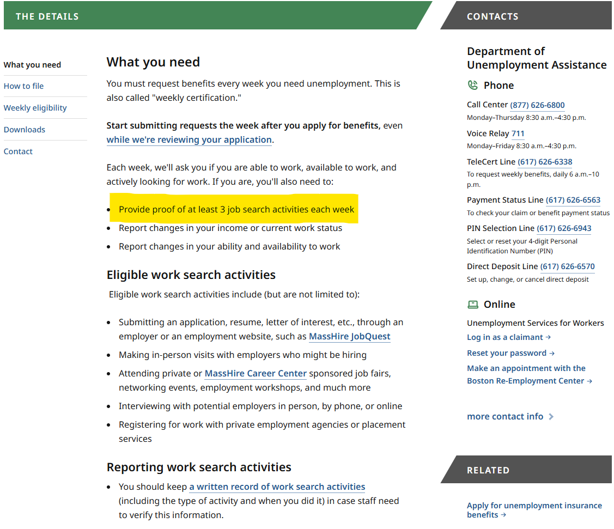
Source: DUA— “File your weekly unemployment claim” (https://www.mass.gov/how-to/file-your-weekly-unemployment-claim)
| Date published: | September 21, 2026 |
|---|