Overview
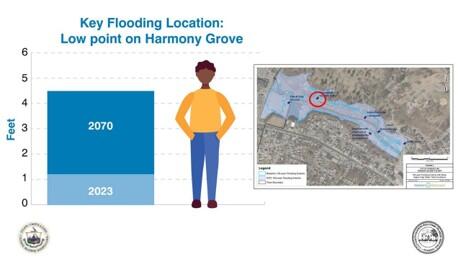
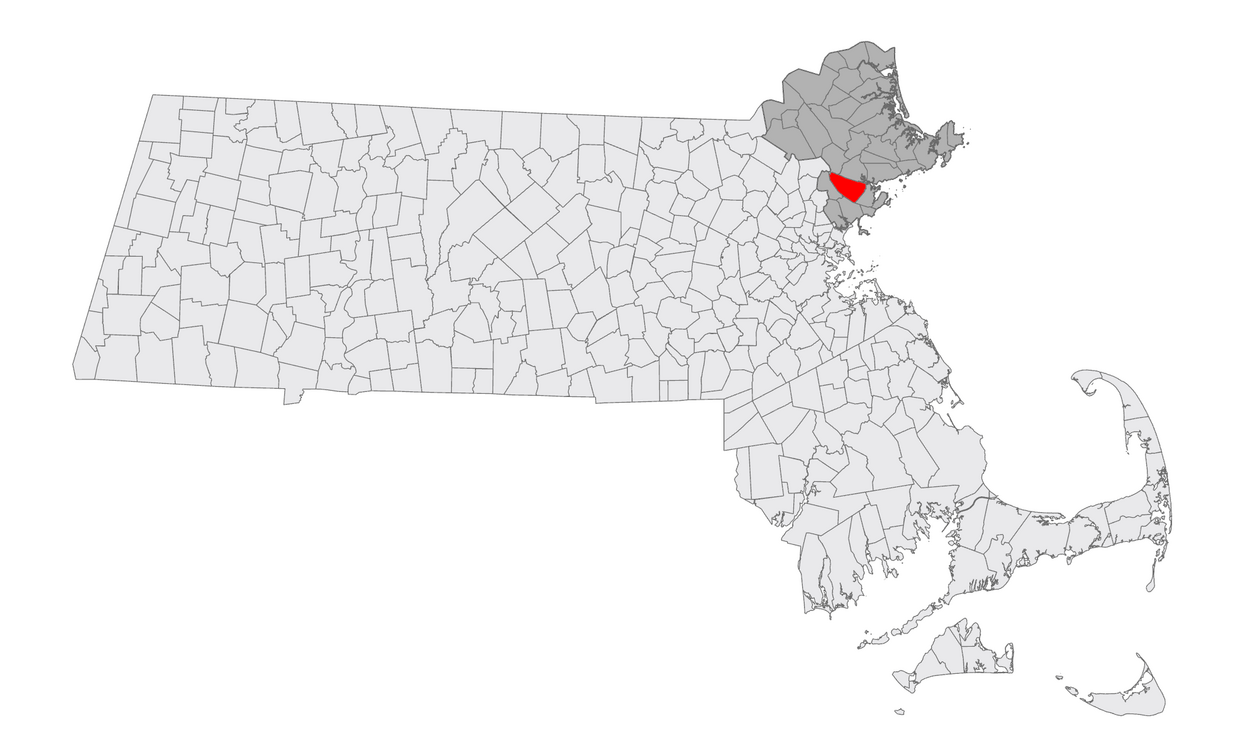
Peabody is a city in Essex County, Massachusetts, in the northeast part of the state. They have a population of 54,056 people and an area of 16.2 square miles. Climate hazards present in Peabody include inland flooding, drought, wildfires, extreme temperatures, and other severe weather.
Peabody's Core Team
The MVP 2.0 Core team is a group of municipal staff and Community Liaisons who work together to identify local climate resilience priorities and implement a project that supports those priorities.
Peabody's Community Liaisons include representation from:
- Resident, Biz Owner, Chamber, Community Engagement, Cyber-Security for Elderly
- Citizen Inn, EJ Population Rep, Priority Population, Community Engagement & Outreach, Community Engagement Leader
- Community Activists (Climate Change/Sustainability), Conservation Commissioner, EJ/CV Community Representative
- Retiree, Engineer, Climate Resiliency Advocate, Connection w/ Peabody Senior Citizens Population
Peabody's Core Team includes municipal representation from:
- MVP Program Project Manager, Lead Planner for several MVP Projects, Previous MVP Core Team Member
- CDBG Program Manager, Housing Planner, Community Engagement
- Director of Health Department
- Director of Public Services
- Certified MVP Specialist, Lead Planner for Hazard Mitigation Plan/Updates, Established the Health Equity Zone Initiative for Town of Bristol, R.I., Certified National Charrette Institute (NCI) to conduct public workshops and charrettes, Certified Floodplain Manager
Peabody Community Resilience Priorities
Community resilience priorities are practical actions created during the MVP 2.0 Planning Grant process. They were shaped through community input, thoughtful discussion about changing local needs, and feedback from Environmental Justice groups and other community members.
Peabody, in partnership with their Core Team, identified the following priorities through the MVP 2.0 process.
Priority 1: Refocus citywide emergency preparedness through a social equity lens.
Potential Actions:
- Evaluate feasibility of smaller scale, neighborhood hubs as short term alternative shelter locations for sustainable systems (particularly in EJ neighborhoods). Conduct GIS analysis of underserved areas.
- Plan for shelter upgrades, including the addition of a multicultural/multi-lingual resource staff (stipend) on site.
- Increase education/outreach efforts by developing Community Resource Manual/tri-fold pamphlet to identify multitude of available resources/services, that also includes implementation/update schedule. Pull from existing resources first.
- Increase emergency response certification levels, and planning for emergency management staffing and CERT Team to include DEI/sensitivity training.
Acquire a generator for the senior center and work to increase the center’s capacity to serve as a shelter.
Priority 2: Flood-proof and upgrade sewer pump stations
Potential Locations:
- Russell Street
- Pine Street
- Cobbs Avenue
- Walnut Street
- Northfield Road
- Dobbs Road
Sylvan Street
Priority 3: Conduct a public buildings assessment to evaluate their capacity for withstanding hazard events.
Make sure the assessment includes all smaller scale neighborhood hubs (shelters) as identified.
Potential Actions:
To be determined
Priority 4: Partner with local agencies/adjacent towns to implement a robust Food Access Program
Potential Actions:
- Conduct a survey of food pantry patrons for culturally appropriate food staples.
- Establish new thresholds for food pantry access based on income, family size, etc.
- Collaborate with Salem on partnering/resource-sharing.
- Partner with Haven from Hunger to implement a mobile food market during emergencies/weather events.
- Partner with Haven from Hunger to expand medically-appropriate food options.
- Expand collaboration between Haven from Hunger and the School District for families.
Priority 5: Transportation Improvements
Potential Actions:
- Conduct a 15-minute pedestrian shed study around public/private housing facilities/EJ areas to identify ‘desire lines/goat paths’ for snow removal/clearing priorities.
- Re-evaluate parking regs. at congregate housing sites to allow for medical personnel/home visits.
Partner with local agencies/orgs. to expand transportation services.
Priority 6: Information Distribution
Potential Actions:
- Evaluate feasibility of smaller scale, neighborhood hubs as short term alternative shelter locations for sustainable systems (particularly in EJ neighborhoods)
- Plan for shelter upgrades, including the addition of a multicultural/multi-lingual resource staff (stipend) on site, prior to an event to serve as liaison to cultural communities in a structured approach.
- Consider establishing precedent for Mayor to distribute news/information as a trusted official.
Increase education/outreach efforts by developing Community Resource Manual/tri-fold pamphlet to identify multitude of available resources/services, that also includes implementation/update schedule (similar to above). Pull from existing resources first.
Priority 7: Housing Initiative
Potential Actions
- Ensuring households have what they need to mitigate impacts from hazard events (protection from flooding/AC units/etc.).
- Policies for rooming housing…number of residents cap/with enforcement approaches (consideration of fines for landlords/owners).
- Policies for temperature controls in congregate care/housing scenarios.
Peabody's Action Grant Projects
The MVP Action Grant provides funding to communities that want to take important steps to prepare for climate change, such as dealing with extreme weather, flooding, rising sea levels, and extreme heat.
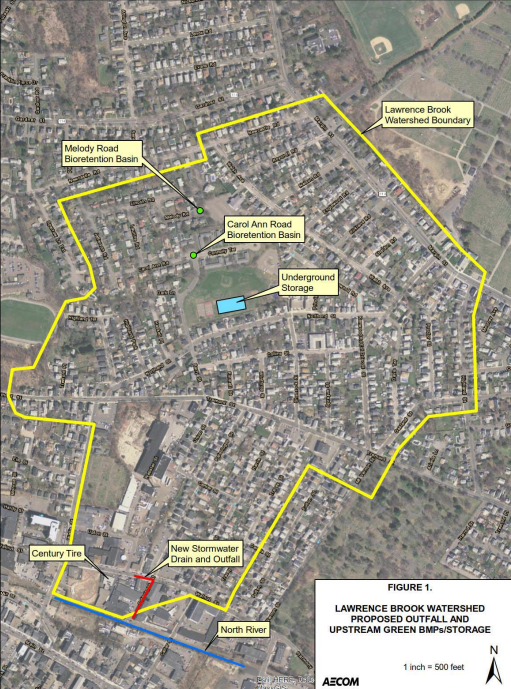
Lawrence Brook Watershed Flood Mitigation and Water Quality Improvement (FY18)
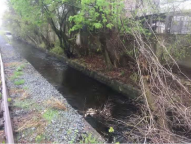
To address ongoing flooding issues along City streets in the watershed, the City of Peabody advanced efforts to alleviate flooding in the Lawrence Brook Watershed. The City evaluated climate change projections on a final design for the outfall and BMPs/LID elements. Execution of the final design and permit application were also prepared.
North River Canal Resilient Wall, Riverwalk and Park (FY18)
The City of Peabody conducted a comprehensive project along the North River Canal with project components that will improve resilience, address site contamination from historic use as a tannery district, and create a park resource that enhances public access and vitality of the area.
Resilient North River Canal Corridor– Phase 2 (FY20)
The project proposed Phase II of the Resilient North River Canal Corridor project. Phase II prepared designs and permitting documents for a riverwalk and for stabilization of the south bank. The bank stabilization will increase the stormwater and riverine flood storage capacity in Peabody Square, while the riverwalk will create new recreational open space as well as a pedestrian corridor for multimodal transportation in an economically disadvantaged part of the community.
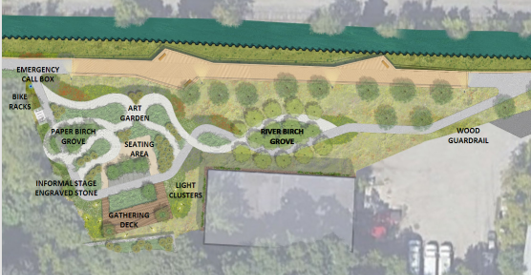
Peabody-Salem Resilient North River Corridor & Riverwalk Project (FY22)
Ongoing redevelopment and the identification of a gap in the region's expanding multiuse path network has brought a renewed focus to the North River Corridor's vulnerability to climate change impacts. This project evaluated climate change impacts on this area and identify potential nature-based solutions.