
What Are Bioengineering Projects and Natural Fiber Blankets?
Coastal bioengineering projects reduce erosion and stabilize eroding shorelines by using a combination of deep-rooted plants and erosion-control products that are made of natural, biodegradable materials. Natural fiber blankets are mats made of natural fibers, such as straw, burlap, and coconut husk, which is also called coir. Some natural fiber blankets are made of loosely woven coir twine and others are made of straw, coconut, or a mix of fibers held together with netting made from coir or other materials. The blankets are used to help reduce erosion of exposed soil, sand, and other sediments from wind, waves, and overland runoff.
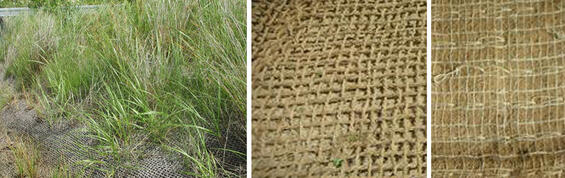
Vegetation growing up through a natural fiber blanket (left) and blankets made of woven coir (middle) and stitched fiber (right). Photos: Wilkinson Ecological Design (left) and Coir Green “Environmentally Friendly” (middle and right)
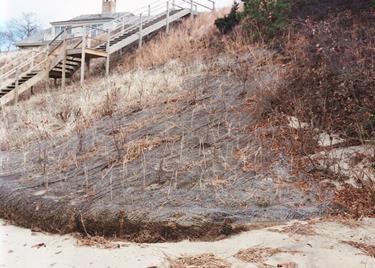
In this bank stabilization project, a natural fiber blanket was installed on the face of the bank and vegetation was planted through it. A coir roll was also installed at the base of the bank.
For important instructions on using plants in bioengineering projects, see the StormSmart Properties Fact Sheet 3: Planting Vegetation to Reduce Erosion and Storm Damage. This fact sheet includes specific information on how vegetation reduces erosion and storm damage, tips on maximizing the effectiveness of vegetation projects and minimizing impacts, specifics on project design and implementation, and instructions on selecting, properly planting, and caring for appropriate species.
Natural fiber blankets are frequently used with other techniques for erosion management, such as coir rolls (cylindrical rolls packed with coconut husk fibers) and runoff control projects. See the following StormSmart Properties fact sheets: Controlling Overland Runoff to Reduce Coastal Erosion and Bioengineering - Coir Rolls on Coastal Banks.
No shoreline stabilization option permanently stops all erosion or storm damage. The level of protection provided depends on the option chosen, project design, and site-specific conditions such as the exposure to storms. All options require maintenance, and many also require steps to address adverse impacts to the shoreline system, called mitigation. Some options, such as seawalls and other hard structures, are only allowed in very limited situations because of their impacts to the shoreline system. When evaluating alternatives, property owners must first determine which options are allowable under state, federal, and local regulations and then evaluate their expected level of protection, predicted lifespan, impacts, and costs of project design, installation, mitigation, and long-term maintenance.
How Natural Fiber Blankets Stabilize Slopes and Help Reduce Erosion
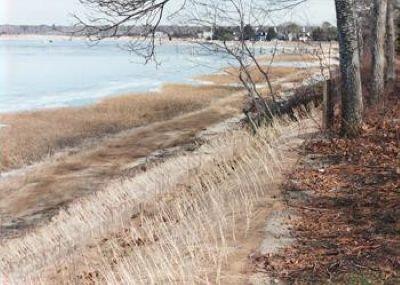
A natural fiber blanket was installed on this bank and vegetation was planted through the blanket while the plants were dormant.
Natural fiber blankets are used on non-vegetated portions of banks to prevent erosion while native salt-tolerant vegetation with extensive root systems becomes established on the site. A salt-tolerant seed mix is spread across the area before the natural fiber blanket is secured, and then live vegetation is planted through the blanket. The blanket helps hold sand, soil, and other sediments in place by protecting the surface from erosion caused by wind, salt spray, and flowing water. The seeds grow quickly and also help secure the soil surface while the larger live plants become established and begin to spread. The blanket also retains moisture to promote seed growth and protect the roots of the live plants. As the natural fibers in the blanket disintegrate over 6 to 24 months, depending on the density and type of fiber blanket selected, the dense root systems of the plants take over the job of stabilizing the site.
Under the Massachusetts Wetlands Protection Act, new hard structures are typically prohibited on all beaches and dunes. On coastal banks, hard structures are only allowed when necessary to protect buildings permitted before August 10, 1978, and only if no other alternative is feasible. In many cases, coir roll projects and other non-structural alternatives are therefore the only options available for reducing erosion and storm damage on coastal properties.
Relative Benefits and Impacts Compared to Other Shoreline Stabilization Options
Natural fiber blankets and vegetation provide direct, physical protection to reduce erosion of bare soils. Because they are made from natural, biodegradable materials and are planted with vegetation, natural fiber blankets absorb much more wave energy than seawalls, rock revetments, or other “hard” shoreline stabilization structures, which reflect significantly more of the wave energy that hits them onto beaches or neighboring properties. The design of a hard structure affects how much wave energy is reflected, for example vertical walls reflect more wave energy than sloping rock revetments. These reflected waves erode beaches in front of and next to a hard structure, eventually undermining and reducing the effectiveness of the structure and leading to costly repairs. This erosion also lowers the elevation of the beach in front of the structure, ultimately leading to a loss of dry beach at high tide and reducing the beach’s value for storm damage protection, recreation, and wildlife habitat. Natural fiber blanket projects also allow some natural erosion from the site while hard structures impede virtually all natural erosion of sediment. Without this sediment supply, down-current areas of the beach system are subject to increased erosion. In addition, natural fiber blankets can often be installed without the use of mechanized equipment that can significantly impact the site. Because they are made with natural fibers and planted with vegetation, natural fiber blankets also help preserve the natural character and habitat value of the coastal environment.
Bioengineering projects using natural fiber blankets can cause minor impacts that may be effectively minimized through appropriate project design (see Design Considerations). However, projects using blankets made of synthetic materials, which do not degrade readily in the coastal environment, can cause significant impacts. For example, synthetic materials washed into the ocean during storms or exposed at the ground surface can entangle wildlife, and unlike natural fiber blanket materials, the synthetic materials will remain in the environment for long periods of time. Therefore, the use of blankets made with synthetic fibers is strongly discouraged for coastal projects.
Design Considerations for Natural Fiber Blanket Projects
This section covers a variety of factors that should be considered to minimize adverse impacts and ensure successful design, permitting, construction, and maintenance of natural fiber blanket bioengineering projects.
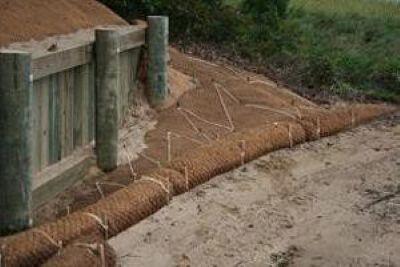
A coir roll, natural fiber blanket, and fill were installed to minimize erosion at the end of this bulkhead. (Photo: Wilkinson Ecological Design)
Appropriate Locations
Natural fiber blankets can be installed on almost any coastal bank to help stabilize soils while plants become established. However, they are most effective in areas with higher beach elevations with some dry beach at high tide, where the toe of the bank is not constantly subject to erosion from tides and waves. Blankets are typically installed over the entire surface of a non-vegetated bank, but they may also be placed in specific areas where a bank is devoid of vegetation. Blankets will not prevent erosion on unstable slopes or in areas subject to erosion from high tides or storm waves.
On banks where the toe is subject to erosion from tides or storm waves, it may be appropriate to combine natural fiber blankets and vegetation with other shoreline stabilization options. Coir rolls can be installed to protect the base of the bank (see StormSmart Properties Fact Sheet 4: Bioengineering - Coir Rolls on Coastal Banks). Sediments can also be brought in from off-site sources to increase beach width and dune volume to help dissipate wave energy before it reaches the bank (see StormSmart Properties Fact Sheet 1: Artificial Dunes and Dune Nourishment and StormSmart Properties Fact Sheet 8: Beach Nourishment).
Establishing a Stable Slope
On banks, a stable slope is essential for project success. If the bottom of the bank has eroded and its slope is steeper than the upper portion of the bank, the bank is likely unstable. Even when heavily planted with erosion-control vegetation, banks with unstable slopes are extremely vulnerable to slumping or collapse, which can endanger property landward of the bank. Before planting vegetation, therefore, the bank slope should be stabilized.
Ideally, any existing invasive vegetation is removed and soil of a similar type to that on the bank or beach is brought in as fill and added to the lower part of the bank to create a lower slope that matches or is less steep than the upper slope. However, if adding fill brings the toe of the bank within the reach of high tides, the fill will erode quickly and undermine the rest of the bank. In these cases, regrading the bank slope by removing sediment from the top of the bank is a better option. While removing part of the upper portion of the bank does reduce the land area of the property, it can be done in a controlled fashion that improves the overall stability and storm damage prevention capacity of the bank. And if the slope is not stabilized by either adding fill at the bank toe or regrading the top of the bank, bank collapse during a storm could cause substantially more loss of land area to the sea. In addition, any investment in natural fiber blankets, vegetation, and other site stabilization methods will be lost if the bank collapses. On sites where the top of the bank is well vegetated with mature, salt-tolerant species with extensive roots, the appropriate approach to stabilize the bank should be carefully developed by a professional with extensive experience successfully stabilizing similar sites.
Removing/Replacing Invasive Plants
Invasive plants (i.e., introduced species that thrive at the expense of native plants) should be removed and replaced with appropriate native plants if they are preventing establishment of erosion-control vegetation on a bank. This effort is particularly warranted when bank stability is severely compromised by invasive plants. Because of their tenacity, successful control of invasive plants can take years to accomplish and may require perpetual monitoring and management. Effective ways to manage invasive species on the bank should therefore be incorporated into project design. See StormSmart Properties Fact Sheet 3: Planting Vegetation to Reduce Erosion and Storm Damage for more information.
Protecting Vegetation
To help ensure the success of newly planted vegetation, sources of erosion on the site, including upland runoff and waves, should be identified and addressed as part of the site evaluation and design process. If surface runoff is causing erosion, it should be reduced and/or redirected to give newly planted vegetation the best chance of survival (see StormSmart Properties Fact Sheet 2: Controlling Overland Runoff to Reduce Coastal Erosion for more detail). In addition, exposed areas should not be planted during the winter when the plants are dormant because wind or waves are likely to pull them out before they can get established. See StormSmart Properties Fact Sheet 3: Planting Vegetation to Reduce Erosion and Storm Damage for more planting tips. To further protect the bank, pedestrian access to the shoreline should be restricted to designated access paths or walkways, and the number of access points should be limited as much as possible. Often, multiple properties can use a common access point. To limit shading impacts to vegetation, access structures should be elevated on open pilings and their size should be minimized as much as possible.
Preparation of the Site Surface
Natural fiber blankets are most effective when vegetation, rocks, twigs, and other debris have been removed to create a smooth surface so that the blankets are placed in close contact with the soil or sediments. If the blanket is not in close contact with the ground surface, vegetation shoots may push the blanket up instead of growing through it, causing a “tent” effect. Such tenting allows overland runoff to flow under the blanket and across the ground surface, causing erosion. Plants growing under the blanket will also have difficulty getting established at the site.
Project Installation and Blanket Anchoring
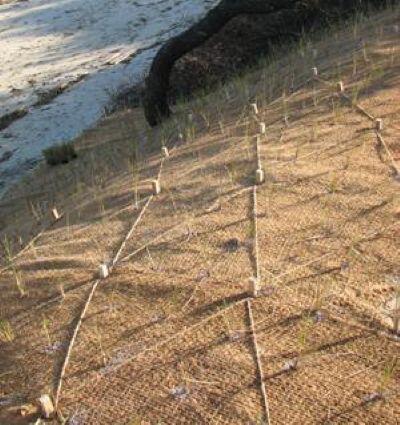
Oak stakes are used to anchor the natural fiber blanket installed on this bank. A notch in the stake is used as a stop to hold biodegradable coir twine to secure the blanket to the ground surface. Vegetation was planted through the blanket. (Photo: Cape Organics, Inc.)
To best protect the site from surface runoff, the rolls of natural fiber blanket should be installed from the top to the bottom of the bank rather than horizontally across the bank. Blankets should be placed so that they overlap by 6 to 12 inches to prevent exposure of the ground surface if the blanket edges curl. To ensure close contact is maintained between the natural fiber blanket and the ground surface, the blanket must be anchored down. Stakes or staples are hammered through the blanket and into the ground to hold the blanket in place. These stakes or staples range from 6 to 24 inches in length and are made of metal, wood, or a biodegradable corn/gluten mix. In coastal settings, anchors made of biodegradable materials should be used to minimize environmental impacts in case they are dislodged from the site. In addition, staples should be installed and maintained so that they stay flush to the ground. In sandy soils, longer staples or stakes will be required to anchor the natural fiber blankets.
When natural fiber blankets are used to cover the entire slope of a bank, anchor trenches are often used. Anchor trenches are small depressions, typically 6-12 inches deep by 6 -8 inches wide that are dug parallel to the shoreline. In this approach, the blankets run from an anchor trench at the top of the bank, down the bank face to another anchor trench at the bottom of the slope. The trenches are backfilled with sediments similar to those found on the bank or beach and compacted so water will flow evenly over the blanket and not under it.
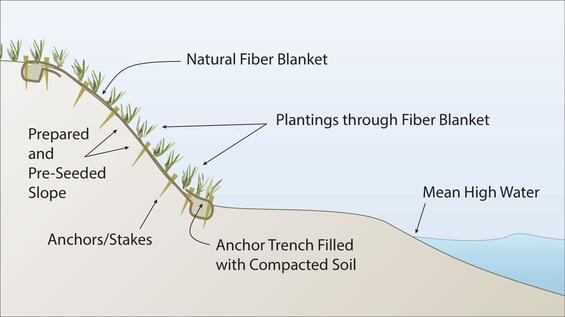
This figure shows a natural fiber blanket that has been installed using anchor trenches and planted with live plants. To promote project success, the bank surface was seeded with a mix of salt-tolerant grasses and stakes were installed throughout the blanket to ensure close contact with the ground surface.
Heavy Equipment
If heavy equipment is needed for a natural fiber blanket project, equipment access must be carefully planned to avoid destruction of existing vegetation; creation of ruts; destabilization of banks, beaches, or other landforms; impacts to wildlife and nesting habitat for protected shorebird and turtle species (i.e., species that are considered endangered, threatened, or of special concern in Massachusetts); and related impacts. When mechanical equipment is being used, contractors should keep hazardous material spill containment kits on-site at all times in case there is a release of oil, gasoline, or other toxic substances.
Wildlife and Fisheries Protection
If the project is proposed in or adjacent to habitat for protected wildlife species or horseshoe crab spawning areas, there may be limitations on the time of year that the project can be constructed. Information about the location of these resources and special permitting requirements can be obtained from the Natural Heritage and Endangered Species Program of the Massachusetts Division of Fisheries and Wildlife (for protected wildlife species) and the Massachusetts Division of Marine Fisheries (for horseshoe crabs). (Please note this fact sheet focuses on banks. Natural fiber blankets are typically not appropriate for use on dunes, particularly in habitat for protected shorebirds and turtles.)
Permitting and Regulatory Standards
Most options for addressing coastal erosion, storm damage, and flooding are likely to require a permit under the Massachusetts Wetlands Protection Act through the local Conservation Commission. Additional permits may be needed from the Massachusetts Department of Environmental Protection (MassDEP) Waterways Program and the U.S. Army Corps of Engineers if the project footprint extends below the mean high water line or seaward of the reach of the highest high tide of the year, respectively. Permits or approvals may also be required from other state agencies and local departments, depending on the location and the work involved. Often, Conservation Commission staff are available to meet with applicants early in the design process to go over the important factors that need to be considered.
Generally, regulatory programs are supportive of projects that involve non-structural approaches to managing coastal erosion, such as bioengineering projects with natural fiber blankets and vegetation, as opposed to hard structures. To obtain a permit, projects need to be designed to comply with regulatory requirements, including minimizing or avoiding impacts to sensitive resource areas (e.g., horseshoe crab spawning habitat and endangered species habitat), which are protected by the various regulatory programs.
Professional Services Required
A landscape architect, biologist, engineer, or other environmental professional with experience designing, permitting, implementing, and successfully maintaining bioengineering projects in coastal areas should be consulted to: 1) identify regulatory requirements that must be addressed and ensure the project fully conforms with those requirements; 2) determine the conditions at the site, such as the history of erosion, exposure to wind and waves, soil types, and runoff patterns that will affect the choice of materials for the site; 3) identify any existing conditions including over-steepened slopes and the presence of invasive species that must be considered as part of the design; 4) identify the appropriate natural fiber blanket and vegetation for the site conditions; 5) determine the volume and composition of fill, if needed; 6) determine the best time of year to install the various components of the project; 7) develop an access plan if any heavy equipment is needed; 8) prepare plans for and oversee permitting; and 9) prepare design specifications for and oversee construction. It is also recommended that the consultant be involved in the monitoring and maintenance of these projects.
Project Timeline
It may take as little as two to six months to have a bioengineering project with natural fiber blankets and vegetation designed, permitted, and installed, assuming only a Massachusetts Wetlands Protection Act permit is required. It can take longer, however, depending on the factors involved. Factors influencing this timeline include the contractor’s experience with designing and permitting similar projects, completeness of permit applications, special considerations in the permitting process (such as objections by abutters, sensitive resources to be protected, and availability of access for construction), the need for special timing to avoid impacts (e.g., a prohibition on construction during endangered species nesting season), special timing needed for planting vegetation, and/or weather conditions during construction.
Maintenance Requirements
Bioengineering projects with natural fiber blankets and vegetation require ongoing maintenance to ensure their success. Maintenance requirements will vary greatly depending on site conditions. As with all bioengineering projects, maintenance is initially required to ensure that the vegetation that has been planted becomes successfully established (such as watering and replacing dead plants). Blankets and plantings should also be inspected frequently and areas of erosion, areas where the blanket is no longer in contact with the soil, and stakes or staples that are not flush with the ground should be addressed immediately to avoid further deterioration. Other maintenance activities include replacing eroded fill, re-establishing a smooth surface under the blanket, re-anchoring or replacing blankets as needed, and reseeding and replanting vegetation at the appropriate time of year. The frequency of maintenance needed will largely depend on the proximity of the bank to the reach of high tide and the frequency and severity of rain events and coastal storms. Because the replacement of sediment and plants removed by storms is typically necessary, the original permit application should include a maintenance plan. This plan should specify any replacement materials and activities that may be used on the site and how the site will be accessed so that maintenance can be conducted without additional permitting.
Project Costs
With bioengineering projects, a range of options are available that give increasing levels of protection with increased construction costs. In addition, whenever you hire a professional to conduct work on your property, total costs will vary significantly based on site-specific considerations. The considerations that most influence costs of natural fiber blanket projects are the severity of erosion, condition of the existing site (e.g., proximity of the eroded area to the high tide line), density of the blanket selected, type and size of plants selected (plugs are less expensive than plants in containers), need for regrading, amount of fill required, presence of invasive species, and complexity of project design and permitting. For comparison with other shoreline stabilization options, bioengineering projects with natural fiber blankets have relatively low design and permitting costs, low construction costs, and low maintenance costs. See the StormSmart Properties chart, Relative Costs of Shoreline Stabilization Options (PDF, 132 KB), for a full comparison.
Additional Information
The following publications and websites also provide valuable information on bioengineering with natural fiber blankets and vegetation:
- CZM’s Coastal Landscaping website includes information on landscaping coastal areas with salt-tolerant vegetation to reduce storm damage and erosion.
- CZM’s Landscaping to Protect Your Coastal Property from Storm Damage and Flooding fact sheet (PDF, 1 MB) gives specific information for homeowners on appropriate plants for erosion control in coastal areas.
- CZM’s Environmental Permitting in Massachusetts briefly describes major environmental permits required for projects proposed in Massachusetts.
- Guidelines for Barrier Beach Management in Massachusetts (PDF, 12 MB), which was produced by the Massachusetts Barrier Beach Task Force in 1994, provides an overview of the Massachusetts Wetlands Protection Act Regulations and the function of beaches, dunes, and other resource areas (in Chapter 2). It also gives information on various erosion management techniques, their potential impacts, and measures to minimize those impacts (Chapter 5).
- Massachusetts Wetlands Protection Act Regulations (310 CMR 10.00) cover work in wetland resource areas and buffer zones.
- The Natural Heritage and Endangered Species Program website provides information on protected species in Massachusetts, habitat maps, and regulatory review for projects in or adjacent to these habitats.
- The Massachusetts Division of Marine Fisheries can provide information on horseshoe crab protection and other fisheries resources.
- The Massachusetts Ocean Resource Information System, or MORIS, is a web-based mapping tool for interactively viewing coastal data. MORIS data layers, such as endangered species habitat and shellfish, can help identify sensitive resource areas within or near the project site.
Other Available StormSmart Properties Fact Sheets
- Fact Sheet 1: Artificial Dunes and Dune Nourishment - Sand, cobble, or other sediment (of appropriate size) is brought in from offsite to build a new dune (i.e., mound of sediment) or add to an existing dune to protect inland areas from erosion and flooding. Dune projects are appropriate for almost any area with sufficient space to maintain some dry beach at high tide.
- Fact Sheet 2: Controlling Overland Runoff to Reduce Coastal Erosion - Runoff is water from rainfall, snowmelt, irrigation, and other sources that flows over the ground surface where it can cause erosion. Runoff flowing over a coastal bank, dune, or beach can exacerbate other coastal erosion problems. Runoff-control methods reduce the quantity and speed of water flow and change its direction to reduce erosion.
- Fact Sheet 3: Planting Vegetation to Reduce Erosion and Storm Damage - Plants can help control erosion by stabilizing soil and sediments with their roots, breaking the impact of raindrops and wave splash, and trapping sand to build dunes. Vegetation projects are appropriate for virtually any dune or bank with exposed sand or other sediments (although their effectiveness as a stand-alone option can be limited in locations regularly inundated or overwashed by tides and waves).
- Fact Sheet 4: Bioengineering/Coir Rolls on Coastal Banks - Coastal bioengineering projects use a combination of deep-rooted plants and erosion-control products made of natural, biodegradable materials, such as coir rolls. Coir rolls are long, cylindrical rolls of mesh packed with coir fibers (i.e., coconut husk fibers). They can be stitched together to provide a continuous physical barrier that helps reduce erosion of exposed sediments on a bank. Coir rolls can be used on both sheltered and some exposed sites where there is dry beach at high tide but may require more frequent maintenance in exposed conditions.
- Fact Sheet 6: Sand Fencing - Sand fencing helps capture sand to build dunes. It is typically made of thin, wooden slats that are connected with twisted wire to wooden or metal stakes. Because of its relatively low cost and minor impacts, sand fencing is appropriate at almost any site not reached by daily high tides and waves from minor storms, except areas with endangered or threatened shorebird or turtle nesting habitat.
- Fact Sheet 7: Repair and Reconstruction of Seawalls and Revetments - Recommended design practices for seawalls and revetments have advanced significantly over the last 50 years. Any repair or reconstruction project for seawalls and revetments—whether minor repairs or complete reconstruction—should therefore include design improvements based on the best available techniques to reduce impacts, improve structure longevity, and minimize maintenance costs.
- Comparison Chart - Relative Costs of Shoreline Stabilization Options (PDF, 132 KB) - This chart gives information on relative costs for each of these techniques.