
Introduction
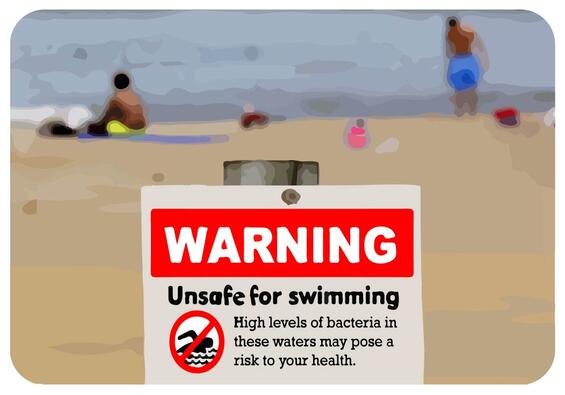
Beaches may be closed for swimming when bacteria from pet waste, septic systems, and other sources of stormwater pollution contaminate coastal waters.
Household contaminants—such as oil from automobiles, toxins from pesticides and cleaning products, soils and other sediments from landscaping activities, and bacteria from pet waste and septic systems—can contribute to stormwater pollution. But simple changes at home, from reducing fertilizer use to properly disposing of batteries and other hazardous household products, can help keep inland and coastal waters clean. This fact sheet focuses on how to minimize contaminants, organized into the following sections: Housekeeping and Maintenance Practices, Household Hazardous Waste, Trash, Pet Waste, “Green” Lawn and Garden Techniques, Septic System Maintenance, and Erosion and Sediment Controls. These common-sense practices can also be combined with vegetated buffers, rain gardens, vegetated swales, and other stormwater solutions to further protect local water quality (see the Stormwater Solutions for Homeowners fact sheet website for details on these and other options).
For information on reducing boating-related contamination, see CZM's Clean Boating web page and the Massachusetts Clean Marina Guide. The guide’s Boater Fact Sheets give specific information on: boat operation and fueling; hazardous waste and trash disposal; bilge water, graywater, and boat sewage; boat cleaning and hull/engine maintenance; and non-toxic cleaning alternatives. See CZ-Tip - Simple Steps to Clean Boating in Massachusetts for additional information.
Impacts to Neighboring Properties - Stormwater management practices must be designed to responsibly collect, convey, and/or infiltrate (i.e., filter into the ground) runoff from your property without transferring problems to neighboring properties, roads, and municipal drainage systems. Management practices that redirect or divert stormwater—such as re-grading the land surface or channeling water—can cause flooding problems in roadways or neighboring yards, basements, or leach fields (potentially causing a septic system failure). These projects must therefore be designed to ensure that no additional stormwater is transferred offsite. Carefully following design guidelines in the Stormwater Solutions for Homeowners fact sheets will help you avoid impacts to neighboring properties. If in doubt about offsite impacts, consult a professional, such as a civil engineer or landscape architect.
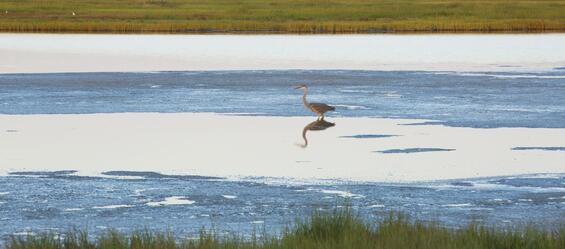
Photo credit: George Headley, Mass.gov Image Library
For properties near beaches, coastal banks, dunes, floodplains, rivers, salt marshes, wetlands, and other “resource areas” protected under the Massachusetts Wetlands Protection Act,* “green” lawn and garden practices, proper septic system maintenance, and erosion and sediment controls are particularly beneficial for helping to reduce stormwater impacts. If these projects involve alterations near or within a resource area, however, a permit through the local Conservation Commission may be required. To maximize the benefits and avoid negative impacts to resources and adjacent properties, permitted projects must be properly designed, installed, and maintained. For example, regrading projects or those that redirect water flow should be sited so that runoff does not flow directly toward resource areas and cause erosion problems. In addition, short-term construction impacts must be avoided or minimized by providing erosion and sediment controls. Where work is within the 100-foot buffer zone (i.e., adjacent to but outside of any resource area), minor landscaping activities such as the planting of native trees, shrubs, or groundcover (excluding turf lawns) will not likely require a permit if the work is minimal and will not cause excessive land disturbance. For any project, homeowners are encouraged to contact their local Conservation Commission before undertaking work to determine whether a resource area exists, what permitting requirements may apply, and how to avoid impacts.
*MGL Chapter 131, Section 40 and corresponding regulations at 310 CMR 10.00.
Housekeeping and Maintenance Practices
Many common housekeeping or maintenance activities have the potential to harm human health and the environment. Products such as motor oil, antifreeze, and car-wash soaps pose a particular threat when used outdoors where they are likely to run off into storm drains or waterbodies. The following options can help reduce these risks.
- Environmentally friendly cleaning products - Phosphates found in many commercial soaps can cause the overgrowth of algae and weeds in rivers, streams, lakes, ponds, and coastal waters, harming fish populations and other aquatic life. Therefore, when washing cars, boats, yard-care equipment, house siding, or other items outdoors, only use phosphate-free cleaning products. In addition, since many cleansers also contain toxic chemicals, choose eco-friendly commercial products or try making your own “green” cleaners out of materials such as baking soda and vinegar. See the CZ-Tip - Get Your Home Squeaky Green-Clean! for information on these alternatives.

A common cause of excess algae growth in waterbodies is runoff contaminated with phosphorus and nitrogen—nutrients found in cleansers, fertilizers, and human and animal waste. (Photo credit: Mass.gov Image Library)

Oil spills are extremely harmful to habitats, fish and wildlife, and humans if washed offsite—so absorb leaks as soon as possible (with baking soda or similar materials) and sweep up the debris and dispose of it in the trash.
- Car washing - Instead of washing your car at home, take it to a commercial car wash where wash water is collected for recycling and/or treatment. In addition, the high-pressure system of a commercial car wash typically uses significantly less water than your hose (35 to 50 gallons compared to 80 to 140 gallons). If you do wash a car at home, park it on a lawn, gravel area, or other surface that can absorb and filter the water to help reduce runoff. Also, use environmentally friendly soap (or preferably no soap at all), or spot-clean with an eco-friendly cleaner and a rag. See the Massachusetts Clean Water Toolkit’s Car Washing page for details.
- Equipment leaks - Maintain equipment and fix and clean up fluid leaks from cars, lawnmowers, or boats as soon as possible to prevent oil, gasoline, antifreeze, and other toxic substances from washing to storm drains and local waterbodies. Placing gas and oil cans within secondary containers can also retain spills if the cans crack. Clean any spills or drips as soon as possible by absorbing the liquid with cat litter, cornstarch, or baking soda and then sweeping up the debris and disposing of it in the trash.
- Snow and ice removal - Rock salt (sodium chloride), a common deicer used on paved surfaces, can harm aquatic life, damage plants and soils, and degrade drinking water resources. Sand is non-toxic but can still have damaging effects by smothering habitats and transporting attached nutrients, metals, and other contaminants. To minimize impacts, shovel snow as quickly as possible to avoid ice buildup, or use alternative deicers, such as ashes or kitty litter. When shoveling, avoid placing snow on storm drains, which carry contaminants to local waterbodies. Piles of snow and ice can also prevent water from reaching the storm drain, leading to localized flooding or icing. Instead, shovel snow onto lawns or other surfaces in your yard that can absorb and filter snowmelt. Sand can be swept up, collected, and either reused or disposed of at a solid waste facility.
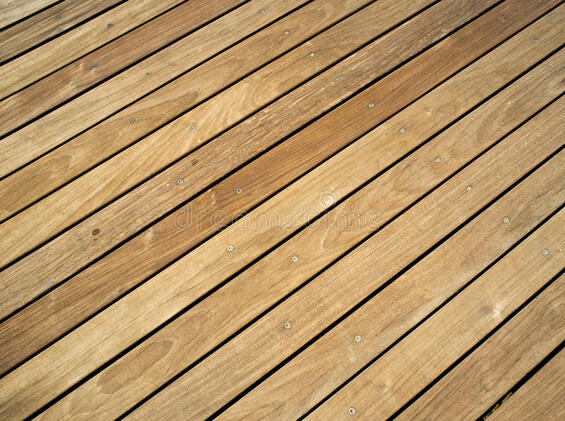
Pressure treated wood can contain chromium, copper, and arsenic—contaminants that can contribute to runoff pollution.
- Pressure treated wood - When selecting building materials, avoid using pressure treated wood for decking, playground equipment, or other outdoor structures. Though lumber treated with chromated copper arsenate, a preservative containing poisonous arsenic, was banned by the U.S. Environmental Protection Agency (EPA) in 2003, pre-existing treated structures may still contain arsenic. Moreover, current wood treatments typically still contain copper and biocides that may be harmful to the environment. Instead of using or reusing pressure treated wood, choose non-treated hardwoods (such as cedar and redwood), wood composites (such as those made of 100 percent recycled wood and plastic), or non-wood alternatives (such as metals and plastics). See the Massachusetts Department of Environmental Protection (MassDEP) Q&A: Pressure Treated Wood page for additional details.
Household Hazardous Waste
Automotive fuels and oils, paints and pesticides, chemical detergents, and other household materials can contain lead, mercury, chromium, cadmium, and other contaminants that are harmful to people, animals, and the environment. If disposed of improperly, these hazardous wastes can pollute ground and surface waters. To help prevent such contamination, properly manage and dispose of the following materials.

- Motor oil - Motor oil should not be thrown in the trash, dumped on the ground, or poured into the sewer system or storm drains. Instead, return used oil to the store where it was purchased (Massachusetts law requires retailers to accept up to two gallons of used oil per person per day, with the receipt), or bring it to a municipal collection center. See MassDEP’s Motor Oils & Filters section within the Guide to Safely Managing Hazardous Household Products (PDF, 345 KB) for additional details.
- Other hazardous household liquids - Do not dump pesticides, paints, stains, or any other chemical down a drain or storm drain. Take oil-based paints and stains and unused pesticides or herbicides to municipal collection programs or commercial hazardous waste facilities, or save the materials for a hazardous household waste collection day. Latex (water-based) paint should be dried to solid form and then disposed of as trash. See MassDEP’s Safely Manage Hazardous Household Products page for information on what to do with specific items, along with details on nearby collection facilities and community programs.
- Lead paint - When removing paint or repairing or reconstructing a house that was built prior to 1978, be aware that lead paint may be present and has the potential to contaminate soils and stormwater runoff, as well as significantly harm human health (particularly in children). Hire a certified inspector to determine the severity of lead-based paint hazards and use only lead-safe certified home contractors to ensure that appropriate protective containment measures are used. For more information on disposing of lead-based materials, see MassDEP Lead Information, the Getting the Lead Out: Guidance for Homeowners & De-Leading Contractors fact sheet (PDF, 29 KB), and The Massachusetts Lead Law for additional safety requirements.
- Pressure treated wood - Do not reuse pressure treated wood, particularly for high-contact uses such as mulch or garden boxes. Small amounts of pressure treated wood can be disposed of with your trash, while larger quantities may need to be sent to an approved solid waste handling facility. See MassDEP’s Q&A: Pressure Treated Wood page for details.
- Other household products - See MassDEP’s How & Where to Recycle for additional guidelines and requirements for various household products, ranging from building materials to packing peanuts.
Trash
Improperly disposed of trash can travel by wind or stormwater to streams, rivers, and coastal and ocean waters where it can harm wildlife and negatively impact recreation, navigation safety, and human health. This material can remain in the environment for extended periods of time, particularly plastic waste. Plastics also degrade and fragment into tiny particles known as “microplastics,” which can be ingested by animals, introducing toxic chemicals into the food chain. Follow these tips to properly manage trash.
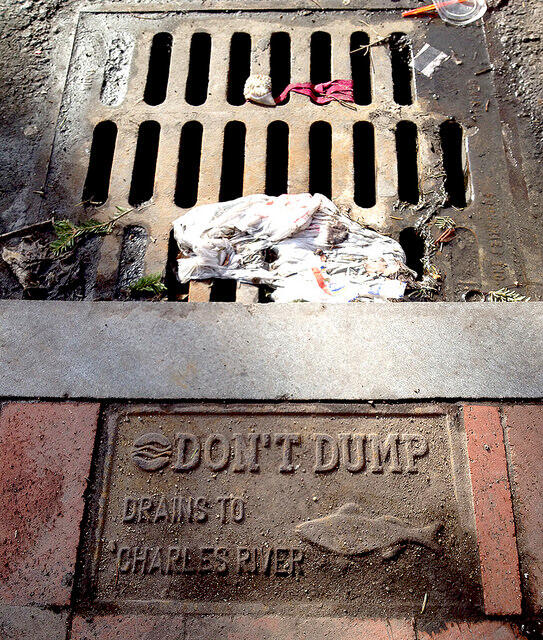
Storm drains can carry trash and stormwater pollutants to local waterways.
- Reduce, reuse, recycle - Choose reusable items and use fewer disposable ones. For example, you can bring your own bags to the grocery store, carry reusable water bottles and food containers, and purchase fewer heavily packaged foods. See the EPA Trash-Free Waters website for information on how to “unpackage your life” and CZ-Tip - Repurposing with a Purpose for ideas on how to reuse many common household items. Also, recycle appropriate items in curbside recycle bins or take them to the transfer station. Glass and metals can be infinitely recycled without losing structural integrity, and 92% less energy is used when aluminum cans are made from recycled cans rather than from virgin aluminum. To find other recycling facts and to determine what items can and cannot get recycled, see the Recycle Smart website.
- Trash receptacles - Dispose of trash in proper receptacles, which should be securely covered to prevent contents from being scattered by animals or blowing away and to keep water from mixing in with the trash.
- Storm drains - Do not dispose of trash, sand, or other materials in storm drains. Not only can the storm drains become clogged, but stormwater can carry these contaminants to the nearest waterbody, impacting water quality and habitats.
Pet Waste
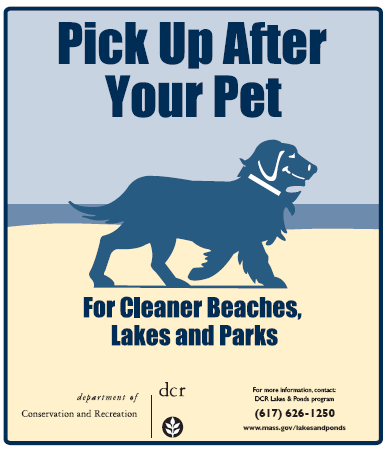
Properly disposing of pet waste helps prevent bacterial contamination of swimming beaches and shellfish beds. (Sign courtesy of the Massachusetts Department of Conservation and Recreation)
Pet waste can contaminate waterbodies with bacteria and other pathogens, potentially impacting human and animal health and requiring areas to be closed for fishing or shellfishing. Pet waste left in yards can also spread disease (for example, Toxocariasis—an infection from the parasitic roundworm—can cause vision loss, rash, fever, or cough, and is a particular threat to children exposed to the eggs found in dirt). Consequently, always pick up pet waste and dispose of it in the trash or flush it down a toilet where it can be treated. When walking a pet, carry a scooper or bags to pick up the waste, and never leave bags containing pet waste on the beach, trail, or side of the road. These bags are not only unsightly, they can end up in local waterbodies and become a source of pathogens and marine debris. For the same reasons, never throw the bags and/or waste down a storm drain. See Massachusetts Clean Water Toolkit’s Pet Waste Management page for details
“Green” Lawn and Garden Techniques
Traditional lawn and garden practices have the potential to increase the quantity and contamination levels of stormwater runoff. The following strategies will help reduce these problems (for more details, see the Stormwater Solutions for Homeowners Fact Sheet : “Green” Lawn and Garden Practices or the Greenscapes website, including their Greenscapes Guide).

This oceanfront property features a small lawn and ample perennials, shrubs, and trees to help absorb stormwater and prevent contaminants from flowing to the ocean.
- Less lawn - Mowed grass does not slow and absorb water as well as shrubs, perennials, longer grasses, and other vegetation—especially since soils under lawns tend to get compacted, and most lawn grasses have shallow roots. In addition, lawns typically need fertilizers, herbicides, pesticides, and irrigation, leading to contaminated runoff. To help reduce these stormwater impacts, limit lawns to pathways and recreational areas and avoid mowing right up to the edge of a waterbody or sensitive resource area, such as a salt marsh, wetland, or coastal bank. Good alternatives to lawn grasses include fescue mixes (typically a mix of native and non-native species that can be left unmown) and hardy, low-growing groundcovers, such as bearberry (Arctostaphylos uva-ursi) and wild and barren strawberries (Fragaria virginiana and Geum fragarioides). Another good choice for turf areas is Pennsylvania sedge (Carex pensylvanica) and other native sedges, which tolerate moderate foot traffic and only need to be mowed once per season.
- Low-maintenance plants - Select and plant trees, shrubs, perennials, and non-turf grasses that require little maintenance, watering, and pest and disease control. Choose native species that are adapted to local conditions (see CZM’s Coastal Landscaping website for options—many that work for both coastal and inland sites), plant at the appropriate time of year (generally spring or fall), and follow the specific instructions on plant labels for general care and maintenance
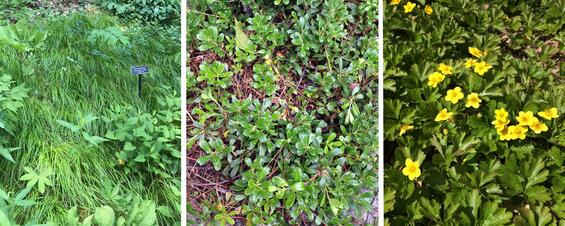
Pennsylvania sedge, bearberry, and barren strawberry are excellent low-maintenance plants.
- Fertilizers - Before adding commercial fertilizers on lawns and gardens, have your soil tested for moisture, nutrients, and pH by the University of Massachusetts Amherst’s Soil and Plant Nutrient Testing Laboratory. If the soil test shows that additional nutrients are needed, try organic methods, such as leaving grass clippings on the lawn after mowing and applying compost. If organic options are not available, use a slow-release fertilizer that controls the release of nitrogen, reducing the potential for runoff pollution. Note: Water quality laws in Massachusetts prohibit the use of phosphorus-containing fertilizer on lawn or non-agricultural turf unless a soil test indicates additional phosphorus is needed, and then only during the first growing season. If you do not meet these requirements, check the fertilizer bag for the percentage of nitrogen (N), phosphorus (P), and potassium (K), and use only fertilizers with “0” phosphorus.
- Pesticides - Rather than using commercial pesticides, provide wildlife habitat to attract birds and bats that will eat insects. The National Wildlife Federation has extensive information on their Garden for Wildlife website.

Drip-tubing, which allows water to slowly seep into the root zone, helps prevent runoff.
- Watering - Only water when necessary, and water strategically to limit runoff and improve plant survival. Follow the specific watering instructions on plant labels and seed packets, and adjust amounts if necessary for weather, time of year, and site conditions—and remember that unlike lawns, native plants typically do not require watering once they become established. Soaker hoses or drip tubing can be used to allow water to slowly seep into soils without creating runoff or wasting water, and timers can be used so that sprinklers run at desired times (often early morning when less water is lost to the heat of the day). Also, aerate compacted soils annually and apply a layer of compost to significantly reduce compaction and improve the capacity for water to infiltrate (i.e., filter into the ground). You can also use water that has been collected and stored in rain barrels to maximize your conservation efforts (see Stormwater Solutions for Homeowners Fact Sheet: “Green” Lawn and Garden Practices). For detailed information on watering methods, such as drip irrigation, sprinklers, and hand watering, see the Ashton Real Estate Group’s Smart Landscaping: A Guide to Water-Efficient Irrigation.
Septic System Maintenance
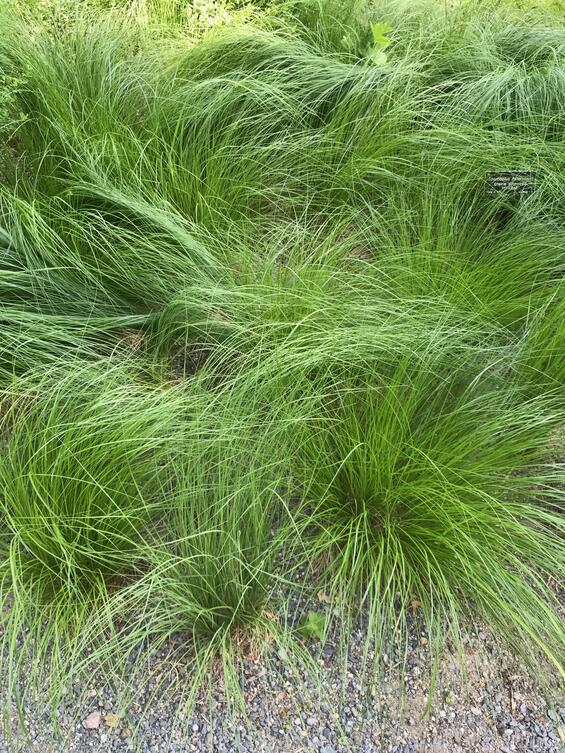
Native wildflowers and grasses, such as this prairie dropseed, make good cover plants for septic mounds and drain fields.
Bacteria and nutrients from septic systems can contaminate local waterbodies, harming human health and wildlife habitat. The following strategies can help keep septic systems in proper working order.
- Soil moisture - Saturated soils in the drainfield can prevent a septic system from operating properly. Consequently, limit watering of any lawn over the septic system. Also, divert and redirect water flowing from roofs, sump pumps, driveways, and other sources away from the drainfield and to a vegetated surface, such as a vegetated buffer, rain garden, or vegetated swale, where it can be infiltrated.
- Appropriate plants - Plant grasses or small perennials over the septic system to help stabilize the soils and take up excess water. Do not plant trees and shrubs over the drainfield or where roots can damage the drain lines.
- Septic system maintenance - See MassDEP’s Caring for Your Septic System web page for additional septic system maintenance tips for both inside and outside the home.
Erosion and Sediment Controls
Construction projects, removing soil and adding fill, grading ground surfaces, and other activities that expose soils can cause concentrations of silt and sediments to run off to waterbodies, salt marsh, and other wetland areas. These silts and sediments can reduce plant growth, smother habitats, and carry attached pollutants, such as nitrogen and phosphorous. The recommendations below can help address these problems.
- Before and during construction - Install erosion and sediment controls, such as silt fences and compost filter socks, to capture sediments before they run offsite. Minimize soil exposure by sequencing the timing of the disturbance (i.e., do not leave the entire site exposed at one time) and temporarily covering disturbed areas with erosion-control blankets. If mounds of soil remain onsite for more than two weeks, they can be sowed with seed to grow a stabilizing vegetative cover.

Compost filter socks can be placed down slope from exposed soils to prevent muddy water from flowing offsite and into roads, adjacent yards, or wetland resource areas.
- After construction - Once land disturbance activities are completed, stabilize the soils as soon as possible by seeding with a native seed mix or planting vegetation. A natural fiber blanket can also be used to prevent erosion and stabilize soils until plants become established. Live vegetation can be planted through the blanket or a seed mix can be spread under it (see StormSmart Properties Fact Sheet 5: Bioengineering - Natural Fiber Blankets on Coastal Banks for more information). Once plantings mature, the dense cover will slow runoff, stabilize soils, and filter and capture sediments to reduce stormwater impacts from your property.
- More Erosion and Sediment Control Resources - See the Stormwater Solutions for Homeowners Fact Sheet: Preventing Erosion and the MassDEP Massachusetts Erosion and Sediment Control Guidelines for Urban and Suburban Areas (PDF, 1.9 KB) for detailed guidance, along with other measures to help reduce erosion on disturbed sites and prevent sedimentation of resources.
Additional Information
- For related fact sheets, see the CZM Stormwater Solutions for Homeowners fact sheet website.
- The CZM Coastal Landscaping website has details on landscaping coastal areas with salt-tolerant vegetation to reduce storm damage and erosion.
- CZM’s StormSmart Properties Fact Sheet 2: Controlling Overland Runoff to Reduce Coastal Erosion provides general approaches for homeowners to help control runoff, including limiting impervious surfaces and redirecting the flow of water away from resource areas.
- MassDEP's Clean Water Toolkit includes Best Management Practices to prevent and control stormwater runoff, with links to fact sheets on Permeable Paving, Preserving Natural Vegetation, Soil Amendments, Dry Wells, Subsurface Drains, Green Roofs, Filter Berms, and other stormwater control options.
- The Metropolitan Area Planning Council’s fact sheets on Permeable Paving and Green Roofs give an overview of the benefits, limitations, design principles, and costs of these stormwater management options.
- The Greenscapes website focuses on nature-friendly lawn and gardening practices and includes a downloadable Greenscapes Guide that details how to use attractive “green” landscaping practices to reduce pollution, conserve water, support wildlife, and protect against climate change.
- The New Hampshire Department of Environmental Services Homeowner’s Guide to Stormwater Management Do-It-Yourself Stormwater Solutions for Your Home (PDF, 6 MB) provides comprehensive guidance and specific details on implementing various stormwater control techniques, such as pervious walkways and patios.
- EPA's Soak Up the Rain website includes outreach tools, how-to guides, and many other resources on reducing the impacts of stormwater runoff.
Other Available Stormwater Solutions Fact Sheets
Fact sheets are currently available on these techniques:
- Vegetated Buffers - Trees, shrubs, high grasses, perennials, and other vegetation can be strategically planted to help slow, capture, and filter runoff and reduce stormwater impacts.
- “Green” Lawn and Garden Practices - Environmentally friendly yard care methods—such as planting native species, conserving water, and reducing fertilizer and chemical use—help to protect water quality and can save time and money.
- Rain Gardens - Rain gardens are specially designed and planted depressions in the ground that collect, filter, and treat stormwater.
- Vegetated Swales - Vegetated swales are channels with moisture-loving plants and amended soils that intercept, treat, and slowly convey stormwater runoff to where it can be effectively infiltrated.
- Reducing Impervious Surfaces - Impervious surfaces (such as asphalt driveways and concrete patios) allow greater volumes of stormwater to flow quickly offsite, carrying contaminants and causing local flooding and erosion. Replacing impervious surfaces with gravel driveways, planted areas, and other options that infiltrate or absorb water can significantly reduce stormwater problems.
- Preventing Erosion - Stormwater can carry sediments that fill storm drains, obstruct channels, smother wetlands, and cause other water quality and habitat impacts. Erosion and sediment controls can help slow and redirect stormwater, reducing erosion and capturing sediments and attached pollutants on site.