
This webpage compiles guidance and resources from trusted partners to help early educators and providers keep children safe during the summer months. While these materials are intended for informational purposes and do not constitute medical advice, they offer practical recommendations and best practices to support safe, healthy summer experiences for children.
- This page, Summer Safety Guidance and Resources, is offered by
- Department of Early Education and Care
Summer Safety Guidance and Resources
Table of Contents
Summer Safety Guidance and Resources (Full PDF)
Summer Safety Guidance, Open PDF file, 2.94 MB
(English, PDF 2.94 MB)
Outdoor Play Safety
Public Playground Safety Handbook (PDF)
Source: U.S. Consumer Product Safety Commission (CPSC)
Handbook for assessing playground safety.
Tips and Infographics
Source: National Program for Play Area Safety
Provides information on how to evaluate the safety of a playground and how to stay cool while playing.
Summer Safety Tips (PDF)
Source: Head Start National Center on Health, Behavioral Health, and Safety
Covers weather, sun protection, hydration, water safety, playground safety, insect repellent, and helmets.
Playground Safety Tips for Early Childhood Programs
Source: Head Start
Video with playground safety tips for early childhood programs.
Sun Safety
EEC Reminder: Only parental consent is required for programs to apply sunscreen to children. A physician's approval is not required. For more information, see the EEC Family, Group, and School Age Child Care Regulations on administering medications (pg 42).
Sun Safety: Information for Parents About Sunburn & Sunscreen
Source: HealthyChildren.org
Appropriate sun care for children of all ages, including how to choose protective clothing and different types/SPF levels of sunscreen.
Summer Sun, Heat & Air Quality – Tips to Keep Kids Safe
Source: HealthyChildren.org
Touches on many different topics related to staying in the heat, poor air quality, and pollution.
The UV Index
Source: United States Environmental Protection Agency
Information about the UV Index, including how to monitor it using websites and mobile apps.
Protect Your Skin on "Don't Fry Day" (JPG file)
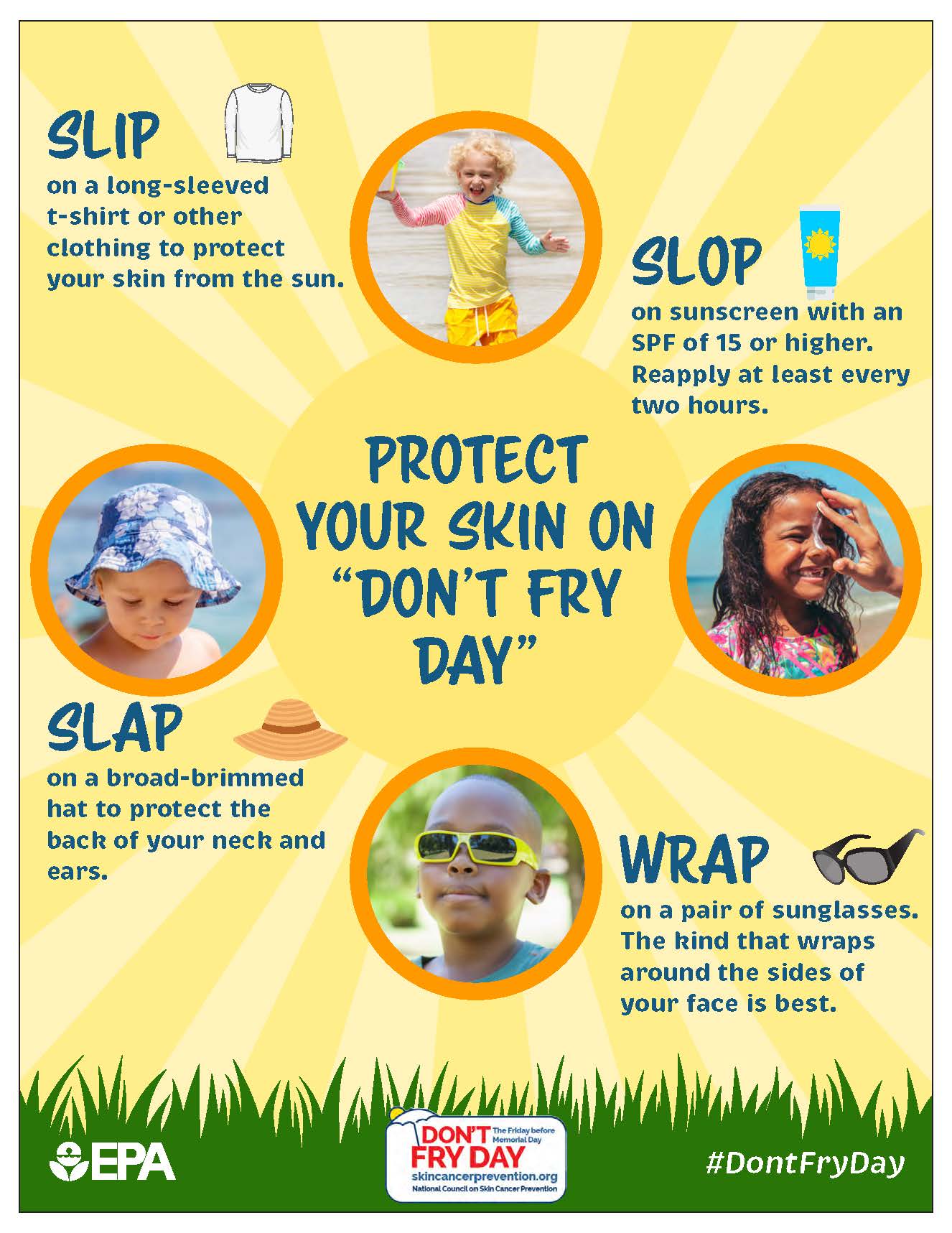
Source: United States Environmental Protection Agency
Printable poster with guidance on sun protection.
Heat Safety
Extreme Heat Best Practices for Operators of Recreational Camps for Children (PDF)
Source: Massachusetts DPH and BCEH
Tips for preventing and treating heat-related illness, how to recognize symptoms and understand when to seek medical attention. Learn about populations that may be more vulnerable to unhealthy heat, and how to keep people safe in the heat at a beach or pool.
What Should I Do During an Extreme Heat Event? (PDF)
Source: Centers for Disease Control and Prevention and United States Environmental Protection Agency
Easy-to-follow “Dos and Don’ts” guidelines during an extreme heat event.
Massachusetts Unhealthy Heat Forecast
Source: Massachusetts Department of Public Health and Bureau of Climate and Environmental Health
Provides daily updates and alerts for unhealthy heat and extreme heat events.
Healthy Hydration Campaign Toolkit
Source: American Academy of Pediatrics
#ChooseWater posters and social media graphics available in English and Spanish. Also provides short informational videos and articles on how to introduce water to children.
Recommended Drinks for Children Age 5 & Younger
Source: HealthyChildren.org
Establishes water and plain milk as the best choice beverages for young children and provides additional information about the effects of different drinks on the health of children.
Heatstroke in Cars: Safety Tips (PDF)
Source: Massachusetts Department of Public Health
Important reminders to help prevent children from being left in hot vehicles and reduce the risk of heat stroke.
Tick & Environmental Exposure Prevention
Ticks Can Make You Sick (PDF)
Source: Massachusetts Department of Public Health
Printable poster with simple reminders — use bug spray and check your body for ticks after going outside.
How to Do a Tick Check (PDF)
Source: Massachusetts Department of Public Health
Shows key spots on the body where ticks might be found, and how to identify common types of ticks.
Preventing Lyme Disease in Children
Source: Center for Disease Control and Prevention
3-minute video featuring a CDC pediatrician sharing steps that can be taken to help prevent tick bites and Lyme disease.
MassAir Online
Source: Massachusetts Department of Environmental Protection
Provides daily measures of air quality across the Commonwealth, with information about health implications.
Air Quality
Source: Child Care Aware® of America
Provides an overview of the health risks of air pollution in children, and information on assessing indoor and outdoor air quality.
Water Safety
What You Can Do to Stay Healthy at Splash Pads
Source: Centers for Disease Control and Prevention
“Dos and Don’ts” to prevent waterborne illness from splash pads.
CDC Fact Sheet with simple tips for staying healthy during and after playing at the splash pad.
Drowning Prevention for Curious Toddlers: What Parents Need to Know
Source: HealthyChildren.org
Supervision tips to keep toddlers safe at water play venues.
Autism, Wandering, and Water Safety: Information for Caregivers
Source: Massachusetts Department of Developmental Services
Water safety tips for children with Autism Spectrum Disorder (ASD).
Beach Safety for Families: How to Keep Kids Safe in the Sun, Sand & Surf
Source: HealthyChildren.org
Simple tips and considerations for ensuring safety at the beach.
Injury Prevention
Choking Hazards
Source: Centers for Disease Control and Prevention
Lists common choking hazards and offers prevention tips to ensure safe eating environments for infants and toddlers.
Non-Fatal Burn Injuries in U.S. Infants, Children, and Adolescents (PDF)
Source: Children's Safety Network
Statistics of non-fatal burn injuries to children by type, body area, and consumer products. Also provides prevention tips.
Window Falls Prevention
Source: Boston Public Health Commission
Guidance on preventing window falls and window-covering injuries, including information about window guards, window stops, furniture placement, and other safety measures.
Environmental Health
Radon in Schools and Child Care Programs
Source: Massachusetts Department of Public Health
What radon is, the dangers it poses, and how to find out if a building has radon.
Property Questionnaire
Source: Massachusetts Department of Public Health
Complete a property questionnaire to request an environmental check of your new or existing child care program’s location.
Videos and Training for the "Choose Safe Places" Program
Source: Massachusetts Department of Public Health
Learn how to choose a location for a child care program that is safe from environmental hazards, and how the Department of Public Health can help.
Choose Safe Places: A Resource for Early Childhood Educators
Source: Massachusetts Department of Public Health
A guide for choosing the right location for a child care program that protects children’s health and helps the business succeed.
Protecting Children from High Levels of Lead in Soil, Open PDF file, 503.76 KB
(English, PDF 503.76 KB)
Guidance on reducing children’s exposure to lead-contaminated soil through safe outdoor play practices, proper hygiene, landscaping strategies, and other preventive measures to help keep children healthy.
Lead in Drinking Water (PDF)
Source: Massachusetts Department of Public Health
This fact sheet addresses common questions about lead and health.
Lead in Drinking Water for Schools and Child Care Facilities (PDF)
Source: Massachusetts Department of Public Health
This fact sheet provides information on lead and health, how lead may get into the drinking water at your school or child care facility, and how children, teachers, and staff can avoid exposure.
Help Us Improve Mass.gov with your feedback
Thank you for your website feedback! We will use this information to improve this page.
If you would like to continue helping us improve Mass.gov, join our user panel to test new features for the site.