
Current Drought Status
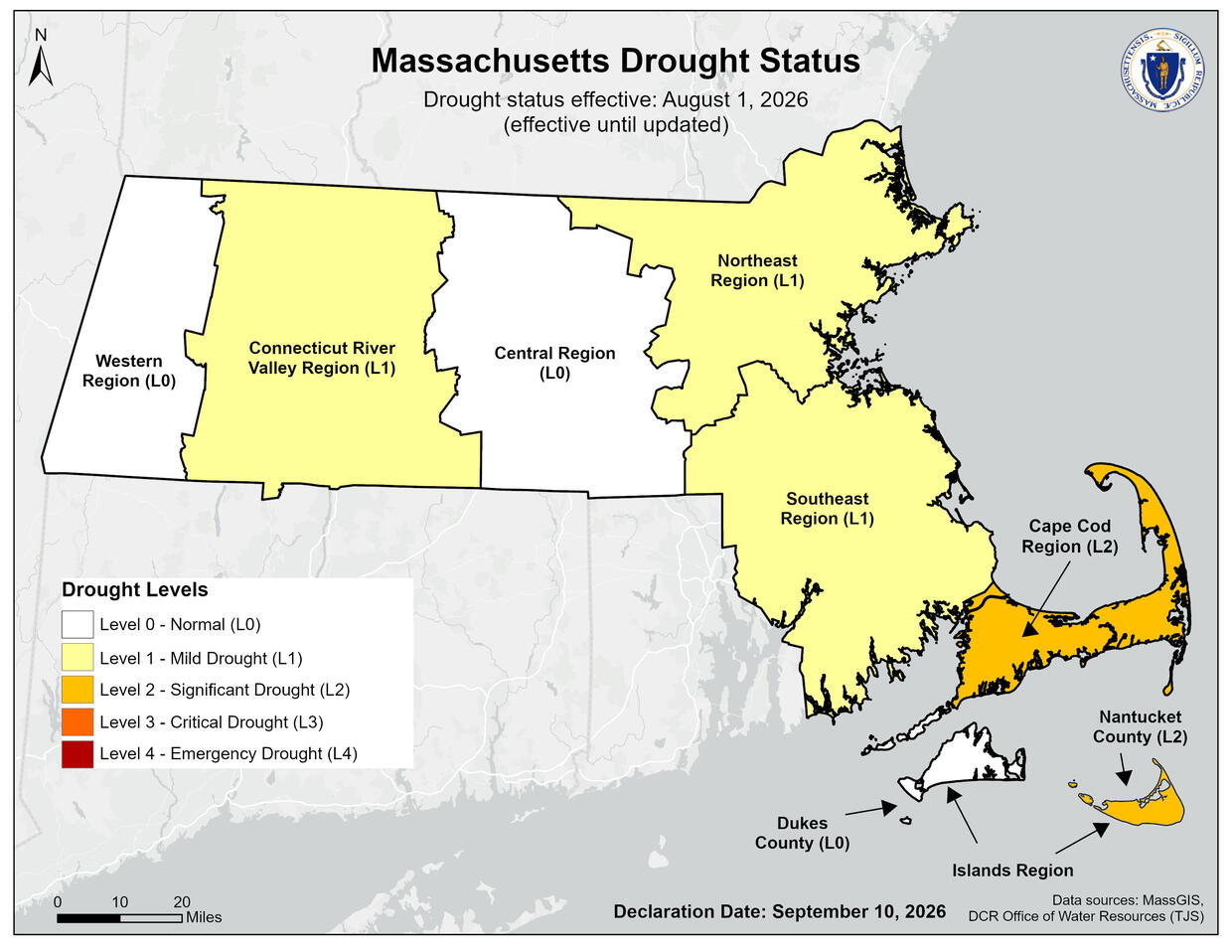
*The drought levels shown in the map above are in effect until the next drought declaration
September 10, 2026:
Today, Energy and Environmental Affairs (EEA) Secretary Rebecca Tepper declared the Central Region has returned to normal conditions. The Connecticut River Valley and Northeast Regions have improved to a Level-1 Mild Drought, while the Western Region and Dukes County remain at normal conditions.
Regions in current drought levels are:
- Level 2 – Significant Drought: Cape Cod and Nantucket County
- Level 1 – Mild Drought: Connecticut River Valley, Northeast and Southeast
Following a wet July, August was drier than normal, with 1.5 to 4 inches of rain across Massachusetts. Essex, Suffolk, Berkshire, Barnstable and Nantucket counties saw some of the lowest rainfall totals. Overall, rainfall from June through August was near or above normal across much of the state. However, longer-term rainfall deficits remain in many parts of the state.
As outlined in the Massachusetts Drought Management Plan, communities in Level 2 – Significant Drought and Level 1 – Mild Drought should continue taking steps to conserve water. Residents can report dry environmental conditions and submit photos to help monitor the situation on the Massachusetts Water Impact Reporter. Additionally, a FAQ is now available for questions regarding the current drought status and water conservation; and private well owners can learn more for information on how the drought may impact them.
State agencies will continue to closely monitor and assess conditions across the state, coordinate any needed dissemination of information to the public, and help federal, state, and local agencies prepare additional responses that may be needed in the future. The DMTF will meet again on October 8th at 9:30 AM. For further information on water conservation and what residents can do, visit the EEA’s drought and water conservation pages.
Below are recommendations for communities and individuals living and working within Level 1 – Mild Drought and Level 2 – Significant Drought Regions including those utilizing a private well. Residents and businesses are strongly urged to check with their local water systems in case more stringent water restrictions are in place. Many systems may have other more severe local conditions and constraints on water supply.
For Regions in Level 2 – Significant Drought
Residents and Businesses:
- Minimize overall water use;
- Follow local water use restrictions;
- Fix indoor leaks, such as from toilets, faucets, and showers, which result in more than 60 percent of indoor use; and,
- For larger buildings and businesses, conduct water audits to identify areas of leaks and potential water conservation opportunities.
Immediate Steps for Communities/Municipalities:
- Limit or prohibit washing of hard surfaces (sidewalks, patios, driveways, siding), personal vehicle or boat washing; and,
- Establish water-use reduction targets for all water users, identify top water users and conduct targeted outreach to help curb their use.
Short- and Medium-Term Steps for Communities/Municipalities:
- Establish a year-round water conservation program that includes public education and communication, taking advantage of the state’s library of outreach materials;
- Provide timely information to local residents and businesses;
- Implement or establish drought surcharge or seasonal water rates;
- Check emergency inter-connections for water supply; and,
- Develop or refine a local drought management plan using guidance outlined in the state Drought Management Plan.
For Regions in Level 1 – Mild Drought
Residents and Businesses:
- Minimize overall water use;
- For larger buildings and businesses, conduct water audits to identify areas of leaks and potential water conservation opportunities;
Communities/Municipalities:
- Establish a year-round water conservation program that includes public education and communication, taking advantage of the state’s library of outreach materials;
- Provide timely drought and water conservation information to residents and businesses;
- Check emergency inter-connections for water supply; and,
- Develop a local Drought Management Plan.
Past Droughts and Declaration
Drought History
The information in this Drought Status History dates to 2001, when the Massachusetts Drought Management Plan was developed in response to a period of deficient precipitation that began in 1999. The most severe drought of modern times was the drought of the 1960s, equivalent to a drought emergency. A less severe drought occurred in the early 1980s.
The Commonwealth experienced another impactful drought in 2016-2017 with drought levels reaching Level 4 Drought (Warning) out of five levels of drought; the drought impacted the agricultural sector, some water supplies, the natural environment and many habitats and species. Read more about the drought, how it fared and the state responses and actions.