
Video: Digital Accessibility and Equity Governance Board FY25 Annual Report Part 1
Skip this video Digital Accessibility and Equity Governance Board FY25 Annual Report Part 1.Executive Summary
Accessibility, inclusivity, and usability are essential to integrate and implement to produce and purchase digital services that are equitable and consumable for all. This includes the 26.5% of Massachusetts residents that identify as having a disability and individuals for whom English is not their primary or preferred language. The production, purchasing, and provisioning of accessible and equitable digital assets levels the playing field for all users to locate, interact with, and consume digitized content and channels to participate in programs, services, and activities provided by the Commonwealth. The need to increase and improve accessibility for both internal and external stakeholders is driven by user feedback as well as legal mandates, including Executive Order 614, signed in July of 2023, and the finalized ruling to amend Title II of the Americans with Disabilities Act for state and local government entities. Both stipulate the need to provide accessible, inclusive, and usable digital services.
Since the signing of Executive Order 614, the Digital Accessibility and Equity Governance Board has been mobilized to provide insight, oversight and guidance to contribute to the development and sustainability of a statewide digital accessibility program and strategic planning efforts. Three members of the public have been appointed to the Board as of June of 2024. The Commonwealth has hired a Chief Information Technology Accessibility Officer(“CIAO”) to lead the charge of creating a statewide strategic plan and developing and leading a digital accessibility program. The CIAO serves as chair of the Digital Accessibility and Equity Governance Board and has spearheaded initiatives related to policy updates, community outreach, accessibility training, and public reporting during fiscal year 2025 in partnership with Board members and additional stakeholders. The CIAO has also built a team: the Accessibility Center for Consulting, Education and Support Services (“ACCESS”), within the Executive Office of Technology Services and Security (“EOTSS”) to support the delivery and implementation of a digital accessibility and equity program for the Executive Branch. The Executive Office of Administration and Finance, Executive Office of Energy and Environmental Affairs, and Executive Office of Health and Human Services have hired Secretariat Information Technology Accessibility Officers (SIAOs) to provide leadership and expertise, advance programs, and broaden coverage within their respective secretariat. The Executive Office of Administration and Finance and Massachusetts Department of Transportation have each hired an additional Accessibility Specialist to support the SIAO.
Awareness and education around the various aspects of accessibility including digital content production, procurement of digital applications, and how individuals with disabilities interact with and consume digital services has increased in response to trainings developed and delivered by the ACCESS team. The updates made to the Enterprise Digital Accessibility Policy will pave the way forward to buying and building software and provide employees with requirements to embed accessibility into their work. The updates made to the design components to create a unified, accessible design system will provide the building blocks to develop software and increase usability for employees and constituents.
In October of 2024, the CIAO, with guidance from the Board, completed the development of a statewide digital accessibility and equity strategic plan. This plan, with specific recommendations, action steps, and requirements, will serve as the foundation to mature digital accessibility. Some SIAOs have begun and other SIAOs will be creating their secretariat implementation plans in partnership with the ACCESS team to align with the statewide strategic plan.
To provide additional support to executive offices and agencies, a new statewide contract, ITS82, was established in June of 2025 to replace ITS61. ITS82 will expand access to external vendor support for digital accessibility for public entities across the Commonwealth.
Video: Digital Accessibility and Equity Governance Board FY25 Annual Report Part 2: Background and Policy Context
Skip this video Digital Accessibility and Equity Governance Board FY25 Annual Report Part 2: Background and Policy Context.Background and Policy Context
The Commonwealth has a long history of supporting the rights of people with disabilities, starting with Article of Amendment 114 of the Massachusetts Constitution, which provides that no otherwise qualified person with a disability shall be excluded from participation in, denied the benefits of, or be subject to discrimination based on disability under any program or activity within the Commonwealth. The Commonwealth has built on this principle with the following laws and executive orders:
- Ch. 93, section 103: Equal rights “regardless of handicap or age”
- Ch. 151B: Unlawful to discriminate in employment and housing, etc.
- Ch. 272 section 98: Discrimination in places of public accommodation
- Executive Order Number 348: Establishing the state policy for providing access to electronic equipment and information technology for citizens with disabilities – revoked and superseded by EO 614
- Executive Order Number 559: Establishing the Office of Access and Opportunity within the Office of the Governor
- Executive Order Number 526: Regarding Non-Discrimination, Diversity, Equal Opportunity, and Affirmative Action – revoked and superseded by EO 592
- Executive Order Number 592: Ensures that non-discrimination, diversity, and equal opportunity are safeguarded, promoted, and reflected in state workplaces, programs, services, policies, activities, decisions, and contracts
- Executive Order Number 614: Establishing the Digital Accessibility and Equity Governance Board. As the office charged with overseeing digital compliance for the Executive Department, EOTSS sets standards for Commonwealth agencies to ensure that Executive Department digital assets live up to these requirements. See, M.G.L. c. 7D, §3 (charging EOTSS and its secretary with supervising all activities concerning information technology of state agencies)
- Titles I and II of the Americans with Disabilities Act (ADA) prohibit discrimination against employees with disabilities and require that state governments make their programs and services, including digital services, accessible to people with disabilities. In April 2024, the U.S. Department of Justice approved a final rule for public entities to bring its digital offerings into compliance with WCAG 2.1, level AA conformance standards, which is the technical standard in the Enterprise IT Accessibility Policy set by EOTSS
Other federal laws also prohibit discrimination against people with disabilities, such as:
- Section 504 of the Rehabilitation Act, 42 U.S.C. §2000d and its implementing regulations, prohibiting discrimination by federal and federally funded programs.
- Section 508 of the Rehabilitation Act of 1973, 29 U.S.C. §794d. Information and communication technology (ICT) standards for Section 508 are issued by the Architectural and Transportation Barriers Compliance Board (Access Board). Section 508 only applies to federal agencies, but our standards are harmonized with Section 508 regulations. Additionally, some federal grants specify compliance with Section 508 standards.
- Section 255 of the Communications Act of 1934, as amended by the Telecommunications Act of 1996. Requires telecommunications service providers and equipment manufacturers to ensure that their services and equipment are accessible to individuals with disabilities. This includes interconnected Voice over Internet Protocol (VoIP) service providers and equipment manufacturers. The Executive Department’s responsibility is to make sure providers of telecommunications goods and services are in compliance. Additional laws related to video and communications accessibility include the following:
- Telecommunications Act Section 255 Accessibility Guidelines
- Telecommunications Access for People with Disabilities Consumer Guide
- FCC Accessibility Clearinghouse, created for the 21st Century Communications and Video Accessibility Act (CVAA), includes consumer telecommunications product information
- Help America Vote Act includes accessibility requirements for election-related services and activities; see Voting accessibility guidance
- Individuals with Disabilities Education Act (IDEA) provides for a "free appropriate public education" for all children with disabilities from preschool through high school
- Section 1557 of the Affordable Care Act (ACA) includes requirements for IT accessibility of health programs and activities
Video: Digital Accessibility and Equity Governance Board FY25 Annual Report Part 3: Overview
Skip this video Digital Accessibility and Equity Governance Board FY25 Annual Report Part 3: Overview.Digital Accessibility and Equity Governance Board
Board Overview
On the 33rd anniversary of the Americans with Disabilities Act, Governor Healey issued Executive Order 614 creating a new Digital Accessibility and Equity Governance Board.
The purpose of the Board is to strengthen and advance digital accessibility and equity within the Commonwealth. The Board advises the EOTSS Secretary and the CIAO on all aspects of digital accessibility and equity, including but not limited to:
- The establishment, adoption, and maintenance of digital accessibility and equity standards, guidelines, and policies;
- The development of strategies and platforms to promote best practices for digital accessibility and equity;
- The development, in consultation with other executive branch offices and agencies, of procurement policies, contractual standards, and other related documents to promote digital accessibility and equity; and
- The consideration of federal funding opportunities for digital accessibility and equity priorities.
Additionally, the Board is responsible for establishing strategic goals and objectives to support the mission of the Board and identifying priorities to serve as areas of focus for the Board’s work.
Board Composition
The Board is chaired by the CIAO and is composed of representatives from each Executive Office, the Governor’s Office of Access and Opportunity, the Massachusetts Commission for the Deaf and Hard of Hearing, the Massachusetts Commission for the Blind, and the Massachusetts Office on Disability. The Board also includes three appointed members of the public.
Fiscal Year 2025 Board Activities
To support the mission of the Board, working groups were established to carry out activities to further develop and update policies, requirements, and plans to serve as the foundation for the digital accessibility program. The goals and activities for these working groups were predicated on the initial Executive Department accessibility assessment conducted by the CIAO in FY2024. Policy updates, accessibility training, public reporting, and community outreach were identified as strategic initiatives that align with Executive Order 614 in conjunction with providing Commonwealth employees with the knowledge, requirements and accountability to embed accessibility into their day-to-day work activities. Additional working group accomplishments are detailed in the following section.
Video: Digital Accessibility and Equity Governance Board FY25 Annual Report Part 4: Policy Updates Working Group Activities
Skip this video Digital Accessibility and Equity Governance Board FY25 Annual Report Part 4: Policy Updates Working Group Activities.Policy Updates Working Group Activities
The Policy Updates Working Group provided recommendations to create an accessible, usable, and inclusive digital environment for all Commonwealth of Massachusetts employees and residents to participate in programs, services, and activities. The primary objective and goals for this working group are to:
Policy Updates Working Group Objective
Increase digital equity through the use of inclusive policies and standards for the Executive Department and beyond.
Goals for Policy Updates Working Group
- Update the Enterprise Digital Accessibility Policy.
- Create policy-related documentation and requirements for digital assets developed and purchased by the Commonwealth Executive Department.
- Create a process for policy exceptions and mitigation planning.
- Create an updated Accessibility Statement for Mass.gov and additional applications.
Figure 1: Enterprise Digital Accessibility Policy and Related Documentation
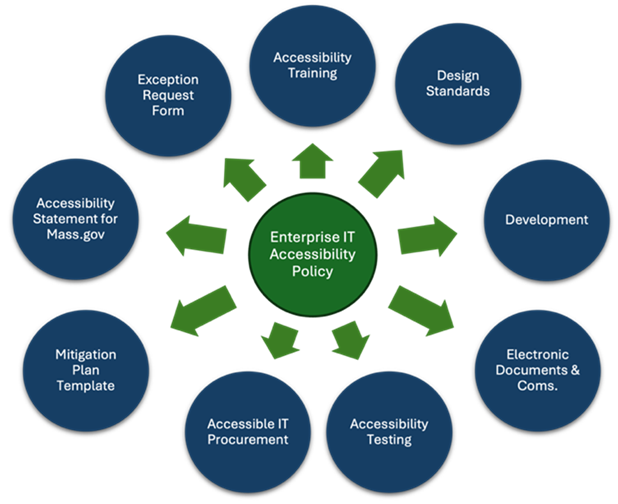
The Policy Updates Working Group reviewed and revised the Enterprise Digital Accessibility Policy and related documents. This work was informed in part by new regulatory accessibility requirements for web and mobile content under Title II of the Americans with Disabilities Act, 42 USC § 12131 et seq. and the Commonwealth’s ongoing obligations to ensure all persons have equitable access to government services and information. The following steps were completed to update the current Digital Accessibility Policy:
- Inventoried existing IT-related accessibility policies across the Executive Department.
- Reviewed the current Enterprise Digital Accessibility Policy and recommended updates to scope, authority, responsibilities, standards, compliance, mitigation planning, policy exceptions, and other procedural requirements.
- Reviewed and refined initial and subsequent drafts of the revised policy.
- Shared the revised policy for review and feedback by EOTSS stakeholders including legal and contracts teams.
- Created initial drafts of a Mitigation Plan template, Exception Request Form, and an Accessibility Statement for Mass.gov.
- Presented revised Enterprise Digital Accessibility Policy to the Digital Accessibility and Equity Governance Board for review in June of 2025.
The Policy Updates Working Group plans to accomplish the following in FY26:
- Publish the revised Enterprise Digital Accessibility Policy on Mass.gov.
- Publish the revised Accessibility Statement on Mass.gov.
- Complete and publish all policy-related requirements.
- Engage with EOTSS Enterprise Risk Management teams and Digital Governance team to establish oversight protocols of policy implementation and tracking metrics.
Video: Digital Accessibility and Equity Governance Board FY25 Annual Report Part 5: Accessibility Training Plan Working Group Activities
Skip this video Digital Accessibility and Equity Governance Board FY25 Annual Report Part 5: Accessibility Training Plan Working Group Activities.Accessibility Training Plan Working Group Activities
The Accessibility Training Plan Working Group was established to develop a plan to include digital accessibility training as part of the annual required trainings and specific training requirements. This group also provides feedback and contributes to the trainings produced by the ACCESS team. Per Executive Order 614, this working group has the following primary objective and goals:
Accessibility Training Plan Working Group Objective
Provide accessibility training to introduce Commonwealth employees to digital accessibility in conjunction with role-based accessibility requirements.
Goals for Accessibility Training Plan Working Group
- Create a plan to include digital accessibility training in the annual required trainings to level set Executive Department employees on the basics of digital accessibility.
- Identify and create a plan for role-specific accessibility training to be provided to leadership, management and teams educating them on resources and requirements to integrate accessibility into their day-to-day functions and work.
This group has created a training plan in partnership with the Massachusetts Office on Disability (MOD) and the Human Resources Division (HRD). The training plan has been reviewed by HRD and includes a digital accessibility basics course as well as role-specific training modules.
The Digital Accessibility Fundamentals course will be included in the modules for FY26 required training. It is planned to have role-specific training modules provided through the MassAchieve platform and tracked by managers, Secretariat leadership, and SIAOs.
Video: Digital Accessibility and Equity Governance Board FY25 Annual Report Part 6: Public Reporting Working Group Activities
Skip this video Digital Accessibility and Equity Governance Board FY25 Annual Report Part 6: Public Reporting Working Group Activities.Public Reporting Working Group Activities
Per Executive Order 614, the Public Reporting Working Group was charged with developing a plan to create a public dashboard. This dashboard will track progress toward digital accessibility program maturity and provide information on additional metrics beyond the selected maturity model dimensions and aligned with the accessibility strategic plan. This working group had the following primary objective and associated goals:
Public Reporting Working Group Objective
Increase accountability and transparency through the use of public reporting to identify trends, gaps, and opportunities for growth and demonstrate maturity.
Goals for Public Reporting Working Group
- Review established digital accessibility maturity models: Gain a common understanding of the model and the key dimensions and determine metrics associated with the models.
- Reporting platform selection: Review existing reporting platforms to determine suitability, cost/effort, and gain consensus on a selection.
- Engage with constituency on metrics that matter to them: Meet with constituents and socialize metrics to determine if they are meaningful or if there are other metrics to consider for inclusion.
The Public Reporting Working Group was tasked with researching and evaluating maturity models to select the model that best meets the Commonwealth’s reporting needs. After reviewing several industry models, it was decided to use a model currently in use by the federal government intelligence community. This model is very flexible. It contains five (5) maturity levels and includes required criteria to be met to receive a score from one (initial) to five (optimized). Using the dimensions from the federal accessibility maturity model, the Working Group has developed a list of 10 digital accessibility and equity metrics that can be tracked to identify trends, gaps, opportunities, and maturity.
Community Outreach Working Group Activities
Engaging with constituents is essential to identify gaps and areas of opportunity to further develop an accessibility program and increase the accessibility of digital assets. The Community Outreach Working Group was created to develop engagement opportunities with constituents from within the Commonwealth workforce and the public. This working group had the following objective and associated goals:
Community Outreach Working Group Objective
Engage community stakeholders to collect feedback to enhance accessibility across digital channels.
Goals for Community Outreach Working Group
- Create a scalable feedback session model to engage internal employees and the public to gather real-time feedback on digital government experiences.
- Create a scalable form template to gather feedback on specific digital asset accessibility issues and general suggestions and recommendations for the digital accessibility program.
Significant progress has been made in FY25, including recruiting stakeholders to create employee and public constituent participant groups. These groups will be invaluable to provide feedback on the accessibility of digital government experiences, participate in research opportunities, and user acceptance testing of digital deliverables. The first feedback session involving internal employees has been piloted in May of 2025 and the feedback collected will be used for accessibility of internally used digital assets and tools. Additional feedback sessions with members of the public and internal employees are planned for FY26. The working group has also created a feedback form to provide an alternative method for submitting specific accessibility feedback for digital assets along with providing recommendations and suggestions to advance the accessibility program.
Video: Digital Accessibility and Equity Governance Board FY25 Annual Report Part 7: Strategic Plan
Skip this video Digital Accessibility and Equity Governance Board FY25 Annual Report Part 7: Strategic Plan.Strategic Plan
Strategic planning work began in March of 2024 to identify the goals, strategies, and associated action steps for the final plan. From July through August, Board members participated in the research phase to gather insights on digital accessibility across the Executive Department to assist with goal and strategy development. The Board reviewed the final draft of the digital accessibility strategic plan in September to provide feedback. Nava, the primary firm leading the plan development work met with the Board to collect feedback on the plan in October. The research insights and Board feedback were collected, reviewed, and incorporated into the final plan deliverable in November.
Fiscal Year 2026 Board Goals and Objectives
The Board is making progress with defining its FY26 goals. The focus areas for the Board’s work include:
- Finalize and publish the Enterprise Digital Accessibility Policy, IT procurement program updates, and associated requirements for buying and building IT solutions.
- Finalize and publish the updated Accessibility Statement for the Mass.gov platform and corresponding form for collecting constituent experience feedback.
- Pilot feedback sessions with internal and external constituents to learn about their digital experiences and scale these feedback sessions to all Secretariats.
- Finalize the plan for the first version of the public reporting dashboard to present accessibility maturity and growth over time.
- Identify and connect with local, state, and national organizations that support digital accessibility and persons with disabilities to create ongoing relationships and partnership opportunities.
- Engage with K-12 schools, postsecondary institutions, and municipalities to increase Board engagement, representation and partnership opportunities.
- Create a research plan with associated deliverables to prepare for Americans with Disabilities Act Title II.
- Review the Board Charter and select public members to serve from 2026-2028.
The Board will define specific action items and targets around these focus areas that, in addition to insights from the Digital Accessibility and Equity Strategic Plan, will build momentum and drive the Board’s mission forward in a tangible way.
Implementing Executive Order 614
Secretariat Information Technology Accessibility Officers
Secretariat IT Accessibility Officers are integral to ensuring leadership and representation with appropriate expertise, influence, and authority within each Secretariat. They are the cornerstone of formal governance and a programmatic structure for the Commonwealth’s digital accessibility and equity program. To date, The Executive Office of Administration and Finance, Executive Office of Energy and Environmental Affairs, and Executive Office of Health and Human Services have hired SIAOs.
EOTSS has plans to hire four additional Accessibility Officers to lead the remaining 6 Secretariats. The hiring process is in progress. The Executive Office of Education and Executive Office of Labor and Workforce Development will each have a dedicated SIAO. In order to have full coverage across all Secretariats, it was decided that the Executive Office of Economic Development and Executive Office of Housing and Livable Communities have a single SIAO covering both Secretariats due to their previous unification. A similar pairing has also been decided for the Executive Office of Public Safety and Security and Executive Office of Veterans Services due to the size and having military-serving units. The Massachusetts Department of Transportation plans to promote their existing Accessibility Lead to the SIAO role in the future.
EOTSS plans to retain the four SIAOs until they can transition to a Secretariat. Secretariats can choose to have the current Officer transition from EOTSS or post for the role. These SIAOs will report to the CIAO with dotted line reporting to the Secretariat’s Chief Information Officer or designee. With support from the Board, the ACCESS team at EOTSS, and the SIAOs, Secretariats can begin structuring and executing a digital accessibility implementation plan in earnest.
Video: Digital Accessibility and Equity Governance Board FY25 Annual Report Part 8: EOTSS ACCESS Team
Skip this video Digital Accessibility and Equity Governance Board FY25 Annual Report Part 8: EOTSS ACCESS Team.EOTSS ACCESS Team
To provide ongoing support to Secretariats, a central accessibility team has been formed within EOTSS, known as the Accessibility Center for Consulting, Education, and Support Services or ACCESS. The team is led by the CIAO and comprises six staff, with four hires made this year. An Accessibility Engineer focuses on the software development lifecycle activities including testing and also performs basic audits to assist internal development teams on coding best practices, and the remediation of accessibility issues. An Accessibility Training Coordinator focuses on the creation of an accessibility training program to augment and build upon the digital accessibility mandatory training for all Commonwealth employees. A Documents and Communications Accessibility Coordinator has been hired to provide expertise on creating accessible documents, emails, newsletters and social media posts and explore tools to assist with document and communications testing and remediation. An Accessibility Procurement and Policy Strategist has been hired to embed accessibility into each stage of the procurement and contract lifecycle process and to support and advise on IT solution purchases.
The team is planning to expand as gaps are identified and needs change. Strategic planning efforts, as well as future programmatic requirements, will also dictate the need to create new positions within both the ACCESS team and directly within Secretariats to support the SIAOs. Business planning efforts at EOTSS are underway and immediate and long-term team positions to serve critical functions have been identified and included in plans for future growth opportunities.
Strategic Plan Work
Executive Order 614 stipulates the creation of a statewide Digital Accessibility and Equity Strategic Plan to serve as the foundation of a statewide program led by the CIAO and for Secretariat-specific adoption plans. To commence the planning effort, accessibility consulting firms were identified to support in the plan development process and serve as a partner to assist with creating accessibility processes, procedures, key performance indicators, program goals and objectives and identifying and selecting a maturity model framework. The Digital Accessibility Transformation Index created by the accessibility firm, Deque, was selected to cover multiple accessibility areas including software development lifecycle, procurement, human resources, documents, governance, communications, and additional areas needing to be addressed. The maturity model framework has provided a big-picture representation to identify where the Commonwealth is on the accessibility journey and where the maturity level currently stands and aims to be within specified time periods leading to programmatic maturity and inclusion and implementation of accessibility across all areas.
EOTSS completed the strategic plan development with a primary contractor consulting firm, Nava PBC, to partner with the selected accessibility firm to serve as a subcontractor. Deque was the subcontractor accessibility firm that was selected by EOTSS and Nava PBC. Deque has provided accessibility consulting for government and additional sectors for 20 plus years and has employed accessibility consultants with and without disabilities to provide accessibility services and support to organizations large and small.
As of June 2025, the following work has been completed resulting in a plan deliverable for internal use and an external template document to publish on Mass.gov. Nava and Deque have met with internal stakeholders across all secretariats, independent offices and external agencies to provide feedback from multiple constituencies. External constituent groups were also identified and participated in the research phase to provide their feedback for plan development and inclusions. Several drafts of the plan were created with stakeholder reviews including EOTSS and the Board. Feedback was collected and analyzed to be incorporated into the plan for the final deliverable. The research and feedback yielded insights to create six goals related to the areas of software and digital asset creation and procurement, training, program staffing and funding, community engagement, and digital accessibility governance with corresponding strategies and action steps. The strategic plan includes specific deliverables related to accessibility, including the creation of needed IT accessibility standards, contract language, and associated testing and remediation approaches along with associated timelines.
The completion of the accessibility strategic plan will assist all secretariats with building their own custom plans specific to their Secretariat needs. Secretariat Chief Information Officers and SIAOs will receive implementation plan templates based on the accessibility strategic plan to provide additional guidance, standards and strategies toward the creation and delivery of digital content. Secretariat leadership and staff will be engaged in the development of Secretariat and agency implementation plans in FY26 to commence and continue program development efforts. Secretariat staff also indicated that alignment with the Commonwealth Digital Roadmap is underway for consistency and accountability. Accessibility for products and services and integrating diverse perspectives in service design and delivery is a core tenet of the Commonwealth Digital Roadmap, providing further alignment with the digital accessibility strategic planning efforts.
Video: Digital Accessibility and Equity Governance Board FY25 Annual Report Part 9: EOTSS ACCESS Team Activities
Skip this video Digital Accessibility and Equity Governance Board FY25 Annual Report Part 9: EOTSS ACCESS Team Activities.EOTSS ACCESS Team Activities
Digital Accessibility Training Provisions
Reaching compliance with Title II of the ADA requires an all-hands-on-deck approach when it comes to Commonwealth employees that create digital content. Training in how to make that content accessible for our constituents is paramount.
ACCESS team training goals include the following:
- Raise awareness and buy-in of executive leadership to ensure they sponsor the change and training need.
- Create awareness and ability in individual contributors to deliver accessible content.
- Support Secretariats before and during content creation to reduce post-deployment remediation.
- Support remediation of existing content to streamline and reduce time and effort.
The ACCESS team offers self-paced guides available on Mass.gov, regular live training webinars, and twice a week Accessibility Office Hours that invite individuals and agencies to get help on their strategies and content development.
The ACCESS team FY26 training plans include the following:
- Expand training offerings both in topics and audience and integrating accessibility considerations into existing required trainings for Commonwealth employees.
- Work with Human Resources Division colleagues to finalize and include a training course on digital accessibility basics as part of the mandatory annual trainings.
- Create a dedicated training site including interactive practice examples and interactive step-by-step checklists.
- Expand training and office hours to Municipalities and Schools.
Design and Development Accessibility Work
To strengthen the accessibility of Commonwealth applications and the Mass.gov platform, a unified accessible design system and development best practices are needed. These measures will lead to a more proactive approach to shift accessibility left into the software development process and expedite development time while reducing discovered issues during the testing process. Plans for FY25-26 include the following:
- Partner with the Massachusetts Digital Service experience design and research team to embed accessibility into the current and future Massachusetts design system and pattern asset library.
- Further define and implement accessibility requirements for planning and software development project phases.
- Explore and implement tools to test designs, conduct design reviews, and test code.
- Partner with the experience design and research team to ensure that studies are accessible and include individuals with disabilities using assistive technology into constituent participant pools.
- Create and publish an interactive searchable online knowledge base to allow designers, developers, testers, and third-party vendors to learn about accessibility requirements, remediation techniques, and design and coding best practices.
Testing and remediation of discovered accessibility issues is essential to further increase accessibility of digital asset deliverables. The ACCESS team has assisted with several testing projects covering multiple Secretariats and will continue providing testing services in FY26. Plans to structure and hire an EOTSS accessibility testing services team are in progress. This team will bring testing in-house for greater control, quality, speed and cost efficiency.
Video: Digital Accessibility and Equity Governance Board FY25 Annual Report Part 10: Documents Accessibility Work
Skip this video Digital Accessibility and Equity Governance Board FY25 Annual Report Part 10: Documents Accessibility Work.Documents Accessibility Work
With over 298,000 documents attached to Mass.gov and over 4,000 new documents added each month on average, the importance of ensuring the accessibility and usability of these documents cannot be understated. Internal documents increase that number even more, along with the thousands of daily emails, hundreds of newsletters, and dozens of Commonwealth-related social media accounts that regularly post and require review, testing, and remediation to ensure accessibility. With this scope in mind, our work centered around three goals:
- Initiate training to help all Commonwealth employees create more accessible documents and communications.
- Begin assessing the accessibility of existing documents and communications.
- Assess tooling to support large scale document remediation.
Each Commonwealth employee is responsible for providing documents and communications that are accessible to constituents as well as fellow employees. Through a multi-prong training and outreach approach, including individual and group consultations, self-paced resources, live training opportunities, and Office Hours events, the central accessibility team has started to expose Commonwealth employees to best practices in accessible document creation and supported others in upskilling their accessibility practices. Those responsible for shaping the content on Mass.gov or intranet sites are also beginning to incorporate these practices into their training for content authors, as well, which is another strategy for bringing accessibility into employees’ everyday work routines.
Through tooling explorations, potential systems for identifying inaccessible documents along with the most common accessibility errors within those documents are being explored and identified. A system will emerge through exploration and pilots to begin categorizing existing documents. The goal of these initiatives is to provide a baseline of document and communication accessibility that is regularly monitored, supported through training and consultation, and provides transparency when issues arise for constituents or employees.
Artificial Intelligence and Accessibility
The proliferation of artificial intelligence is increasing leading to wide-spread adoption across the Commonwealth. There have been multiple initiatives and committees to identify the risks, strengths, and opportunities concerning the use of artificial intelligence. Digital accessibility must not be omitted from these initiatives, committees and discussions as usage increases and the impact on internal and external constituents broadens. The ACCESS team participates in the Artificial Intelligence Risk Committee as part of the AI Center of Excellence to evaluate project submissions and incorporate accessibility into the consideration factors for approvals. The ACCESS team has created the Artificial intelligence (AI) and Accessibility web page on Mass.gov to provide a resource for InnovateMA student cohort teams, project planners, and developers to gain knowledge and understand the requirements necessary to increase accessibility into the deliverable in conjunction with the integration of artificial intelligence. Training for student cohorts has also been produced to provide a digital accessibility baseline requirements list and expectations for the use and implementation of artificial intelligence. ACCESS team participation and the provision of evolving resources will increase and expand as artificial intelligence usage increases across the Commonwealth digital services and deliverables.
Video: Digital Accessibility and Equity Governance Board FY25 Annual Report Part 11: Procurement Accessibility Work
Skip this video Digital Accessibility and Equity Governance Board FY25 Annual Report Part 11: Procurement Accessibility Work.Procurement Accessibility Work
Procurement of accessible digital assets and IT professional services is integral to achieving the Commonwealth’s digital accessibility goals. Furthermore, digital solutions created, customized, or configured by a third party and used in the delivery of Commonwealth programs, services, and activities must be accessible in accordance with federal and state laws.
Procurement Accessibility Work Objective
Embed accessibility standards and requirements into all phases of IT procurement.
Accessible IT Procurement Goals
- Update Accessibility Contract Language for IT Solutions.
- Create an Accessibility Questionnaire to assess Bidder’s ability to deliver accessible IT solutions.
- Establish IT accessibility scoring protocols to inform bidder selection.
- Define vendor accessibility testing and verification requirements.
Figure 2: Components of the Accessible IT Procurement Program
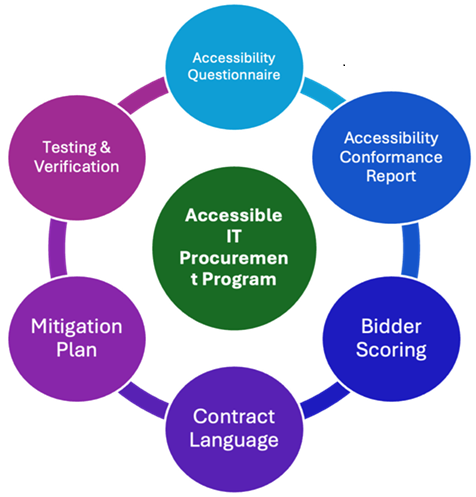
The Accessibility Procurement and Policy Strategist in collaboration with EOTSS Contract Management team revised the Vendor Accessibility Contract Language for IT Solutions. Additionally, an accessibility questionnaire that assesses a bidder’s capacity to build and deliver accessible products was created and piloted.
Completed Work for Procurement Accessibility
- Revised Accessibility Contract Language for IT Solutions and circulated for review by EOTSS Contracts Team. Key updates include:
- strengthened vendor obligations to resolve accessibility violations;
- defined vendor accessibility testing and verification of compliance requirements; and
- defined additional remedies for noncompliance.
- Created and piloted an Accessibility Questionnaire to assess a bidder’s capacity to design, build, and deliver accessible IT products.
- Defined Vendor Accessibility Testing Matrix to replace the current information technology and assistive technology environments list.
The following work is planned for FY26:
- Obtain approval of revised accessibility contract language, publish on Mass.gov, and incorporate into all IT procurements within the Executive Department moving forward.
- Publish Vendor Accessibility Testing Requirements on Mass.gov as part of the Accessible IT Acquisition Compliance Program.
- Determine how revised accessibility contract language may be incorporated by reference or by addendum into existing contracts where needed.
- Develop scoring matrix for Accessibility Questionnaire.
Digital Accessibility Collaborative Engagements
Sharing information with people in other states working on digital accessibility allows us to learn from their efforts and build goodwill as we share what we have learned. These collaborations provide great value for all participants.
The ACCESS team participates in groups pertaining to digital accessibility on a national level to represent Massachusetts and the work that is being done. One is the Multi-State Digital Accessibility Collaborative, originally set up and hosted by the State of Maine. There are over 50 participants from 29 states. The other is the newly formed Digital Accessibility Forum of the National Association of State Chief Information Officers (NASCIO). For the first time, digital accessibility has made NASCIO’s State CIO Top Ten Policy and Technology Priorities for 2025. While there is some overlap in participants, the multi-state collaborative includes accessibility efforts in states where there is no central program under the state’s CIO. The NASCIO group includes a significant number of people who are new to digital accessibility.
In both groups, planning for and implementing changes to meet the new ADA Title II regulations has been the most common topic. This has included discussions of staffing and resource options, policy and program updates, procurement practices, and available services.
The team will also participate in NASCIO’s new subgroup, Digital Accessibility: Policy Operative Subgroup. This will be an interactive space on NASCIO’s website to focus on digital accessibility policies. It includes state members that are working on official statewide digital accessibility policies and related documentation.
ITS Accessibility Vendors Contract Work
The Commonwealth maintains a statewide contract for professional services specific to supporting the accessibility of IT deployed by the Commonwealth. A statewide contract means that we can be sure vendors have the expertise to provide these services:
- Testing websites and applications for accessibility
- Assessing and fixing accessibility problems with websites, applications, and documents
- Establishing accessibility strategies, policies, and procedures
- Training in accessibility requirements and techniques
- Meeting accessibility requirements for audio and video
- Providing accommodations for employees using legacy systems
The current contract, ITS61, expires on June 30th. EOTSS has been working with the Operational Services Division (OSD) to establish a new OSD-managed statewide contract to be in place by July 1, 2025. The Strategic Sourcing Team (SST), with representation from EOTSS procurement and ACCESS teams, has refined the offerings, updated required qualifications, established scoring metrics, and posted the Request for Response for the successor statewide contract, ITS82.
Members of the ACCESS team will continue to support the new OSD-managed contract by:
- Drafting and posting the Contract User Guide, with expanded information on using the different categories and drafting Requests for Quotes and Statements of Work
- Participating in outreach and marketing, especially for schools and municipalities
- Monitoring vendor performance
- Considering requests for new vendors
Video: Digital Accessibility and Equity Governance Board FY25 Annual Report Part 12: Conclusion
Skip this video Digital Accessibility and Equity Governance Board FY25 Annual Report Part 12: Conclusion.Conclusion
The importance of producing and purchasing accessible digital assets cannot be understated. Increasing the inclusivity and usability of programs, services and activities for all stakeholders is a fundamental aspect of accessibility. Providing awareness and training for Commonwealth employees will serve to commence the process of accessibility and usability integration into digital assets. The creation and provision of requirements, standards, tooling and resources is paramount to further mature digital accessibility processes and plans across the Commonwealth.
The digital accessibility and equity strategic plan, program, and Governance Board serve as a solid foundation for future program development and initiatives. The digital accessibility and equity strategic plan and roadmap will create a path and a direction for the Commonwealth to progress forward on the accessibility and equity journey. The initiatives that are generated from this plan, accessibility program and Governance Board will provide measurable key performance indicators to track program maturity and provide additional opportunities for training, tooling and resource allocation.
The creation of the Chief IT Accessibility Officer, Digital Accessibility and Equity Governance Board, ACCESS team, and Secretariat IT Accessibility Officers will bring accessibility and equity to the next level of maturity and provide the necessary expertise to bring future accessibility initiatives to fruition. Accessibility is not a one and done initiative and highlighting progress is key to this realization. The ongoing efforts and industry standards and expectations will continue to grow and evolve. It is the shared responsibility of all Commonwealth employees to support and deliver the inclusivity, accessibility and usability of digital assets that will generate further understanding and awareness to provide a welcoming and inviting culture and digital environment to live, learn and work in the Commonwealth of Massachusetts.