
Hunting laws update
In April, Governor Healey filed legislation to allow Sunday hunting, expand the use of crossbows for hunting, and reduce setback distances for bowhunting. These updates still require legislative approval and have not been changed at this time. Get details about the bill's status and why changes were proposed.
Public archery ranges opening for summer and fall
MassWildlife is opening temporary public archery ranges on Wildlife Management Areas across the state this summer and fall. If you have your own archery equipment and need a place to practice, sign up for a range pass at one of 7 locations.
June 6–7, 2026 is free fishing weekend
Mark your calendars for this year’s Free Freshwater Fishing Weekend on June 6 and 7! No license is required to fish any public lake, pond, reservoir, stream, or river in Massachusetts from 12 a.m. Saturday, June 6 until 11:59 p.m. Sunday, June 7.
- Other than Free Fishing Weekend, you need a license to fish in fresh water if you are 15 or older. If you're 15–17 or 70 and older, your license is free. Funds from fishing license sales support MassWildlife’s fisheries research, fish stocking programs, and angler education programs. Buy your fishing license here.
- All other regulations, including catch limits, apply during Free Fishing Weekend. Before heading out on the water, make sure you know the rules. Review fishing regulations.
- For saltwater anglers, 2026 Free Saltwater Fishing Days are May 10 and June 21.
- Hooks and Books: NEW THIS YEAR, MassWildlife has partnered with public libraries across Massachusetts that provides free access to fishing equipment for local communities. Through this innovative program, participating libraries will offer rod-and-reel kits available for loan—just like borrowing a book—making it easier than ever for people of all ages and backgrounds to try fishing without purchasing gear.
Where to fish
Use the Go Fish MA! fishing map to find places to fish near you! You can also explore trout stocked waters or handicapped accessible fishing sites.
Sharpen your skills
It's easy to learn to fish. All you need to get started is some simple gear and a little practice! Read fishing tips and watch tutorial videos.
Antlerless Deer Permit (ADP) Reminder
Attention hunters: Apply now for an Antlerless Deer Permit before the July 16 deadline.
Veggie Vandals: Protecting your gardens from wildlife
We all know the feeling. You spend winter drawing up your garden plan. You dream of tomatoes, cucumbers, zucchini, and more that you’ll be able to harvest from your backyard. When the weather warms, you get outside and start to prepare your garden beds and, eventually, get seeds or seedlings into the ground. In summer, when it’s finally time to reap the rewards of your hard work, your heart sinks as you find that something else got to your garden first.
You’re not the first, or last, person to have your veggies vandalized by wildlife. Wild animals, like woodchucks, rabbits, squirrels, and deer, see our garden greens as a natural part of their diet and will snack on it if they have easy access. While there often isn’t a single solution to keep wildlife out of our gardens for good, a combination of effective approaches and a little creativity can ensure you’ll be able to enjoy the fruits (and vegetables) of your labor.
Exclusion
The best way to prevent garden damage from wildlife is to exclude them from the area with a physical barrier, like fencing. Three-foot-tall metal mesh fencing buried at least 1 ft down and 1 ft out in an L-shape can help keep critters like rabbits and groundhogs out. If you’re trying to exclude rabbits specifically, make sure the mesh holes are ¼ inch or smaller to prevent young from getting through. Woodchucks are surprisingly agile, so consider using electric wire 4–5 inches off the ground and 4–5 inches from the fence, powered by an approved fence charger, to prevent them and other squirrel species from climbing over. If deer damage is your biggest concern, wire mesh fencing must be at least 8 ft high with an overhang to discourage them from jumping over. Eight-foot-tall electric fencing, regularly baited with peanut butter on tin foil, can also be used.
Eliminate shelter
Close off structures, like under sheds, porches, and walkways, that may provide shelter for wildlife on your property. Be proactive and block up all possible crevices and holes prior to any use. Be careful not to block such places when animals may be trapped inside. Clean up or cut back brushy areas or weed patches to remove potential shelter or nest sites.
Repellents
Scent-based repellents, like cayenne pepper, soap shavings, or predator urine, are commonly used to deter wildlife from gardens. While this can be an appealing option because it’s quick, easy, and inexpensive at first, scent-based repellents do not appear to be hugely successful on their own. They also require regular refreshing, which can make them more expensive yet less effective in the long run compared to other more reliable solutions like fencing.
Scaring is caring
Most animals that damage gardens are prey species, meaning they can be scared off fairly easily. When you’re home, step outside and shoo them away by walking toward them, shouting, clapping, or spraying water in their direction. Try placing shiny pinwheels, draping plastic streamers, hanging metal pie pans, and staging scarecrows to keep wildlife wary when you’re not there. Motion activated moving statues, like owls, or predator eye balloons can also be effective. Deer tend to return at night, so a motion activated sprinkler seems to be a promising deer deterrent. Want to get really creative? Break out your motion activated Halloween decorations early to spook away wildlife.
Pro tip: Keep veggie vandals on their toes! It’s essential to move frightening devices around the yard every few days so the animals don’t get used to their presence and no longer view them as a threat.
Remove other food sources
Your garden may not be the only thing attracting wildlife to your property. Bird seed feeds more than songbirds – it attracts mice, squirrels, chipmunks, turkeys, and more. If an animal finds food at your bird feeder, they could visit your garden next. To avoid this, create a bird-friendly area without bird feeders. Outdoor pet food can also attract wildlife, like squirrels, chipmunks, opossums, and skunks, so feed pets inside or clean up immediately after feeding.
Protect backyard chickens
Wildlife killing unprotected chickens and damaging coops is becoming the number one source of human-wildlife conflict in Massachusetts. A standard chicken coop is not enough to prevent damage from all wildlife. So, while you’re working on your garden, take a moment to protect your chickens with properly maintained electric fencing.
Relocating wildlife
It may seem easier to relocate the veggie vandal somewhere else to prevent garden damage. However, relocating wildlife off your property is not only ineffective at solving wildlife problems, it’s also illegal in Massachusetts. Learn why moving wildlife is harmful and what you can do if you’re experiencing conflict with wildlife.
Dragonfly detectives
On spring and summer days, adult dragonflies can be easily found along shorelines or flying over the water, swooping down from nearby trees to catch prey, and seeking suitable basking spots with ample sun. But these large insects spend most of their lives underwater as aquatic nymphs before transforming into the winged adults we typically see.
Though dragonflies are most noticed around lakes and ponds, many species also depend on stream and river habitats, from small headwater creeks to large rivers like the Connecticut and Merrimack. Of the approximately 117 dragonfly species recorded in Massachusetts, there are 13 identified as Species of Greatest Conservation Need (SGCN) in Massachusetts that largely inhabit riverine systems, 9 of which are listed under the Massachusetts Endangered Species Act (MESA).
How do we survey dragonflies?
MassWildlife biologists survey dragonflies to learn about their population size and distribution across the state; however, identifying these species can be difficult. A trained eye aided by binoculars or a camera is usually required, and maybe a bug net to get a closer look if you have enough patience to swing and miss 50 times! Luckily, because of their unique life cycle, dragonflies leave behind clues that biologists can use to identify a particular species.
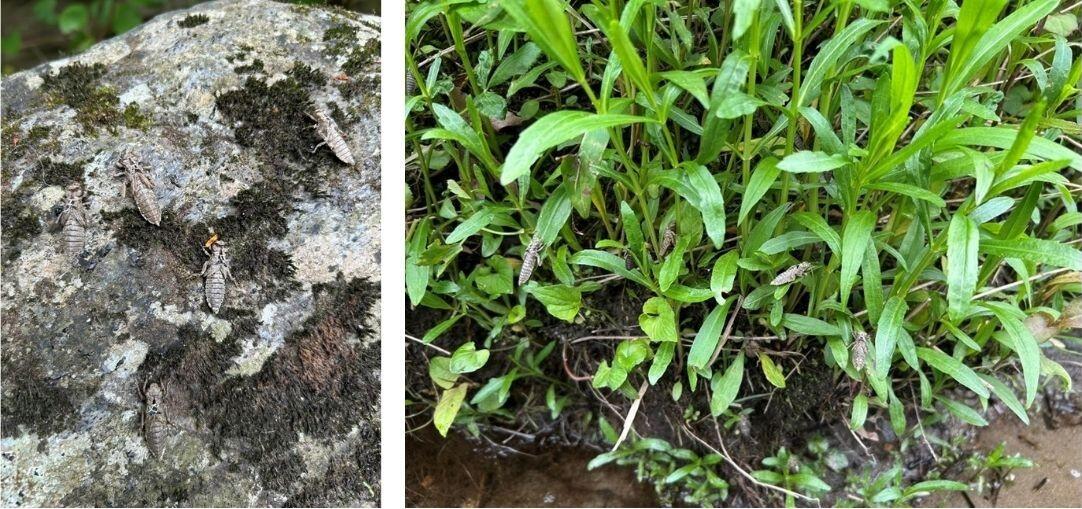
Starting in late spring and throughout the summer, riverine dragonflies transform from water-dwelling nymphs into flying adults by shedding their exoskeleton. The shed skins they leave behind, called exuviae (pronounced ex-zoo-vee), provide biologists with an effective way to monitor dragonflies—with a lot less net swinging! During surveys, exuviae are collected, dried, and later identified under a dissecting scope.
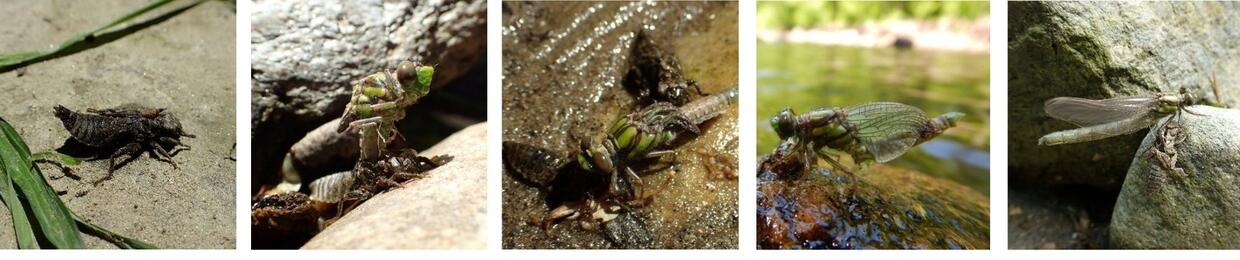
Surveying for riverine dragonfly exuviae is simple but tedious work. Field crews inch their way along pre-defined lengths of stream, examining sand and gravel bars, boulders, grasses, shrubs, tree trunks, and moss. Depending on the landscape, this can make exuviae searches simple or difficult, yielding zero to hundreds of exuviae.
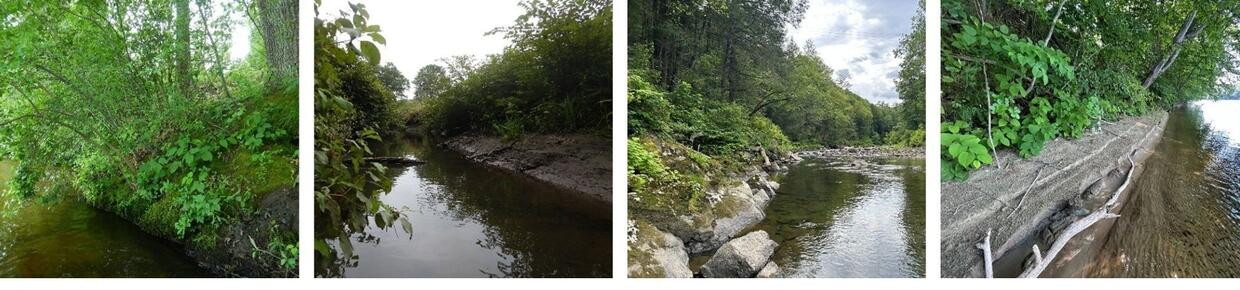
To increase the chances of finding exuviae of rare dragonfly species, timing is critical. Surveys are timed to capture exuviae during or just after nymphs emerge from the water. Many riverine dragonfly species emerge from mid-May to early June. For several species in the dragonfly family Gomphidae (generally known as Clubtails), emergence from streams occurs in synchrony. For example, on sunny days in mid-late May, Maine snaketails (Ophiogomphus mainensis) emerge by the thousands from larger rivers in central and western Massachusetts over a short period of time.
How exuviae surveys impact conservation
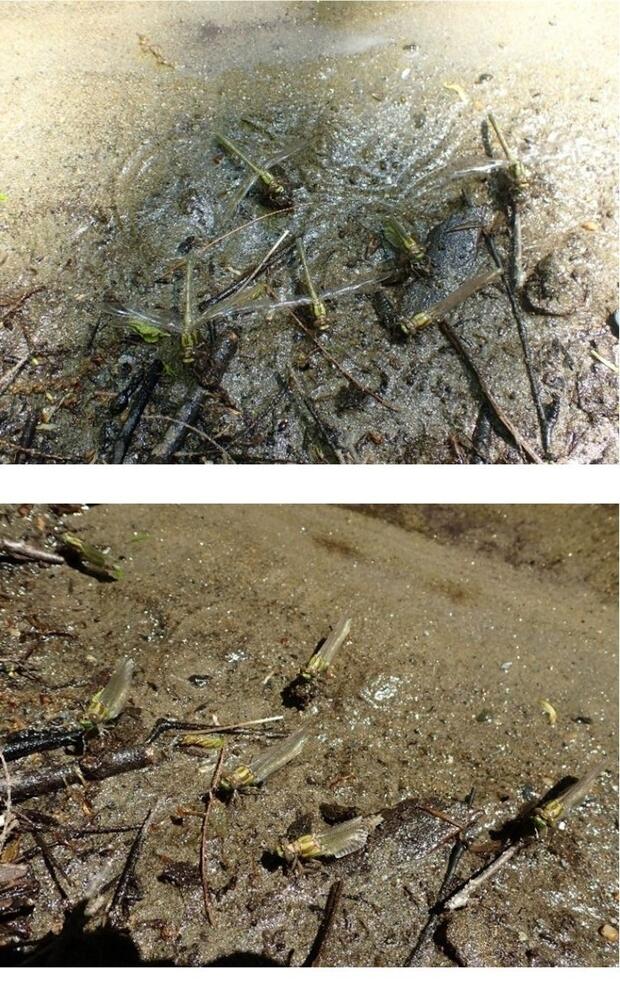
Even though exuviae surveys can be difficult, this approach is easier than trying to capture riverine adults, particularly for rare or elusive species. Over the past 20 years, exuviae surveys have drastically improved our understanding of the distribution and abundance of seemingly rare species. Shadowdragons (Neurocordulia obsoleta, N. yamaskanensis) were once thought to be rare in Massachusetts and were listed under MESA. It turns out that these well-camouflaged dragonflies, which are most active during dawn and dusk, were just evading detection. When exuviae surveys became standard practice, biologists discovered that shadowdragons had a wider distribution than previously known and led to their removal from the MESA list.
A further benefit of exuviae surveys is the valuable insight they provide into where dragonflies have spent the immature stages of their lives. Because these shed skins are left behind on the streambanks where nymphs emerge into adults, finding concentrations of exuviae in a particular area is strong evidence that the adjacent stream provides suitable habitat for the species to successfully complete its life cycle. These sites can therefore highlight high-quality aquatic habitats that may be especially important to conserve.
Interested in finding dragonfly exuviae yourself?
Late spring and early summer are great times to explore the shorelines of ponds and streams in search of shed dragonfly exuviae. Carefully walk along the water’s edge scanning sand, rocks, logs, and vegetation. Exuviae are often well camouflaged, blending in with bark, mud, and stone, so patience and a careful eye are key. Make sure not to collect any just in case you find a MESA-listed species. You can learn more about our SGCN species on our online interactive table.
Breaking down barriers: The return to healthy habitats
This spring, MassWildlife is wrapping up a series of seven dam removal projects across Massachusetts. By the end of 2026, these dam removals on MassWildlife properties will have restored stream and river reaches that have been disconnected for decades. These projects are part of a growing effort to reconnect waterways, improve aquatic and streambank habitat, and reduce the risks associated with aging infrastructure. MassWildlife still owns about 20 dams that are under review for repair or removal. As these barriers come down, the benefits ripple far beyond the dam site—reaching into stream channels, riparian zones, and even upland habitats.
A better flow for streams and wild trout
Many of Massachusetts’ rivers and streams are fed by cold groundwater inputs and have a natural mix of riffles, runs, and pools. These features create ideal conditions for aquatic life by maintaining cool temperatures, high oxygen levels, and clean gravel substrates. Dams disrupt these systems by slowing water, trapping sediment, and increasing temperatures, ultimately degrading the habitat on which many species depend.
When dams are removed, these streams begin to regain their natural rhythm. Sediment moves downstream again, groundwater-fed flows help keep water temperatures low, and over time, stream channels reshape into more complex and stable forms. Just as importantly, reconnecting fragmented sections of stream allows water, nutrients, and organisms to move freely—restoring the full function of these coldwater ecosystems.
Few species illustrate the benefits of stream restoration as clearly as wild trout. Trout are an integral part of many Massachusetts streams, serving as top predators and supporting a strong recreational fishery. Trout require cold, clean water and access to connected spawning habitat—conditions that exist in more than 1,300 streams across the Commonwealth.
Today trout—especially our only native species, eastern brook trout—are increasingly stressed by climate change and development. Dam removal helps ease these stressors by reopening access to coldwater refuges and spawning areas that may have been blocked for decades. In addition to dam removal, MassWildlife and its partners continue to advance conservation efforts through research, restoration, and planning through the Wild Trout Conservation Plan.
Reviving the riparian zone
Dam removal can provide significant benefits for the riparian zone—the green ribbon of vegetation along streambanks and floodplains. These areas act as natural buffers, helping to filter pollutants, stabilize streambanks, absorb floodwaters, and regulate water temperature through shading. When dams are removed, rivers and streams can reconnect with their floodplains, allowing water to spread out during high flows and deposit nutrients across the landscape. This process supports richer soils and more diverse plant communities, which in turn provides habitat for a wide range of wildlife.
Healthy riparian habitat is especially important for Species of Greatest Conservation Need in Massachusetts like the migratory Louisiana waterthrush and the year-round resident American black duck. Both birds depend on clear, flowing streams in forested areas, where they feed and nest along streambanks. By restoring natural stream processes, improving water quality, stabilizing streambanks, and reconnecting habitats, dam removal helps create conditions where these birds, and many other types of wildlife, can thrive.
Benefits that reach the uplands
The benefits of dam removal extend beyond the stream corridor into nearby upland habitats like forests and woodlands. When dams are removed, surrounding upland soils return to more natural moisture levels, reducing prolonged flooding that can stress trees and shift plant communities. This helps maintain the balance between wet and dry conditions that upland habitats depend on, supporting healthier forests and more diverse vegetation. Species like the eastern box turtle, North American racer, and marbled salamander thrive in uplands areas with varying soil moisture throughout the year.
In conclusion
In many ways, removing a dam is like removing a physical barrier in order to reconnect an ecological puzzle. And while the changes may start in the water, their benefits flow outward, strengthening habitats across the landscape.
Deborah Rocque and John Hitt Appointed to Fisheries and Wildlife Board
The Healey-Driscoll Administration announced today the appointments of Deborah Rocque of Worthington and John Hitt of Scituate to the Massachusetts Fisheries and Wildlife Board. Rocque and Hitt bring extensive experience in wildlife conservation, public service, outdoor recreation, and natural resource stewardship to the seven-member Board, which provides supervision and oversight to the Division of Fisheries and Wildlife (MassWildlife). Rocque will represent the Western Wildlife District and Hitt will represent the Southeast Wildlife District.
“I look forward to working with Deborah Rocque and John Hitt as they begin their service on the Fisheries and Wildlife Board,” said Department of Fish and Game Commissioner Tom O’Shea. “Their leadership and expertise will help advance our efforts to conserve biodiversity across Massachusetts and protect the habitats that are essential to healthy fish and wildlife populations. We are grateful to former members, Stephen Sears and Ernie Foster, who leave long-lasting impacts.”
“I look forward to working with Deborah and John to advance our shared goals for wildlife conservation in the years ahead,” said MassWildlife Acting Director Eve Schlüter. “We are also grateful to our outgoing Board members for their dedicated service and the important contributions they have made to fish and wildlife conservation in Massachusetts.”
Dr. Rocque brings nearly 25 years of public service with the U.S. Fish and Wildlife Service, where she served in senior leadership roles focused on science, conservation planning, and partnership-based approaches to wildlife and habitat management. Most recently, Rocque retired as Assistant Director of the agency’s science applications program, where she worked with state wildlife agencies to advance landscape-scale conservation and address climate change impacts on wildlife and habitat. She also brings local leadership experience as a select board member in Worthington and firsthand knowledge of land stewardship as a private landowner and farmer in western Massachusetts.
“I am honored to join the Board at such a critical moment for conservation and to represent western Massachusetts,” said Deborah Rocque. “Our Worthington farm gives me a deep appreciation for the working landscapes, cold-water fisheries, and forests that define our region — and for the people who rely on them. I see firsthand how climate change is reshaping our natural resources, and I am excited to be part of restoring our biodiversity and investing in nature to sustain our health, food security, economy, and way of life.”
Hitt brings decades of legal, governance, and nonprofit leadership experience, along with a lifelong connection to hunting, fishing, and conservation in the Commonwealth. Before retiring in 2025, Hitt served on the senior leadership team at the Massachusetts Clean Energy Center, where he was responsible for legal support to the board of directors. Earlier in his career, Hitt held senior legal leadership roles at Fidelity Investments. He has also been active in land conservation and outdoor organizations across southeastern Massachusetts including Maxwell Conservation Trust, North and South Rivers Watershed Association, The Trustees, Trout Unlimited, and Scituate Rod and Gun Club.
“As a lifelong hunter, fisherman, forager and conservationist, I was fortunate to be introduced to these lifelong pursuits by my father,” said John Hitt. “I am deeply grateful for the opportunity to work with a world-class organization to preserve and expand wildlife habitat, increase engagement in hunting, fishing and the enjoyment of wildlife, deepen stakeholder engagement, recruit new participants and expand access for underrepresented populations.”
“We are so fortunate to welcome Deborah Rocque and John Hitt to the Fisheries and Wildlife Board,” said Emma Ellsworth, Chair of the Massachusetts Fisheries and Wildlife Board. “Their experience, perspective, and commitment to public service will be great assets to the Board as we continue to support MassWildlife’s conservation mission.”
The Fisheries and Wildlife Board plays an important role in the conservation, protection, and management of Massachusetts fish and wildlife resources. Through its oversight of MassWildlife, the Board helps guide policy, regulations, and long-term stewardship efforts that support healthy habitats, sustainable wildlife populations, and high-quality outdoor recreation opportunities across Massachusetts.
MassWildlife launches “Hooks and Books” program with libraries to expand access to fishing
The Massachusetts Division of Fisheries and Wildlife (MassWildlife) announced today the launch of the Hooks and Books program, a new partnership with public libraries across Massachusetts that provides free access to fishing equipment for local communities. Through this innovative program, participating libraries will offer rod-and-reel kits available for loan—just like borrowing a book—making it easier than ever for people of all ages and backgrounds to try fishing without purchasing gear.
“Fishing is a great way to connect with nature, spend time with family and friends, and enjoy the outdoors,” said MassWildlife Acting Director Eve Schlüter. “Libraries are welcoming, accessible spaces that play a vital role in connecting communities with resources and new experiences, making them an ideal partner for this initiative.”
“With this exciting new program in partnership with public libraries, we’re expanding opportunities for more youth and families to experience the joy of fishing and outdoor recreation, right in their neighborhoods," said DFG Commissioner Tom O’Shea. “We are proud to support local libraries in expanding offerings for their visitors and encourage all to give fishing a try this summer.”
After an initial pilot with Greenfield Public Library last year, MassWildlife is expanding this program to more than 25 libraries statewide this summer, with additional locations expected to join in the future.
“The fishing kits are a fun addition to Greenfield’s Library of Things,” said Greenfield Public Library Information Services Assistant Pamela McBride. “We launched the program last summer and it was an immediate hit with our patrons. The kits are perfect for beginners and young families, and contain everything needed, including helpful hints, for a relaxing day outdoors!”
2026 Participating libraries include:
- Ashfield
- Boston (Central in Copley Square, Connolly, East Boston, Faneuil, Grove Hall, Honan-Allston, Hyde Park, Jamaica Plain, South Boston, Uphams Corner branches)
- Brockton (Main branch)
- Fitchburg
- Framingham (Main branch)
- Gardner
- Greenfield
- Lee
- Leominster
- North Adams
- North Attleborough
- Springfield (All branches)
- Worcester (Main branch)
Each loaner kit includes basic fishing equipment and educational materials to help beginners get started, including information on local fishing spots, how to identify fish, and fishing regulations. The program is designed to complement MassWildlife’s broader efforts to increase participation in fishing and other outdoor recreation. By partnering with trusted community hubs like libraries, MassWildlife aims to reach new audiences and make fishing more accessible to all.
Additional opportunities to get started fishing
If your local library is not yet participating in Hooks and Books, you can still join MassWildlife at one of many free fishing clinics offered throughout the summer. These beginner-friendly events provide hands-on instruction, equipment, and guidance from experienced staff, making them a great way to learn the basics and build confidence on the water.
MassWildlife also encourages residents to take advantage of Free Freshwater Fishing Weekend on June 6–7, 2026. During this annual weekend, anyone can fish in lakes, ponds, rivers, and streams throughout Massachusetts without a fishing license. This special weekend is a perfect opportunity to give fishing a try, whether you’re borrowing equipment from a participating library or attending a fishing clinic.
“We want everyone to have the chance to experience fishing, regardless of their background or access to equipment,” said MassWildlife Angler Education Coordinator Jim Lagacy. “Whether it’s through a local library, a free fishing clinic, or Free Fishing Weekend, there are more opportunities than ever to get started fishing.”
Click here for more information to get started fishing.
Equipment and support for the Hooks and Books program was provided by the Massachusetts Biodiversity Initiative and Bass Pro Shops.
Habitat Management Grant is now open!
MassWildlife's Habitat Management Grant Program is accepting applications. Private and municipal landowners of conserved lands can apply for funding for projects that improve habitat for wildlife, enhance climate resiliency, and promote public recreational opportunities. Since 2015, the program has funded 125 projects that have restored over 4,900 acres of wildlife habitat.
The FY27 Request for Proposals is now live; applications are due by 11:59 p.m. July 6, 2026. Grant awards are anticipated in early fall, and funds must be expended by June 30, 2027. Please note that applications must be submitted through the EEA Grant Management System.
Click here for grant details, a link to our informational webinar, and application instructions.