
What type of leave is available for pregnant workers in Massachusetts?
The Massachusetts Paid Family and Medical Leave program (PFML) is designed to help people in Massachusetts take paid time off of work for family or medical reasons.
If you are pregnant, you may be eligible for two types of leave:
- Medical leave to care for your own health: Eligible mothers or birthing parents may take leave for serious health conditions related to pregnancy and recovery after childbirth. (Up to 20 weeks in a benefit year.)
- Bonding leave: Parents may take leave to bond with a new child within the first year after birth or placement. (Up to 12 weeks in a benefit year.)
The maximum amount of leave you can take in a benefit year is 26 weeks.
Additional Resources
Am I eligible for medical leave and family leave to bond with my child?
You may be eligible to take both medical leave and family leave to bond with a child if all of the following apply:
- You need time to recover from childbirth and/or you have a serious health condition related to pregnancy, prenatal or postnatal care.
- You have given birth, or are expecting to give birth.
- You work in Massachusetts for a Massachusetts business or state agency and your employer is participating in the program.
- You meet the earnings requirement.
Get details on eligibility for PFML
Self-employed? Learn how to opt-in through MassTaxConnect.
Additional Resources
How to apply for medical and bonding PFML
If you are applying for both medical and bonding leave, you should apply for the medical leave first. You may take medical leave for a recovery after childbirth. You may also take leave for a serious health condition related to pregnancy.
Step-by-step guide to applying for medical leave for pregnancy or childbirth
- Notify your employer: Talk to your employer about when you need to take leave. You need to provide at least 30 days notice before your official start date, if possible. Your employer should let you know if they participate in the state plan or if they have a private PFML plan.
- Gather information: You will need your employer’s Federal Employer Identification Number (EIN). Learn what other documents you may need to apply for PFML.
- Get your Medical Certification Form: You and your health care provider need to fill out a Certification of your Serious Health Condition form. NOTE: It is up to your health care provider to decide how much time you will need for medical leave.
- Apply: The easiest way to apply for PFML is online: apply for PFML. Learn more about applying for PFML.
- Provide information: The PFML application will ask what type of leave you need and other details. Questions may include if you are expecting a child or if you have already given birth, if you need leave while pregnant or only for recovery after birth.
If you are applying for medical leave for recovery after birth:
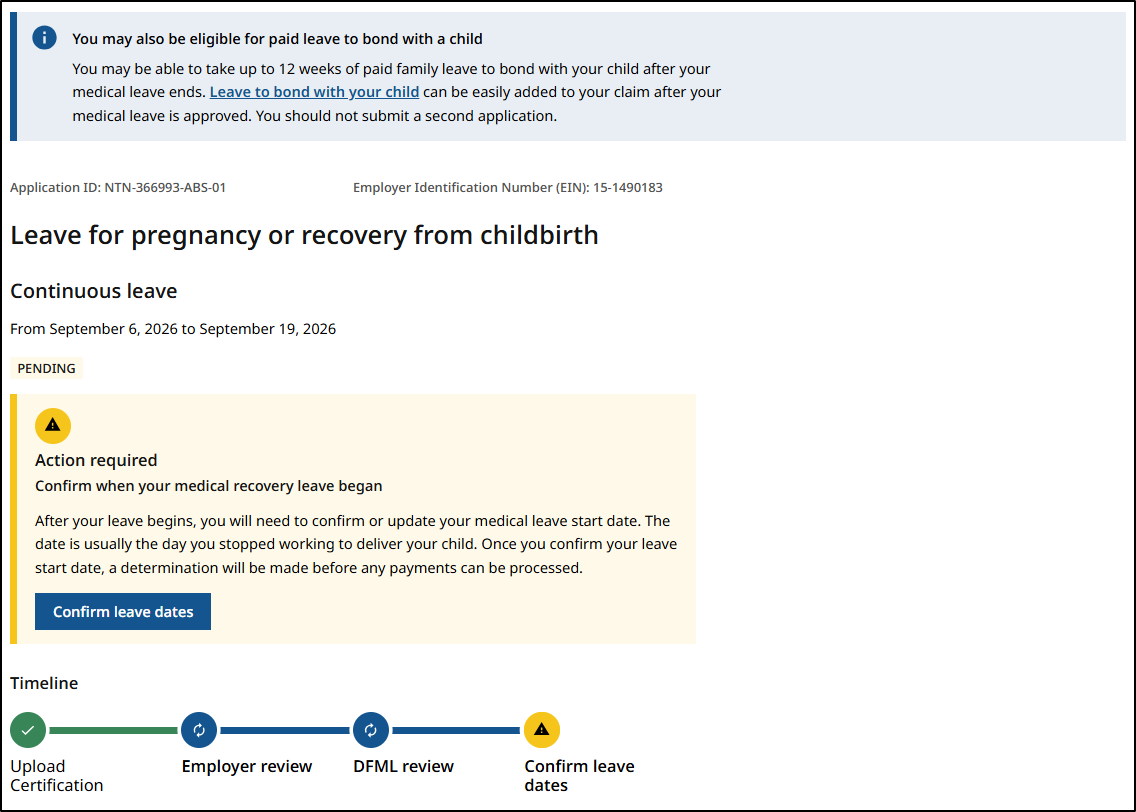
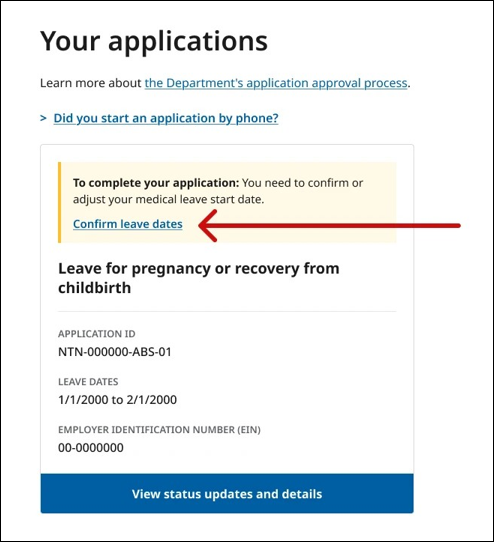
If you are pregnant and applying for medical leave for recovery after birth, you will fill in a leave start date based on your estimated due date. We know that many babies are not delivered on the expected date. For this reason, applications for recovery from childbirth do not receive final approval right away. Your application may remain pending until you confirm your delivery date.
Screenshots of the PFML portal showing where to confirm leave start date for recovery from childbirth.
Add bonding leave after medical leave
After your medical leave has been approved, you can add your bonding leave to your existing application. Do not submit a second application for bonding leave. By adding bonding to your existing medical leave application you will avoid a second 7-day unpaid waiting period. You can add your bonding leave online in your PFML portal or by calling the DFML contact center at (833) 344-7365. Learn about required documents for bonding leave.
Additional Resources
Frequently asked questions about combining medical and bonding leave for new parents
How much leave can I take as a new parent?
You can take up to 26 weeks of combined family and medical leave per benefit year:
- Up to 20 weeks of medical leave for your own health, which includes leave for recovery after childbirth
- Up to 12 weeks of family leave, which includes bonding leave
A benefit year is 52 weeks starting on the Sunday prior to the first day of paid leave through any leave program. You can take more than one kind of leave in a benefit year, but the maximum amount of paid leave you can take in a benefit year is 26 weeks.
Who decides how much leave time I can take for childbirth?
Your health care provider decides how much time you need for recovery after childbirth.
Can my partner take bonding leave?
Both parents may take up to 12 weeks of bonding leave. Parents may be eligible for bonding leave regardless of gender or marital status. Parents may take bonding leave at the same time or at different times, as long as the leave is within the first year of the child’s birth or placement. Learn more about bonding leave.
Can my family member take leave to care for me or my baby?
If you or your child have a serious health condition, your family member may be eligible to take family leave to help with care. This is not the same as bonding leave, which is only available to parents. Family caring leave requires a medical certification form filled out by your health care provider or your child’s health care provider. Learn more about leave to care for a family member.
Example leave scenarios
Example leave scenario 1:
Reese is pregnant and their health care provider decides that they need to stop working 6 weeks before their due date. Their health care provider fills out the Certification of your Serious Health Condition form for Reese’s prescribed bedrest, plus an additional 8 weeks of medical leave to recover after birth. As Reese is nearing the end of their 14 weeks of medical leave, they call the Contact Center at (833) 344-7365 to add family leave to bond with their child. Reese is approved for 12 weeks of family leave benefits before returning to work.
Types of leave taken: Medical pregnancy leave (6 weeks), medical leave for recovery after birth (8 weeks), family bonding leave (12 weeks).
Total leave taken: Reese took a total of 26 weeks of leave.
Possible remaining leave: Reese would not have any remaining leave available for the rest of the benefit year.
Example leave scenario 2:
Ty is pregnant, and is able to work throughout their pregnancy. After giving birth, Ty’s doctor fills out the Certification of your Serious Health Condition form to recommend 10 weeks of medical leave for post birth recovery. Ty applies online for medical leave related to recovery from childbirth. Ty fills out an estimated due date. Once the baby is born, Ty logs into the PFML portal to confirm their leave start date. Ty also adds a request for 10 weeks of bonding leave to their application. Ty is approved for 10 weeks of medical leave to recover from birth and 10 weeks of family leave for bonding.
Types of leave taken: Medical leave for recovery after birth (10 weeks), bonding leave (10 weeks).
Total leave taken: Ty took a total of 20 weeks of leave.
Possible remaining leave: Ty would have up to 6 weeks of leave available for the remainder of the benefit year, which could include up to 2 weeks of family leave.
Contact
Phone
Department of Family and Medical Leave - Hours of operation: Monday-Friday, 8 a.m. - 4:30 p.m.
Department of Family and Medical Leave - Hours of operation: Monday-Friday, 8 a.m. - 4:30 p.m.
Department of Revenue - Hours of operation: Monday-Friday, 8:30 a.m. - 4:30 p.m.
| Last updated: | September 9, 2026 |
|---|