
Compliance, Auditing, and Monitoring
MassHealth may request records from a provider in order to conduct a compliance audit. See 130 CMR 450.205. A compliance audit is a comprehensive review of a provider’s adherence to regulatory guidelines. Its aim is to eliminate fraud, waste, and abuse from government programs. The audit may include a review of paid claims, third-party liability, staffing levels, employee requirements, a review of a provider's financial records, and other records such as prior authorizations, invoices, and cost reports. An audit may also include an examination of the medical necessity of services provided to MassHealth members. Additionally, providers’ claims are subject to regular monitoring by MassHealth that may result in periodic audits.
Under MassHealth regulation 130 CMR 450.204, MassHealth does not pay for services that are not medically necessary, and we may impose sanctions on providers for providing or prescribing a service, or for admitting a member to an inpatient facility, if it is not medically necessary.
Under 130 CMR 450.205, MassHealth will not pay a provider for services if the provider does not have adequate documentation to substantiate the provision of services payable under MassHealth or if the provision of services does not meet MassHealth requirements. All providers must keep all records, including medical records, that are necessary to disclose fully the extent and medical necessity of services provided to, or prescribed for, members. Providers must provide to MassHealth, the Attorney General’s Medicaid Fraud Division, the Office of the State Auditor, and the United States Department of Health and Human Services on request any information about payments claimed by the provider for providing services or performing related work described in 130 CMR 450.205. See 42 U.S.C. 1396a(a)(27). All providers must also disclose records and information to any other state and federal agency to which disclosure is required by law.
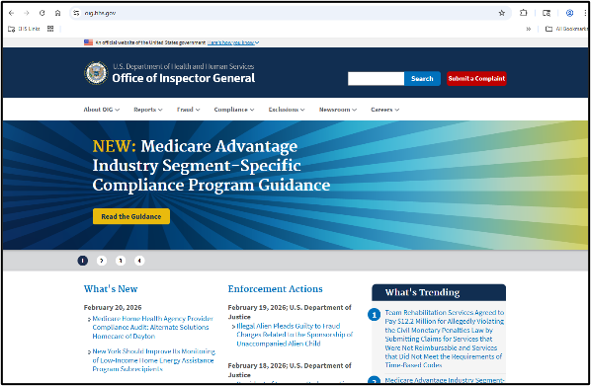
Providers can review recommendations for implementing effective compliance programs via the federal Office of Inspector General (OIG) website.
Provider Self-Disclosures
The Patient Protection and Affordable Care Act of 2010 requires MassHealth providers to report and return overpayments received from MassHealth. Providers must report in writing, and return, any overpayments within 60 days after the date they identify the overpayment or, for payments subject to reconciliation based on a cost report, by the date any corresponding cost report is due, whichever is later. Providers who fail to disclose and return overpayments in a timely manner may be subject to sanctions, including administrative fines and suspension or termination from the MassHealth program.
You can find more information on overpayments at 130 CMR 450.235.
Provider Exclusions/Suspensions
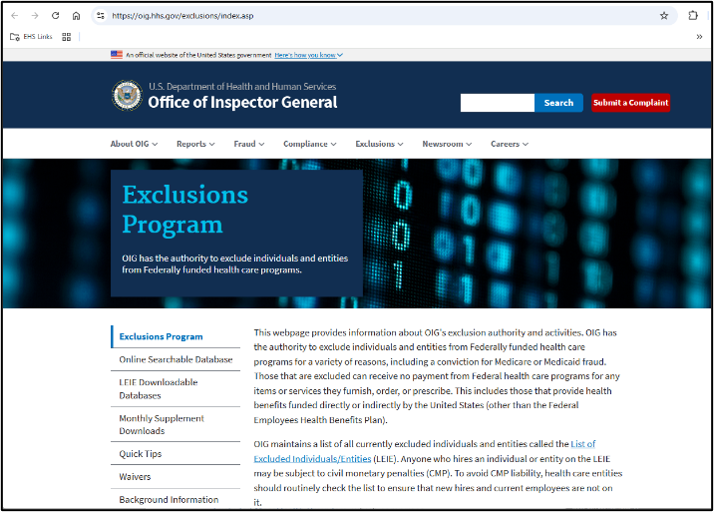
The OIG, as well as MassHealth, has the authority to exclude individuals and entities from federally funded health care programs for a variety of reasons, including, but not limited to, a conviction for Medicare or Medicaid fraud. Those that are excluded will not receive payment from federal or state health care programs for any items or services they furnish, order, or prescribe. The OIG maintains a list of all currently excluded individuals and entities called the “List of Excluded Individuals/Entities” (LEIE). Anyone who hires an individual or entity on the LEIE may be subject to civil monetary penalties. To avoid civil monetary penalties, health care entities should routinely check the list to ensure that new hires and current employees are not on it.
MassHealth maintains the List of Suspended and Excluded MassHealth Providers, which comprises providers that have been suspended or excluded from participating in MassHealth. It reflects for-cause terminations effective on or after March 23, 2010. MassHealth may exclude a provider for reasons such as sanctions from the provider’s licensing board, the results of a provider audit, criminal proceedings, or other justifications.
Attorney General’s Medicaid Fraud Division
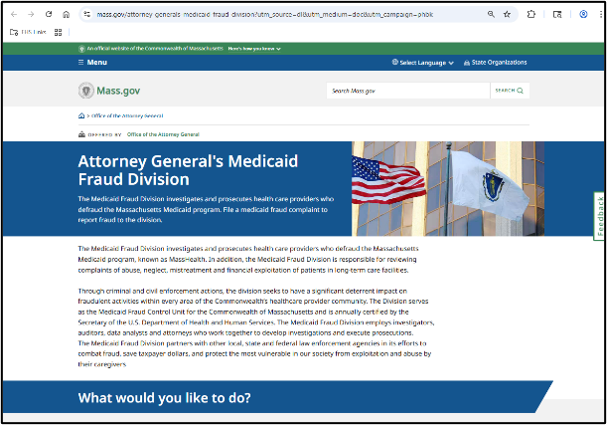
The Attorney General's Medicaid Fraud Division investigates and prosecutes health care providers who defraud MassHealth. It is also responsible for reviewing complaints of abuse, neglect, mistreatment, and financial exploitation of patients in long-term care facilities. Learn more from the Medicaid Fraud Division.
| Date published: | July 29, 2022 |
|---|---|
| Last updated: | August 21, 2026 |