
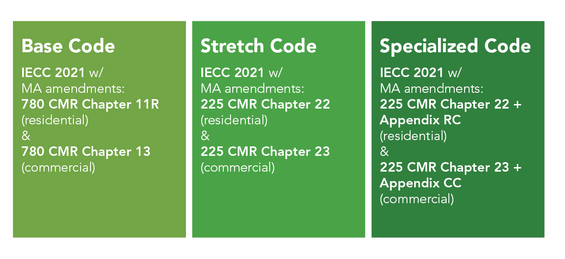
There are three levels of building energy codes in Massachusetts:
- The Base Code is IECC 2021 with MA amendments: 780 CMR Chapter 11R (residential) and 780 CMR Chapter 13 (commercial). The 780 CMR 10th Edition is the current building code for Massachusetts.
- The opt-in Stretch Code is IECC 2021 with key MA amendments: 225 CMR Chapter 22 (residential) and 225 CMR Chapter 23 (commercial).
- The opt-in Specialized Code is IECC 2021 key MA amendments: 225 CMR Chapter 22 + Appendix RC (residential) and 225 CMR Chapter 23 + Appendix CC (commercial).
This map shows which level of code is followed by each municipality.
The tenth edition building code became effective on October 11, 2024 with a concurrency period, during which either the ninth or tenth edition building codes could be utilized. This concurrency period, which was extended, ends June 30, 2025, at which time the tenth edition will be the only building code in effect.
Links to Code Documents
The latest version of the Stretch and Specialized Codes as of February 14, 2025
View the 2021 International Energy Conservation Code (IECC)
Stretch & Specialized Code – Residential
Stretch & Specialized Code – Commercial
780 CMR 10th Edition (MA Building Code)
TEDI Modeling Peer Review
DOER is offering a no-cost peer review service for projects pursuing the Thermal Energy Demand Intensity (TEDI) compliance pathway as part of a study DOER is sponsoring to gather data and feedback on the use of the TEDI (Thermal Energy Demand Intensity) code compliance path in Stretch and Specialized energy code communities. The pdf below outlines the study's goals and objectives. Projects pursuing TEDI energy modeling can participate, and in turn will benefit from both TEDI model review and thermal bridge calculations by a team of technical experts.
The peer review service can benefit those undertaking a feasibility study to evaluate the compliance path for a new construction project or pursuing the Thermal Energy Demand Intensity (TEDI) pathway in a Massachusetts Stretch or Specialized Energy Code community.
Why take advantage of the peer review?
- Evaluate feasibility of your compliance path
- Get direct feedback from experts on energy models and thermal bridge calculations
- Avoid common energy modeling mistakes
- Take advantage of a free peer review service
DOER held a webinar on Wednesday, July 8, 2026 to explain how this peer review service can benefit projects.
Please email MassDoerTEDI@wsp.com with questions.
2026 Public Comment
DOER is pleased to release a series of proposed revisions to the Stretch and Specialized codes, covering both commercial and residential sections. Based on the feedback received over the last year, these modest revisions are now available for public comment.
The revisions to the Stretch and Specialized codes are presented here, in both clean and redline versions, along with a summary of the proposed changes:
2026 Public Comments Received (PDF)
Stretch & Specialized Commercial Proposed (red lines)
Stretch & Specialized Residential Proposed (red lines)
Stretch & Specialized Commercial Proposed (clean version)
Stretch & Specialized Residential Proposed (clean version)
Stretch + Specialized updates explainer 02/03/2026
DOER is seeking public comment on these documents. DOER held a Public Hearing on June 16, 2026 on Zoom. Written comments were accepted until 5 PM EST on June 24, 2026.
District Energy Systems Guidelines
On June 24, 2025, DOER released its draft “Guideline on District Energy Systems” for public comment. DOER accepted public comments on the draft guideline until July 15, 2025. The guideline provides details on how to qualify district energy systems that are decarbonizing for relief from certain electrification requirements in the Massachusetts Energy Code.
Draft Guidelines for District Energy Systems, June 2025
Public Comments Received on Draft Guidelines for District Energy Systems
2025 Stretch Code Updates Webinar
Technical Documents
Stretch Code Technical Guidance Updated 9/30/2025
Attachment A: Envelope Performance and Thermal Bridge Derating
Attachment B: ASHRAE Appendix G Relative Performance Simulation Guidelines
Attachment C: Targeted Performance Simulation Guidelines
Attachment D: District Energy System Guidelines
Attachment E: Embodied Carbon Insulation Calculator
Attachment F: Low-Carbon Concrete Mixes available in MA
Additional Resources
Contact
Online
Address
| Date published: | November 27, 2024 |
|---|