

Recommendations
Establish Statewide Standards
Discussions within the Trail Access Working Group underscored the need for consistent, practical, and user-centered standards for surfaces, grades, and trail amenities. This is important both to ensure consistent quality and performance for trail construction, and to provide a predictable trail experience for users.
Normalizing accessibility in outdoor recreation means treating it as a fundamental part of trail planning—part of the very first conversation, not the last; part of every trail project, not just “accessible” trail projects. It requires asking what is possible rather than assuming what isn’t, and embedding accessibility considerations into baseline planning and design practices. Even in places where full accessibility can’t be achieved, when accessibility is integrated from the outset, genuine opportunities emerge: unnecessary barriers can be removed, accessible features can be incorporated where the landscape allows, and the overall experience can be improved for a far broader range of users.
Critical Issues: The following trail design topics emerged consistently across public engagement, site visits, and working group discussions:
- Surfacing
- Width
- Grades/slopes
- Edges
- Seating and rest areas
- Accessible parking & trailhead access
- Restrooms
- Managed uses
- Shade
- Trail information
Recommended Actions
- In partnership with the Massachusetts Architectural Access Board (MA AAB) and the Advisory Council, develop and adopt statewide standards for accessible trails that include surfacing, grading, drainage, width, slope transitions, edge treatments, and signage. [State Agencies, Trail Builders, Private Contractors, Private Quarries]
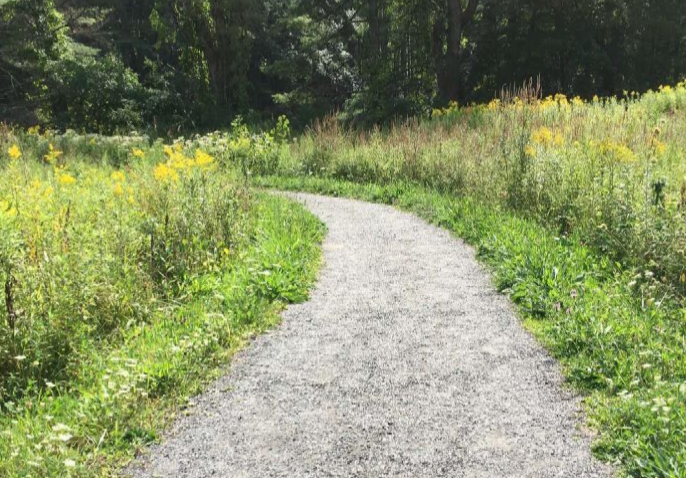
- Establish 3/8” minus crushed stone material as the default material for accessible trail surfacing. Use alternate materials only where site conditions, aesthetic goals or performance requirements demand them. Partner with builders and quarries to test performance, standardize sieve gradations, and maintain a shared, up-to-date guide with ideal mixes for different conditions. [State Agencies, Trail Builders, Private Contractors, Private Quarries]
Build a Common Resource of Best Practices
Communities have different barriers to building accessible trails. For some, it is financial resources; for others, it is political will; for others, it is know-how. Model guidelines and toolkits should be developed to make it easier for trail builders and municipalities to execute their vision for an accessible trail.
Educational and training materials for trail builders should also include best practices for creating a safe, enjoyable, memorable user experience. While standards are important to ensure an accessible trail is in fact accessible, there are many other features that contribute to a positive experience for users.
The following list reflects some important trail design considerations shared through this process:
- Design trails to allow opportunities for solitude, scenic views, and immersion in nature.
- Offer sufficient length and interest to feel the trail is “worth the trip.”
- Offer access to scenic viewpoints, water, and other highlights.
- Consider having multiple trails originate at a single trailhead, stacked loop” with options for users with different interests and abilities.
- Users have different preferences. Some people want a trail to feel as natural as possible, others prefer having interpretive signage, guide ropes or other features. Build a variety of types of trails.
Recommended Actions
- Provide a compendium of best trail design practices, informed by persons with lived experience, to ensure that accessible trails provide a high-quality user experience in addition to meeting minimum standards. [State Agencies (DCR), Large Land Trusts, Trail Builders, Private Contractors, Trail Consultants]
- Provide a compendium of construction best practices, including construction methods and specifications. [State Agencies (DCR), Large Land Trusts, Trail Builders, Private Contractors, Trail Consultants]
- Compile and publish examples of accessible trails to highlight success stories. [Advisory Council, State Agencies (DCR), Large Land Trusts, Trail Builders, Trail Consultants]
Cultivate Trail Construction Expertise
Participants consistently highlighted the variability in trail construction quality and the challenges communities face when hiring builders.
Training contractors in accessible trail construction might increase the number of companies bidding on accessible trail jobs, and help municipalities ensure that the contractors they hire are qualified.
Consistent and reliable sourcing of 3/8” minus crushed stone which is necessary to ensure long-lasting trails. Working with quarries to develop the best gradation of different sieve sizes for the type of stone they produce, in tandem with processing and testing improvements, would help ensure improve trail performance.
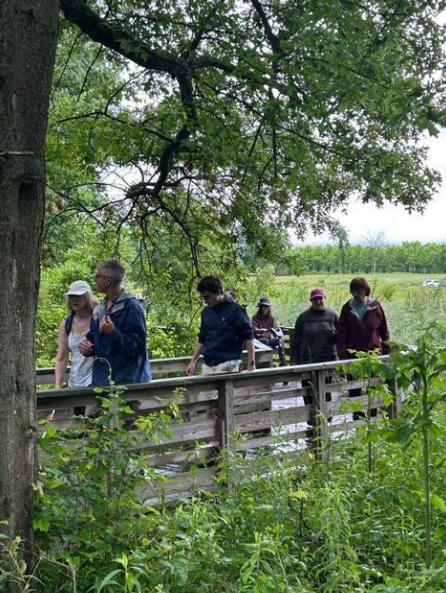
Compiling a list of accessibility consultants with lived experience who can consult on these projects would also help to ensure that construction will be accessible in practice. It is essential to include those with lived experience of disability throughout the design, construction, and testing process so that issues are discovered early.
Recommended Actions
- Support programs to share and disseminate best practices, success stories, specifications, and sources for trail surfacing. [State Agencies, Land Trusts, Trail Builders, Trail Consultants, Advocates]
- Develop model scopes of work and selection criteria to help towns and smaller land owners identify construction contractors with suitable skills and experience with natural surface trails. [Advisory Council, Trail Builders, Trail Consultants]
- Collaborate with DCR, DCAMM and MassDOT to create public contracting categories, qualifications, specifications, best management practices, and mechanisms that are specific to the needs of accessible trail design and construction in natural areas. (See also 1.4.1.) [State Agencies[DCR, MassDOT], Advisory Council]
- Encourage collaboration between trail designers, builders, and individuals with a lived experience of a disability in every trail project. Consider requiring participation of those with lived experience [State Agencies, Advisory Council, Trail Builders, Trail Consultants].
Why Design and Construction Matters
Design and construction determine whether a trail is truly accessible in practice—not just in intent.
Even well-planned projects can fail if trails are built with:
- unstable or inconsistent surfaces
- excessive grades or cross slopes
- inadequate width or clearances
- poor transitions at entrances, bridges, or rest areas
When done well, design, and construction:
- ensure trails are usable by people with a wide range of abilities
- provide a safe, comfortable, and dignified user experience
- reduce long-term maintenance needs and costs
- create consistency across the trail system
In short, planning sets the goal—but design and construction determine whether people can actually use the trail.