

Recommendations
Ensure Ongoing Accessibility Through Planned Maintenance
Even well-designed accessible trails can quickly become inaccessible if they are not properly maintained. Common issues—including erosion, drainage failures, seasonal ground changes, vegetation encroachment, and structural deterioration—can degrade trail conditions and create safety risks.
Erosion and drainage are among the most significant challenges. Water that is not properly managed can concentrate on the trail surface, causing washouts, gullies, and surface instability. Routine upkeep—such as clearing debris from culverts, maintaining swales, and preserving proper drainage patterns—is essential to prevent damage.
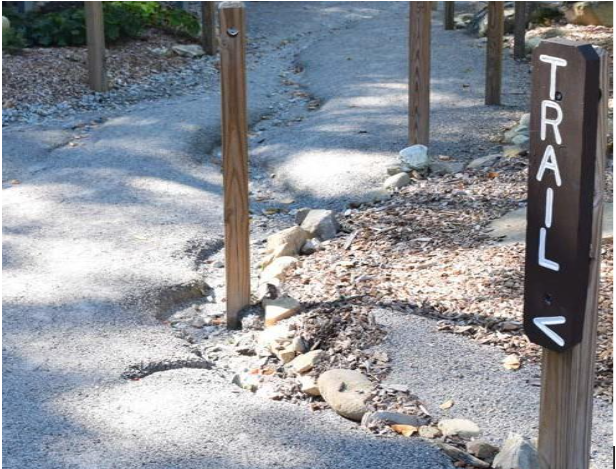
Seasonal changes in soil and water conditions also impact trail performance. Fluctuating water tables, freeze-thaw cycles, and natural wear can soften surfaces, shift materials, and reduce accessibility over time.
To address these issues, regular maintenance practices are critical, including:
- Managing drainage systems (culverts, swales, trail edges)
- Maintaining trail surfaces and repairing damage
- Controlling vegetation and obstructions
- Addressing localized problem areas with design solutions
Timely identification of issues is equally important. User feedback systems—such as reporting tools, on-site staff, or digital platforms—can help flag problems early, though they must be supported by staff capacity to respond.
Finally, effective maintenance requires clear planning and sustained capacity. Land managers need defined maintenance schedules, guidance, and resources to ensure trails remain accessible over time. Without this, even high-quality trail investments can quickly degrade and lose their intended function.
Recommended Actions
- Provide training and/or resources for land managers, contractors, and municipal staff on accessible trail maintenance best practices, including monitoring vegetation, obstructions, surface conditions, and publishing updates online and/or at trailheads to inform users. Consider incorporating accessible trails maintenance-focused sessions into venues such as the MassTrails Conference. [Trail Consultants, Trail Designers and Builders, and/or State Agencies]
- Develop template maintenance plans and guidelines to help trail managers systematize and budget for maintenance and inspections. Require maintenance plans as part of applications for public grants that fund accessible trail design and construction. [Trail Consultants, Trail Designers and Builders, and/or State Agencies]
- Encourage land managers to provide simple, accessible feedback systems (e.g., online forms, QR codes, phone number) so trail users can report issues or provide input in real time. [All Trail Managers, State Agencies, Land Trust]
Expand Capacity of Contractors, Staff, and Volunteers to Perform Maintenance
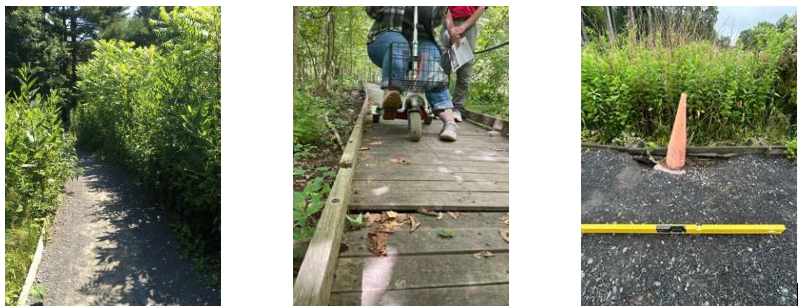
Maintaining accessible trails is challenging due to limited capacity, with many systems relying on volunteers and overextended staff. While this network of agencies, nonprofits, and volunteers represents a significant asset, expanding the accessible trail system will require increased and more coordinated capacity.
Accessible trail maintenance often requires skilled professional labor, particularly for specialized tasks, while volunteers play an important role in routine upkeep such as clearing vegetation and maintaining drainage.
Addressing this challenge will require:
- Expanded training for staff, volunteers, and contractors
- Better coordination across organizations and regions
- Development of a reliable pipeline of skilled professionals
Ultimately, sustaining an accessible trail network will depend on a more intentional, coordinated approach that leverages existing resources while building the expertise and workforce needed for long-term maintenance.
Recommended Actions
- Foster connections between landowners/trail managers and trained maintenance professionals (contractors, NGO staff, or others) to support timely inspections and emergency repairs to sustain accessible conditions.
- Partner with educational programs and landscape professionals to build a consistent pipeline of trained professionals who can conduct inspections, perform routine upkeep, and make repairs. Support the sharing and dissemination of best practices for trail maintenance.
- For routine trail care and non-specialized tasks, leverage volunteers, schools, Scouts, Friends of Trails groups, and AmeriCorps under professional supervision. [All Trail Managers, State Agencies, Land Trust]
Ensure Funding Resources Support Maintenance
While funding is often available for trail construction, securing resources for ongoing maintenance is much more difficult. Accessible trails can require higher maintenance costs due to specialized materials, design features, and construction methods, which are often underestimated.
To address this, maintenance must be planned and funded from the outset. This includes defining routine upkeep needs—such as drainage management, surface repairs, and vegetation control—as well as accounting for the lifecycle and replacement of features like boardwalks, signage, and trail infrastructure.
Incorporating clear maintenance plans and dedicated funding into initial project design is essential to ensuring trails remain accessible and functional over time.
Recommended Actions
- Ensure state grant programs include maintenance of accessible trails as eligible activities [State Agencies]
- Work with the CPA Coalition and other Community Preservation Act stakeholders to more effectively use CPA funds to create, preserve, rehabilitate and/or restore the accessible trail system. (See also Action 1.3.5.) [State Agencies (EEA), CPA Coalition, Advocates]
Why Maintenance Matters
Accessible trails are not a one-time investment—they require ongoing care to remain usable and safe.
Without regular maintenance, trails can quickly become inaccessible due to erosion, surface degradation, vegetation growth, or damaged infrastructure. Even small issues—like clogged drainage, loose gravel, or encroaching vegetation—can create significant barriers for users.
Maintenance is also more complex for accessible trails. It often requires specialized materials, techniques, and trained staff, along with consistent monitoring and timely repairs.
Sustaining accessibility over time depends on:
- Reliable funding for ongoing maintenance
- Skilled staff and trained volunteers
- Clear maintenance plans and schedules
- Systems to identify and respond to issues quickly
In short, a trail is only as accessible as its current condition—and without sustained maintenance, accessibility is quickly lost.