

Recommendations
Center Lived Experience
As captured by the principle "Nothing about us without us,” people with disabilities should be involved in all stages of trail design, funding decisions, management, and maintenance. As one participant noted, “we need to depend on lived experience more than what we think will work.” Many supported the formation of an Advisory Council—with at least one-third of its members having lived experience of disability—to guide future stages of this initiative and implementation of many of these recommendations.
Normalizing accessibility in outdoor recreation means treating it as a fundamental part of trail planning—part of the very first conversation, not the last; part of every trail project, not just “accessible” trail projects. It requires asking what is possible rather than assuming what isn’t, and embedding accessibility considerations into baseline planning and design practices. Even in places where full accessibility can’t be achieved, when accessibility is integrated from the outset, genuine opportunities emerge: unnecessary barriers can be removed, accessible features can be incorporated where the landscape allows, and the overall experience can be improved for a far broader range of users.
Recommended Actions
- Fund, plan, design and test all trails in partnership with people with diverse disabilities, ensuring accessibility is integrated in every project from the outset. Ensure participation from individuals with lived experience of disability who reflect the full diversity of the community, especially underserved populations. [State Agencies, Land Trusts, Land Owners, Trail Design Consultant, Trail Builders, Private Funders, Municipalities]
- Compile a list of accessibility consultants with lived experience who can consult on accessible trail projects throughout planning, design, and construction. [Advisory Council, State Agencies, Large Land Trusts]
- Create a multi-stakeholder Advisory Council at the Executive Office of Energy and Environmental Affairs (EEA) to advise MOOR and EEA Agencies on the findings of the Trails for All Report and the implementation of recommendations. The Advisory Council should center lived experience with at least one-third of its members being persons with lived experience of a disability, and also include broad representation from other key stakeholder agencies, organizations and groups. Specifics of size, agency representation, terms, meeting cadence, and compensation should be determined by EEA. [State Agencies (EEA)]
- Draft a Model Policy Platform which could be adopted by local governments and non-profit organizations to normalize and prioritize accessibility in outdoor spaces. [Advisory Council]
Plan a Robust and Equitable Accessible Trail System
Building out a comprehensive accessible trail network will require efforts in towns and communities across the Commonwealth, at all levels of governance and community organization. It will also require building new trails, redesigning existing trails, and removing barriers that prevent access to otherwise accessible routes.
We recommend a goal to have an accessible trail within 20 minutes of all Massachusetts residents, especially those who live in disadvantaged communities and those who rely on public transportation.
Some trails need to be significantly longer and more immersive, and/or provide greater access to unique scenic, natural, historic, or cultural settings.
Coordination across municipal boundaries and state agencies will be essential to achieve these goals.
While building accessible trails offers the strongest foundation for equitable access, the network can be further strengthened through adaptive guiding and equipment programs
Recommended Actions
- Systematize accessible trail planning by integrating it into routine municipal and regional planning efforts such as Open Space & Recreation Plans, Bicycle & Pedestrian Plans, Regional Greenway Plans, and others. [Regional Planning Agencies, Trail Design Consultants, State Agencies, Municipalities]
- Evaluate trail networks within towns, regionally, and statewide, to identify gaps in the accessible trail networks and experiences. Efforts to identify gaps could begin with: [Advisory Council, Regional Planning Agencies, State Agencies, Municipalities, Land Trusts, Trail Consultants]
- Gateway Cities
- Places where residents do not have an accessible trail within a 20-minute trip
- Existing or planned transit corridors that lack nearby trailheads
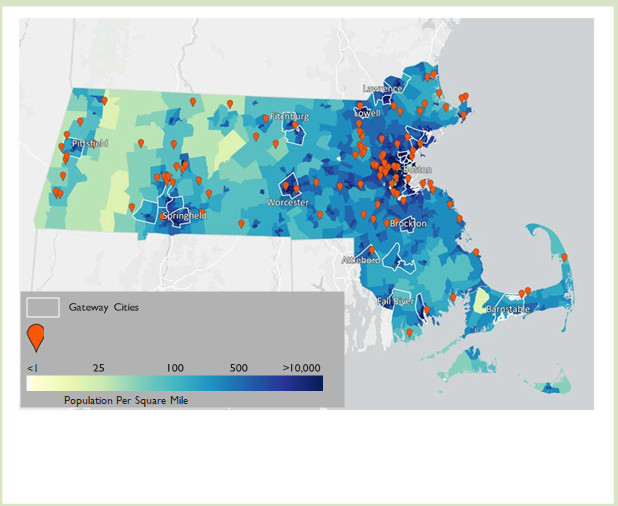
- Evaluate trail networks at the local, regional, and statewide scale to identify opportunities for new “keystone” trails—destinations that offer distinctive natural, historic, or cultural settings, can extend a mile or more, and have the potential to attract regional visitors for an exceptional experience. [State Agencies, Regional Planning Agencies, Large Land Trusts, Trail Consultants]
- Develop an accessible trail redesign decision-making toolkit to guide municipalities and trail organizations in evaluating existing trails for potential accessibility improvements. Key factors to consider include transit access, availability and accessibility of parking, trail length, width, and grades, and the condition of the trail surface, sub-base, and drainage. [Advisory Council, Trail Consultants]
- Ensure that accessibility is a central consideration in all trail improvement projects. [State Agencies, Land Trust, Land Owners, Trail Design Consultant, Trail Builders]
- Expand programs providing adaptive equipment and assistance to access nature. Support, fund, advertise, and maintain adaptive and assistive recreation equipment lending and sharing programs, networks and systems. [State Agencies, Land Trusts, Adaptive Programs, Adaptive Equipment Companies, Advocates]
- Explore opportunities for accessible trails that follow the routes of aqueducts, sewer and water lines, flood control levees and other infrastructure corridors. [Regional Planning Agencies, Trail Design Consultants, State Agencies, Municipalities]
Create and Maintain Funding Sources to Expand and Support the Accessible Trail Network
Ensuring reliable and sustained funding for municipalities, non-profits, and state agencies who are responsible for managing and making improvements to trails is essential for addressing gaps in the network.
Robust agency funding also ensures that accessible trail projects can move from concept to completion, that maintenance needs are met over time, and that the state can effectively coordinate and prioritize investments across multiple funding mechanisms.
Recommended Actions
- Establish a dedicated state fund, able to accept public and private contributions, to ensure sustainable state-level funding for construction and ongoing maintenance of accessible trails. [Legislators, State Agencies]
- Prioritize accessible trails within the MassTrails grant program and other state grants programs. Ensure that any state funding for conservation and/or recreation includes funding for accessible trail construction and maintenance [State Agencies[MassTrails]]
- Integrate accessibility improvements into existing and future climate resilience, open space, and infrastructure funding mechanisms. [State Agencies, Private Funders]
- Partner with hospitals and health networks to [Health Care Providers, Land Trusts, Adaptive Programs, Private Funders, Department of Public Health]:
- Develop accessible trails on or near healthcare campuses;
- Support shuttle services and trailhead access for patients and community members;
- Provide adaptive equipment rentals or loans; and/or
- Incorporate trail-based programs into rehabilitation, wellness, and preventive care initiatives.
- Work with the CPA Coalition and other Community Preservation Act stakeholders to more effectively use CPA funds to create, preserve, rehabilitate and/or restore the accessible trail system. (See also 4.3.2.) [State Agencies[EEA], CPA Coalition, Advocates]
- Guarantee that key state agencies—including the Department of Conservation and Recreation (DCR), the Department of Fish and Game (DFG), and the Massachusetts Office of Outdoor Recreation (MOOR)—receive sufficient operating budget allocations and capital investment resources to plan, design, build, and maintain accessible trails across the Commonwealth. Sustained funding for agency staff, technical expertise, project management, and oversight of grant and capital programs is essential to expanding the accessible trail network and ensuring long-term stewardship of these public assets. [Legislators]
Reduce Administrative and Regulatory Barriers
Trail builders and municipal representatives identified administrative and regulatory burdens that can increase costs and delay projects. Massachusetts wetlands permitting, in particular, was identified as an area where clearer guidance could improve projects without compromising environmental stewardship.
Included in the discussion of Administrative Barriers are the complications of contracting for accessible trail construction. Non-accessible trails lend themselves to a wide range of contracting approaches, and are often built by both contractors and volunteers. These same trail builders often lack the technical training and oversight necessary to build functional and durable accessible trails.
Recommended Actions
- Collaborate with DCR and MassDOT to create public contracting categories, qualifications, specifications, best management practices, and mechanisms that are specific to the needs of accessible trail design and construction in natural areas. Make these contracting mechanisms available to municipalities. (See also 2.3.3.) [State Agencies (DCR, MassDOT), Advisory Council]
- Collaborate with the Department of Environmental Protection (DEP) and advocacy partners to “right-size” the regulatory framework for wetlands review and permitting to reduce the time, cost, and technical barriers to accessible trail maintenance and construction permitting while maintaining strong wetland resource protections. [State Agencies, Advocates, Legislators]
Facilitate Transportation to Trails
Getting to trailheads is the greatest barrier for those who cannot drive and depend on paratransit and public transportation, which can be limited, infrequent, or unreliable.
As an example of a recent success, Mass Audubon advocated for years for public transit to connect to the Broad Meadow Brook Wildlife Sanctuary in Worcester, and was ultimately successful.
Access challenges also occur near the trailhead itself. Dangerous intersections, missing crosswalks, and inadequate sidewalks can limit access even for residents who live nearby. Improving these conditions is essential to ensure that trails are safely and fully accessible.
Recommended Actions
1. Create a Transit to Trails initiative with MassDOT and regional transit authorities to enhance transit access to accessible trails. The initiative may include:
- Ensuring all trailheads can serve as drop-off and pick-up locations using GPS coordinates, regardless of official street addresses. [State Agencies, Regional Transit Authorities, Regional Planning Agencies]
- Exploring and promoting dedicated weekend routes, dedicated shuttle buses, subsidized vouchers, and volunteer buddy systems. [State Agencies, Regional Transit Authorities, Regional Planning Agencies]
- Establishing a “Safe Routes to Trails” initiative and improved sidewalk and crossing connections near trailheads in planning the trail system. [State Agen-cies, Regional Transit Authorities, Regional Planning Agencies.]
Why Planning and Policy Matter
Planning and policy decisions determine:
- Where trails are built
- Who has access to them
- How they are funded and maintained
Without coordinated planning and clear policy direction, accessible trails will remain limited, unevenly distributed, and difficult to sustain.