
About Continuums of Care (CoCs)
Across the Commonwealth there are 10 regional CoCs who receive money from the U.S. Department of Housing and Urban Development (HUD) to support service providers that help people experiencing homelessness. Each CoC serves a unique geographic area.
About the Balance of State CoC
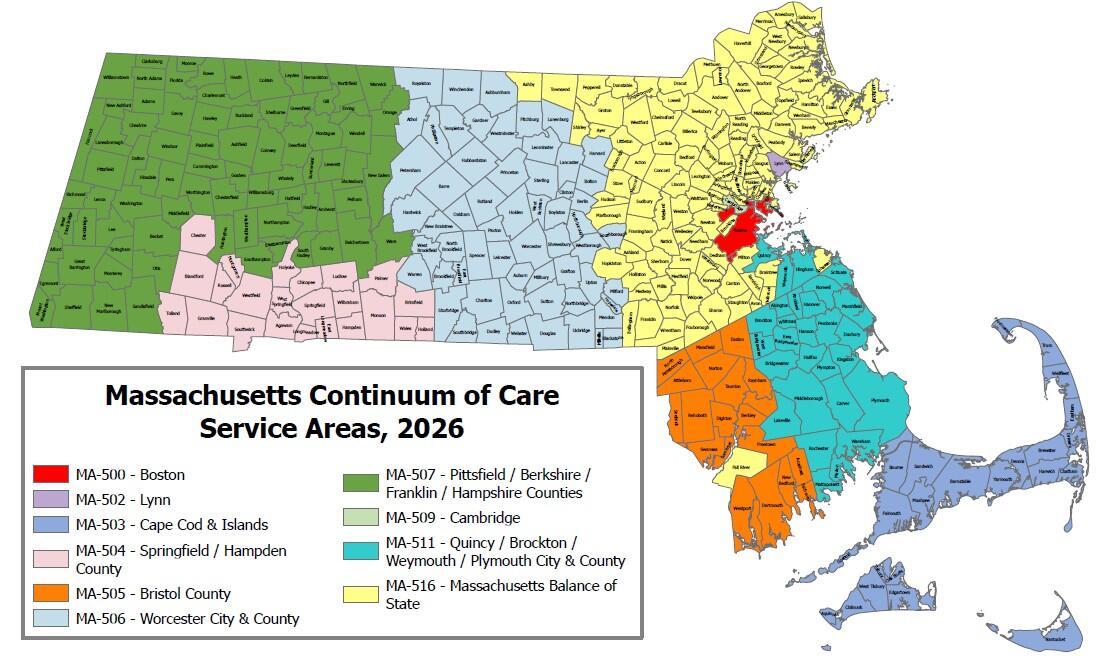
HLC only manages 1 of the 10 CoCs across the Commonwealth. It is called the Balance of State CoC (BoS CoC) and covers the areas of North Middlesex, North Shore, Metro, West, and Fall River.. This is located under the MA-516 region, as highlighted in yellow on the map below. You can download a PDF version of the map.
Who is Eligible?
Homeless individuals and families who are homeless according to the HUD definition of homelessness, living in shelter, or living in places not meant for human habitation.
How to Access Services?
To apply for housing in a CoC-funded program within the Balance of State, applicants need to access the Coordinated Entry System (CE). This process ensures that access to the finite resources available is equitable and provided to those who are most vulnerable first.
Applicants can begin with their local homeless service provider. If it is unclear who that might be, you can reach out to the CE Regional Navigator who oversees the access point in your city or town.
For help in accessing an emergency shelter, either speak with a local homeless service provider, if you know of one, or follow this link to the Service Provider Listing.
Identifying Key Needs
One of the ways we identify this population is through an annual survey most often undertaken in the last week of January. Each year HLC counts all of the homeless people reported by homeless service providers together with collected counting of homeless people on the streets by local police departments and volunteer groups. This is our annual Point in Time Count of homeless people in the 115 Balance of CoC communities to identify the most important needs for services and types of housing. Generally, the most important need identified is determined to be to move homeless people from the streets and emergency shelters into safe permanent housing with ongoing support service
Through the BoS CoC, HLC and our partners, endeavor to end homelessness by:
- Funding permanent supported housing for over 800 formerly homeless individuals and families.
- Conducting street outreach to homeless people living in places people would not normally live (abandoned buildings, under bridges, in their cars, etc.) in an effort to get them into a safer environment.
- Working with CoC members in an effort to help better coordinate homeless services in the CoC jurisdiction.
- Increasing the number of housing units to be made available by leveraging other local and state resources to provide the services.
Additional Resources
-
MA BoS CoC Emergency Transfer Plan - English, Open DOCX file, 91.27 KB (English, DOCX 91.27 KB)
-
MA BoS CoC Emergency Transfer Plan - Español, Open DOCX file, 87.67 KB (Spanish, DOCX 87.67 KB)
-
MA BoS CoC Emergency Transfer Plan - Portuguese, Open DOCX file, 86.73 KB (Portuguese, Brazil, DOCX 86.73 KB)
-
Youth and Young Adult Education and Employment Resources, Open DOCX file, 76.26 KB (English, DOCX 76.26 KB)
-
Balance of State CoC Governance Charter, Open DOCX file, 593.24 KB (English, DOCX 593.24 KB)
FY26 NOFO has been reopened
The Massachusetts Balance of State Continuum of Care (BoS CoC) reopened the FY26 Continuum of Care Notice of Funding Opportunity (NOFO) on September 18, 2026.
Project applications were completed and approved by the Advisory Board prior to the pause on, August 7, 2026. Due to the pause, applicants were notified on September 23, 2026, of their approval status. You can review the list of projects being included in the FY26 CoC NOFO response.
The deadline for the BoS to submit the Consolidated Application, Priority Listing, and Individual Project Applications to HUD is September 30, 2026, 8:00 p.m. EST.
You can review the full CoC Application and Priority Listing. The BoS CoC welcomes your comments. Please reach out to Karen Byron with your questions and feedback: karen.byron@mass.gov.
It is important to acknowledge that the FY26 CoC NOFO is still being reviewed in federal court which could impact future status. You can follow the case and receive live updates from Court Listener.
Questions? Please reach out to Karen Byron: karen.byron@mass.gov
Documents Related to Current BoS CoC NOFO strategies
The documents below were developed before work related to the FY26 NOFO was paused. They are available for reference and may change based on future guidance.
How to Get Involved as a BoS CoC Committee Partner
Membership in the BoS CoC is open to the public. There are no fees or applications to submit. We meet virtually on the first Wednesday of each month at 10:00 a.m. EST and welcome all new participants. We meet via Microsoft Teams, and you can access the meeting by following this link.
There are also several committees that work to address unique issues of subpopulations within our BoS CoC. Membership is open to anyone interested in preventing and ending homelessness in the CoC’s geographic area. New participation is always welcome. Individuals with lived experience and expertise of homelessness are encouraged to become involved. We seek to maintain a diverse membership with representation and participation from the Black, Latino, Indigenous, LGBTQ+, and persons with disabilities communities.
FY26 HUD CoC NOFO Meeting with Continuum of Care Committee Partners
The information below summarizes the June 17, 2026 meeting and was developed before work related to the FY26 NOFO was paused. Information and timelines discussed at this meeting may change.
- Review of BoS CoC FY26 NOFO calendar
- The Project Evaluation Committee has been meeting and we anticipate having specific criteria related to tiering, possible PSH cuts, transition grants, and new TH and SSO grants
- Process for moving a current resident in PSH to TH
- Process for submitting new and renewal applications including partnership with someone from the HLC team
For more information on general membership or committee membership please contact the following:
- General Membership – Karen.Byron@Mass.Gov
- Persons with Lived Experience and Expertise of Homelessness (PLEE) Committee – Karen.Byron@Mass.Gov
- Pathways to Opportunity Council – Loreynis.Figueroa-Brito@Mass.Gov
- Coordinated Entry Committee – Chris.Moskal@Mass.Gov
- Veterans Committee – Chris.Moskal@Mass.Gov
- Domestic Violence Committee – Chris.Moskal@Mass.Gov
- Youth and Young Adult Committee – Troy.Fernandes@Mass.Gov
Contact
Online
Phone
Mass211 is available 24/7 to answer general questions about HLC housing or home energy programs. Translation available.
Please listen for phone menu options for EOHLC divisions
Tara Smith, press secretary
Address
| Date published: | September 11, 2024 |
|---|---|
| Last updated: | September 23, 2026 |