- Office of Consumer Affairs and Business Regulation
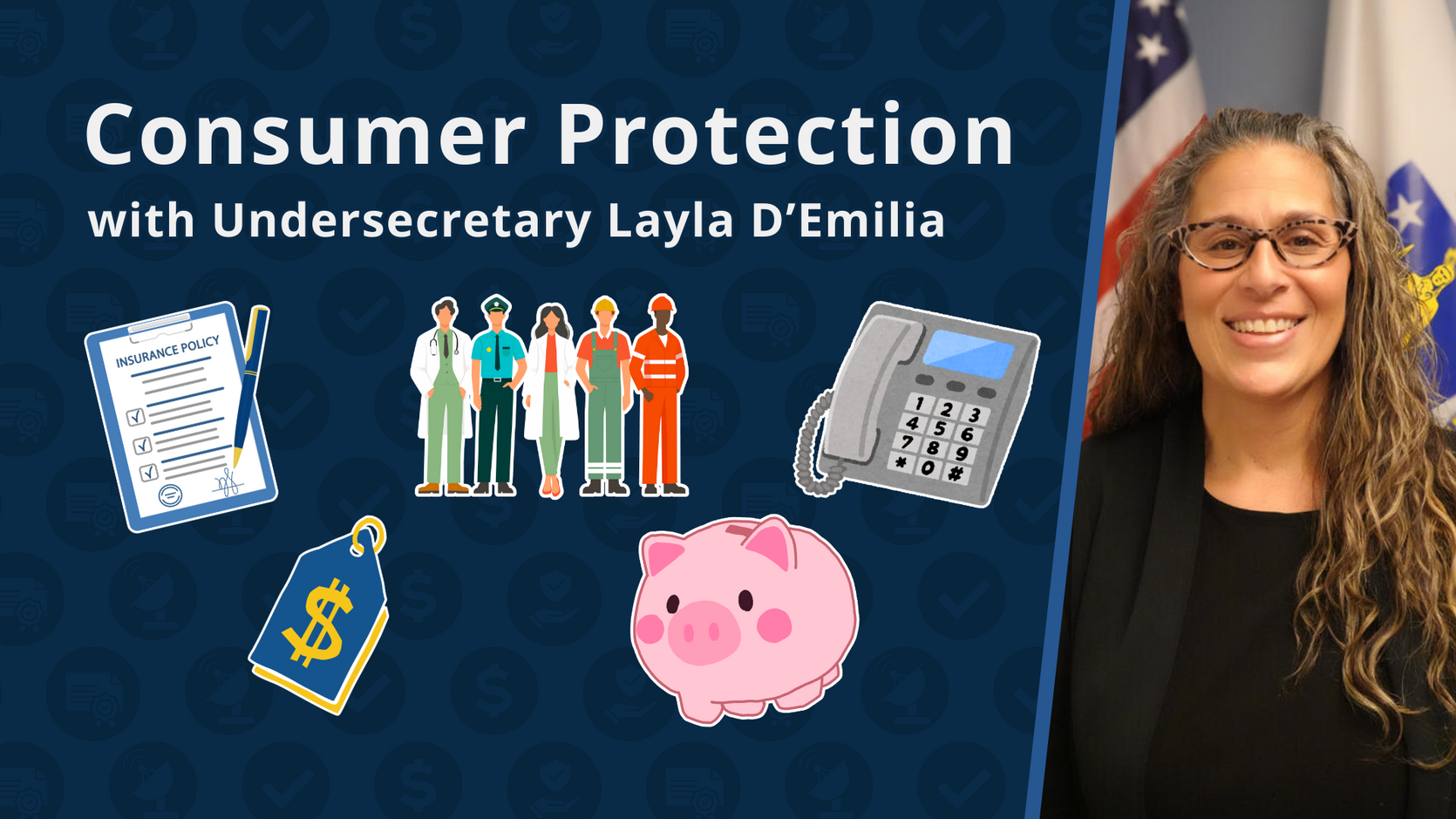
Video: OCABR's Fact or Fraud: Episode One
Skip this video OCABR's Fact or Fraud: Episode One.It's National Consumer Protection Week (NCPW)! Led by the Federal Trade Commission (FTC) annually during the first week of March, NCPW focuses on providing educational resources to help people protect themselves from fraud, identity theft, and other threats.
Organizations and individuals across the nation, including all of us here at the Massachusetts Office of Consumer Affairs and Business Regulation (OCABR), participate to distribute information about how people can avoid, report, and recover from scams.
We sat down with Undersecretary Layla D’Emilia for her thoughts on how OCABR helps consumers and how people can better protect themselves from scammers.
What Does OCABR Do for You?
“OCABR is the backbone of the working class,” says D’Emilia. “Our offices register and license the people who power the economic engine that runs our Commonwealth. Without the work of the people at these agencies, buildings don’t get built, safety inspections don’t happen. Banks, insurers, retail stores, telecommunications — everything that is needed to build something or operate something or sell something — is regulated through these agencies.”
Agencies under OCABR include:
- Division of Banks (DOB)
- Division of Insurance (DOI)
- Division of Occupational Licensure (DOL)
- Division of Standards (DOS)
- Department of Telecommunications and Cable (DTC)
Each agency has a customer service unit to assist with questions and concerns.
OCABR also runs several programs created to protect consumers, including the Home Improvement Contractor (HIC) Program, the Lemon Law Arbitration Program, Data Breach reporting, and the state’s Do Not Call Registry.
In addition, OCABR is committed to helping residents understand scams and fraud, providing tips on consumer protection in multiple languages, and working with community partners across the Commonwealth to provide information on programs and services. This NCPW, Undersecretary D’Emilia shared her top tips you should know about scams and fraud.
#1 Consumer Protection Tip: Passwords
There’s a lot of actions consumers can take to protect themselves and their data. But D’Emilia recommends one above all others: password security. “Passwords are the key to your accounts and personal information and should always be taken seriously,” she said.
- Passwords should be complex and different for every platform.
- Aim to make your passwords at least 15 characters long.
- Use a mix of uppercase and lowercase letters, numbers, and symbols.
- Don’t use commonly known or public information about yourself.
- Stay organized with a secure password manager.
- Turn on multifactor authentication (MFA) for an extra layer of security.
- Pick security questions only you can answer and avoid using publicly available information.
#1 Consumer Threat: Identity Theft
Identity theft — when someone steals and uses your personal or financial information without your permission — is one of the biggest threats to consumers today, according to D’Emilia. While no one is 100 percent immune to scams or identity theft, keep these tips in mind.
- Check your financial records regularly and report suspicious activity.
- Freeze your credit reports to prevent people from using your financial history for fraudulent loan and credit card applications.
- Never give out personal information to unknown individuals.
- Be careful with what you post online, as oversharing can put your data at risk.
#1 Common Scam: Urgent Texts
"Text scams are fraudulent messages designed to create a false sense of urgency, such as impersonating a government agency or a fake financial alert,” said D’Emilia. Scammers take advantage of people’s fear to gain access to their personal information.
- Don’t respond to suspicious messages.
- Filter and block unwanted texts.
- Exercise caution around language that may instill a sense of urgency, such as “immediately,” “act now,” and “suspended.”
- Never click links you’re not 100 percent confident about, especially if they’re excessively long and don’t look official.
Watch D’Emilia discuss how to avoid a text scam in this Fact or Fraud episode.
What to Do if Your Personal Information was Stolen or You Fell for a Scam
File a report with local and federal authorities. Alert your bank or credit card company and credit bureaus.
- Contact the Federal Bureau of Investigation (FBI) at ic3.gov or 857-386-2000.
- Call the Federal Trade Commission Identity Theft Helpline if you have questions: (877) 438-4338, TTY: (866) 653-4261 or visit consumer.ftc.gov.
- File a report with your local police department and receive a copy for your records.
- Send the police report to your financial institutions and the three credit bureaus: Equifax, Experian, and TransUnion and freeze your credit.
Resources
Find resources below in English, Spanish/Español, and for the d/Deaf & Hard of Hearing and ASL users.
In English
MA RESIDENTS — File a consumer complaint with the Massachusetts AGO.
NON-MA RESIDENTS — Find the contact information for your state’s Attorney General’s Office on the National Association of Attorneys General (NAAG) site.
Report a scam to the Federal Trade Commission (FTC).
Learn how to report and handle identity theft.
The CFPB | Consumer Financial Protection Bureau
Learn more about Consumer Protection Week from the FTC.
Suicide & Crisis Lifeline: call or text 988, or chat online.
Resources from Mass.gov
A Massachusetts Consumer Guide to Shopping Rights
The Massachusetts Consumer Protection Law
Massachusetts laws about consumer protection
Resources for Massachusetts Consumers
En Español
Residentes de Massachusetts — Presente una queja de consumidor ante la oficina del fiscal general.
Residentes no de Massachusetts — Encuentre la información de contacto de la Oficina del Fiscal General de su estado en el sitio web de la Asociación Nacional de Fiscales Generales (NAAG).
Reporte una estafa a la Comisión Federal de Comercio (FTC).
Aprenda cómo denunciar y manejar el robo de identidad.
La CFPB | Oficina para la Protección Financiera del Consumidor
Aprenda más sobre la Semana Nacional de Protección del Consumidor (NCPW) de la FTC.
Línea de Prevención del Suicidio y Crisis: llama o textea 988, o chatear en línea. Extensión de llamada: Para español, marca dos.
For the d/Deaf & Hard of Hearing and ASL users
Please note that these are additional resources and contact options to specifically serve d/DHH and ASL users. These are intended to supplement what is given above in written English and Spanish to ensure more equal access, not to replace those resources.
Massachusetts residents — Contact the Massachusetts Attorney General’s Office. MassRelay users: dial 711 and connect via main number: (617) 727-2200.
Contact the Federal Communications Commission’s ASL Consumer Support Line at 844-4-FCC-ASL (844-432-2275).
Watch videos from the Internal Revenue Service's official ASL-language YouTube channel, such as a video playlist about Identity Theft (Videos in ASL, some videos also have English captions and audio).
Massachusetts Commission for the Deaf and Hard of Hearing (MCDHH)’s updated Savvy Consumer’s Guide to Hearing Loss
Videos from the National Association of the Deaf on Discrimination by Businesses, Discrimination by State and Local Government Programs or Services, and Employment Discrimination-by State and Local Government and Business Employers (ASL with optional English captions).
Suicide & Crisis Lifeline: VP/VRS: Dial 988. TTY: Dial 711, then 988. Text conversation: Text 988. You can also chat online.
Deaf Crisis Line: VP/VRS: Dial (321) 800-3323. You can also contact the DCL by web (need a webcam enabled device).