
Massachusetts state courts
State courts apply state and, sometimes, federal law to decide criminal and civil cases. There are multiple departments and levels.
Massachusetts court system organization chart
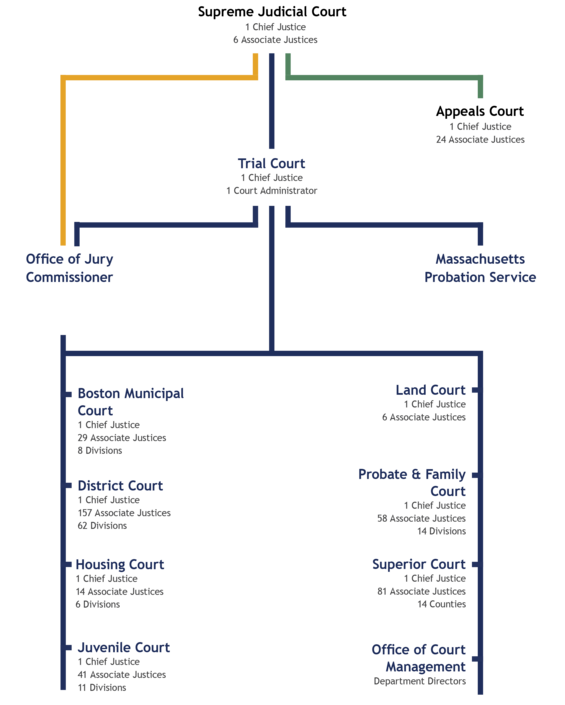
The number of justices for all courts is the total authorized by law.
Massachusetts Court System organization chart (text version)
- Supreme Judicial Court
- 1 Chief Justice
- 6 Associate Justices
- Appeals Court
- 1 Chief Justice
- 24 Associate Justices
- Office of Jury Commissioner
- Massachusetts Probation Service
- Trial Court
- 1 Chief Justice
- 1 Court Administrator
- Boston Municipal Court
- 1 Chief Justice
- 29 Associate Justices
- 8 Divisions
- District Court
- 1 Chief Justice
- 157 Associate Justices
- 62 Divisions
- Housing Court
- 1 Chief Justice
- 14 Associate Justices
- 6 Divisions
- Juvenile Court
- 1 Chief Justice
- 41 Associate Justices
- 11 Divisions
- Land Court
- 1 Chief Justice
- 6 Associate Justices
- Probate and Family Court
- 1 Chief Justice
- 58 Associate Justices
- 14 Divisions
- Superior Court
- 1 Chief Justice
- 81 Associate Justices
- 14 Counties
- Office of Court Management
- Department Directors
- Office of Jury Commissioner
Supreme Judicial Court: The top court in Massachusetts is called the Supreme Judicial Court. It has a Chief Justice and 6 Associate Justices. Together, these 7 Justices decide on appeals for many kinds of civil and criminal cases. The Supreme Judicial Court also supervises the judiciary and the bar, makes or approves rules for court operations, and gives advisory opinions, upon request, to the governor and the legislature.
Appeals Court: The Appeals Court reviews decisions made by trial judges in different types of cases. The Appeals Court has a Chief Justice and 24 Associate Justices. The Appeals Court also has jurisdiction over appeals from final decisions of three State agencies: the Appellate Tax Board, the Industrial Accident Board and the Commonwealth Employment Relations Board.
Trial Court: Trial courts are the first place where a case is filed and tried. There are 7 Trial Court departments: District Court, Boston Municipal Court, Housing Court, Juvenile Court, Land Court, Probate & Family Court, and Superior Court.
Specialty courts: Specialty courts are not actually separate courts; they are problem-solving court sessions that provide court-supervised probation and mandated treatment. Massachusetts has several types of specialty court sessions including Adult Drug Courts, Mental Health Court, Veteran’s Treatment Court, and Homeless Court.
Federal courts in Massachusetts
Federal courts are limited to hearing cases concerning the United States Constitution and Federal Statutes. There are three federal courts in Massachusetts: U.S. District Court for the District of Massachusetts (where cases are first filed), U.S. Court of Appeals for the First Circuit, and the U.S. Bankruptcy Court: District of Massachusetts.
U.S. Court of Appeals: First Circuit
Court rules and process
State courts
About the Massachusetts court system
Learn how the Massachusetts Court System works and find court data, metrics, reports, policies, plans, and initiatives.
Massachusetts court process
Learn how the different court departments work.
Massachusetts court rules and standing orders
Includes rules and standing orders for each of the court departments.
Massachusetts Court Reform Act of 1978 (PDF) (St. 1978, c. 478)
This 1978 law reorganized the Massachusetts Court System to provide for the orderly administration of justice.
Representing yourself in a civil case
Provides an overview of the court process in a civil case, answers frequently asked questions, and directs a self-represented litigant to available resources.
Supreme Judicial Court style manual, SJC Office of the Reporter of Decisions, 2025-2026.
The manual may be useful to those preparing appellate briefs, and it may offer readers of the official reports a better understanding of the process of reporting the opinions of both courts.
Federal courts
Federal court rules
Includes the current rules of practice and procedure as well as federal local rules.
Federal courts and the public
Provides information on the court role and structure, types of cases, types of federal judges, probation and pretrial services, defender services, and educational resources.
Pro se FAQ
Answers frequently asked questions for self-represented litigants appearing in the District of Massachusetts.
Information about court cases
Supreme Judicial Court and Appeals Court: Case search
Provides docket information on cases entered since January 1, 1992 in the SJC, and since January 1, 1988 in the Appeals Court.
Trial Court: Case search
Search for and access case dockets by name or docket number, including those from District, Superior, Housing, Land, and Probate & Family Courts.
Selected reports
Court system data, metrics, and reports
Summary statistics reflect the type and volume of cases handled across the state over recent years. Court metrics measures clearance rate, time to disposition, age of pending cases and trial date certainty.
Court reports: Reports on a range of court management issues including, among other things:
- Access to justice
- Annual reports
- Court management advisory board (CMAB)
- Court management and procedure
- Hiring and promotion
- Diversity reports
Access to court records
Boston Globe Media Partners, LLC v. Chief Justice of the Trial Court, 483 Mass. 80 (2019)
Records of show cause hearings where the judicial officer finds probable cause but declines to issue a criminal complaint are not presumptively public, but the clerk-magistrate or judge shall grant a records request from a member of the public where the interests of justice so require. All show cause hearings must be electronically recorded.
Comm. v. Fujita, 470 Mass. 484 (2015)
A list of jurors must be "retained in the court file of the case and be made available to the public in the same manner as other court records. Only on a judicial finding of good cause, which may include a risk of harm to the jurors or to the integrity of their service, may such a list be withheld."
Massachusetts Trial Court record retention schedule, Administrative Office of the Trial Court.
Outlines requirements for each court department.
Supreme Judicial Court Rule 1:24: Protection of personal identifying information in publicly accessible court documents
This rule aims to prevent unnecessary inclusion of specific personal details in public court documents. This helps lower the risk of identity theft, privacy invasion, or other misuse of these documents.
Trial Court Public Access to Court Records Committee
Find information about the Trial Court Public Access to Court Records Committee and Trial Court Rule XIV: Uniform Rules on Public Access to Court Records.
Written information security program for non-public documents held by the Massachusetts courts (WISP)
The WISP outlines the rules for how the Supreme Judicial Court, the Appeals Court, and all departments of the Trial Court handle personal information in electronic and paper records.
Selected print sources
History of the judiciary of Massachusetts, including the Plymouth and Massachusetts colonies, the Province of the Massachusetts Bay, and the Commonwealth by William T. Davis, The Boston Book Company, 1900. (Online version available on the Internet Archive)
Reflections of the justices by Judith Fabricant, 1st ed., SJC Historical Society, 2009.
A short history of the Massachusetts courts by Alan J. Dimond, National Center for State Courts, 1975.
Sketches of the judicial history of Massachusetts from 1630 to the revolution in 1775 by Emory Washburn, Little & Brown, 1840. (Online version available on the Internet Archive)
The state and federal courts: A complete guide to history, powers, and controversy, ABC-CLIO, 2017.
Contact
Online
| Last updated: | July 23, 2026 |
|---|