
1. Massachusetts Liquor Licensing—A Brief History
Massachusetts has a long history of alcohol regulation, dating back to the colonial era.22 The first legislative attempt to regulate the liquor trade by means of a license system was enacted in 1633.23 By 1675, county courts were given the authority to issue liquor licenses, and, in 1680, a numerical limitation was placed on licenses for the first time.24
The American Revolution and the years that followed saw a surge in alcohol consumption and related social issues throughout the United States.25 The temperance movement soon emerged in response, with Massachusetts quickly playing a central role as Boston became the birthplace of the American Temperance Society in 1826.26 In 1832, licensing authority was transferred from the courts to elected county commissioners, and the status of local prohibition depended largely on the outcomes of those elections.27 Within five years, a majority of the Commonwealth found itself under local prohibition.28
Differences of opinion began dividing the temperance movement between extreme prohibitionists seeking legislative means to abolish all intoxicating liquors statewide, and others who viewed absolute prohibition by legislation as a violation of liberty.29 Massachusetts witnessed the passage of the first statewide prohibition law in 1838, the 15-gallon law, which restricted liquor purchases to quantities not less than 15 gallons, with certain exceptions (later repealed in 1840).30
The pendulum continued to swing back and forth in Massachusetts during the following decades. The movement toward statewide prohibition was revived by the US Supreme Court’s decision in 1847 that every state had the right to regulate, restrain, or prohibit the liquor trade within its borders.31 Periods of statutory prohibition in Massachusetts were followed by repeal or accompanied by exceptions and lax enforcement.32 In 1881, the General Court enacted a local option law over liquor licensing.33 Shortly before a final, unsuccessful popular referendum for state constitutional prohibition in 1889, the General Court set local licenses at one license per five hundred Boston residents, and one license per thousand residents elsewhere–the first time Massachusetts tied liquor license limits to population.
Another period of prohibition followed, beginning in 1919 with the passage of the National Prohibition Act (Volstead Act) and ending with the passage of a constitutional amendment ending federal prohibition (the 21st Amendment) in 1933.34 In anticipation, Massachusetts formulated laws regulating the manufacture, transportation, sale, importation, and exportation of alcohol and alcoholic beverages to become effective upon the 21st Amendment’s ratification.35
2. Current Massachusetts Liquor Licensing Framework
Despite the passage of almost 100 years, Massachusetts continues to employ the population-based approach included in the liquor licensing framework originally enacted in 1933 and embodied in MGL Chapter 138.36 Chapter 138 remains the statutory authority governing the liquor industry today, with provisions for production, distribution, and retail (see Figure 3).
Figure 3. Liquor Licensing Overview (MGL c. 138)37
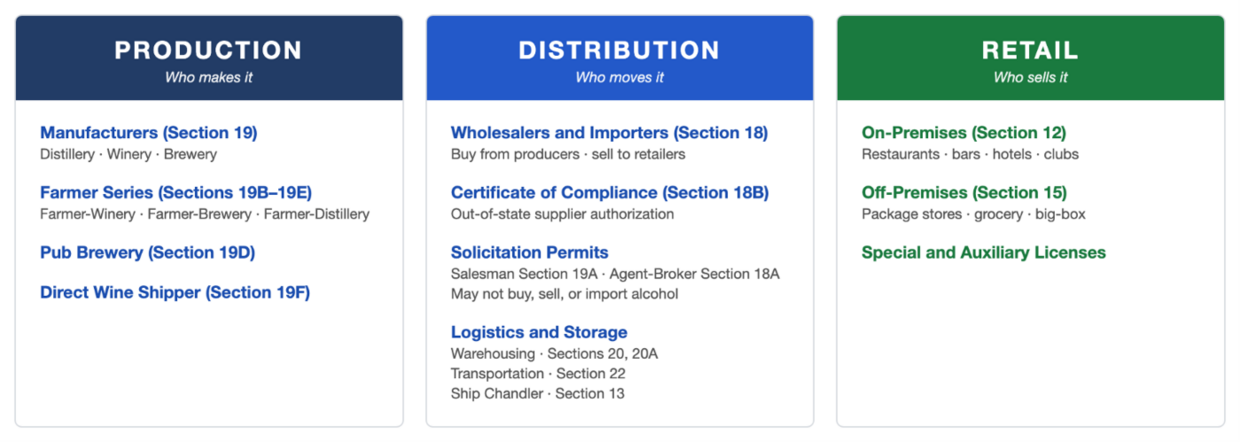
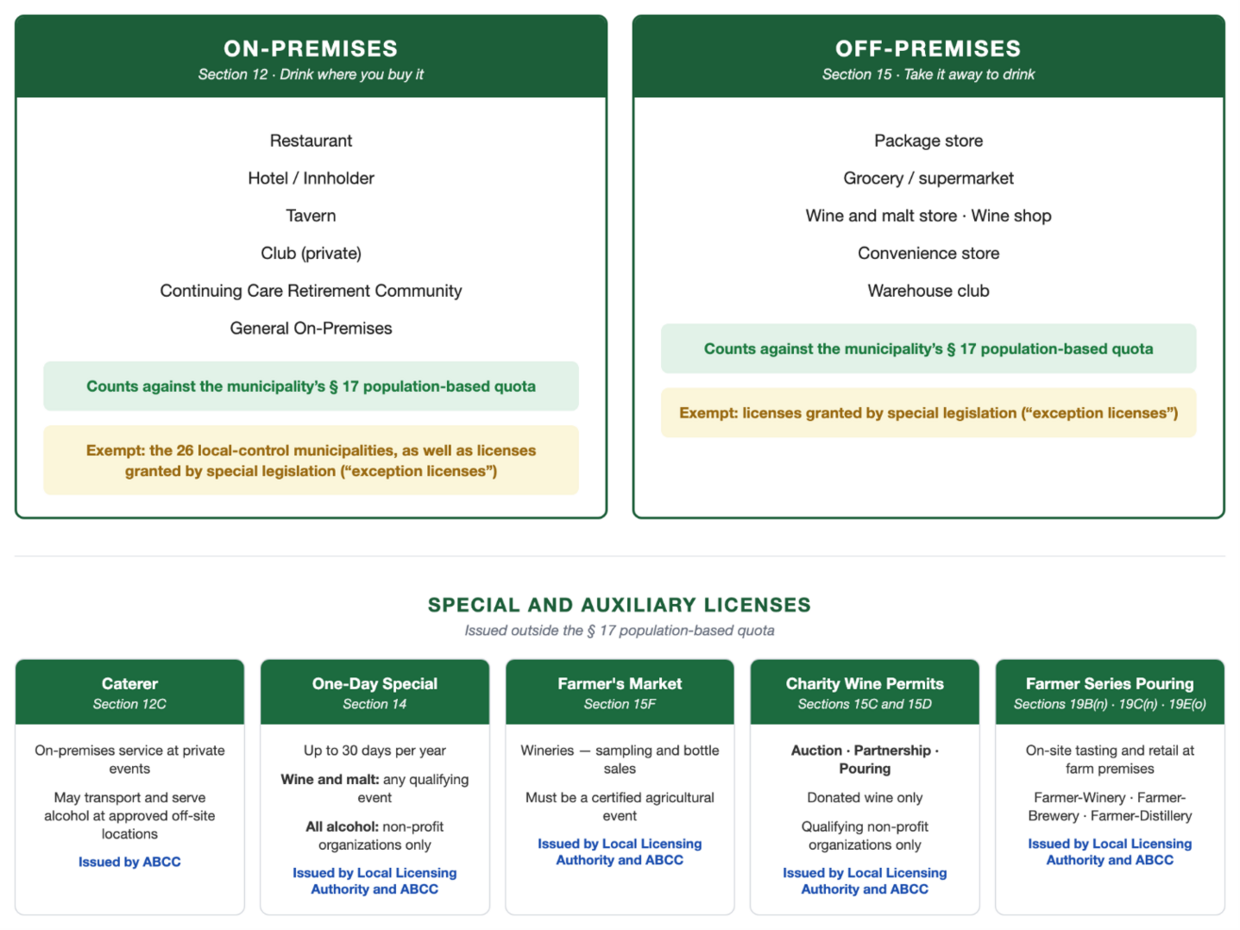
As noted in Figure 3, retail licenses are further classified between on-premises (Section 12) licenses, off-premises (Section 15) licenses, and special and auxiliary licenses. Figure 4 on the next page offers more detail regarding which retail licenses are subject to, or exempt from, the state-imposed population-based quota in MGL c. 138, § 17.
Figure 4. Retail Licenses38
2.1 Dual Regulatory Oversight over Liquor Licensing at State and Local Levels
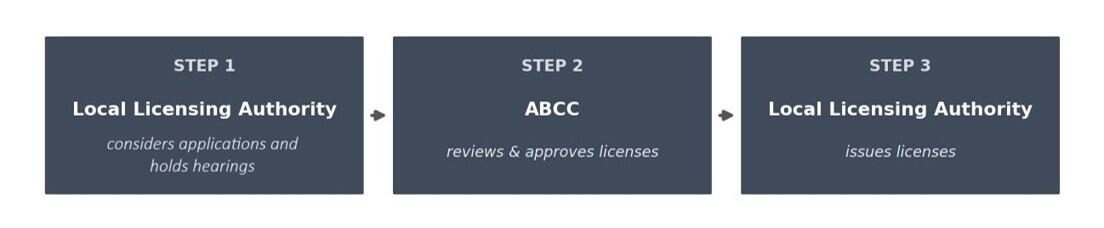
The post-prohibition legislative framework centralized regulatory oversight of MGL c. 138 under ABCC, established in 1933.39 ABCC is responsible for the “general supervision of the conduct of the business of manufacturing, importing, exporting, storing, transporting, and selling alcoholic beverages” across the Commonwealth.40 Licensing decisions, however, begin at the local level where local licensing authorities (LLAs) consider applications and hold hearings. Approved applications are then submitted to ABCC for review and approval. If licensing is approved by ABCC, the LLA issues the licenses. This process is outlined in Figure 5 below.41
Figure 5. Process for issuing liquor licenses
2.2 On-Premises Liquor License Quotas (MGL Chapter 138, Sections 12 and 17)
As in 1933, today’s liquor licensing system relies on population despite substantial changes in demographics, municipal development, and regional economies. MGL Chapter 138 establishes multiple categories of liquor licenses, including on-premises licenses under Section 12 and off-premises licenses under Section 15. Section 17 establishes population-based quota limits on the number of liquor licenses that may be issued by municipalities in the foregoing categories, further divided into All-Alcohol licenses and Wine-and-Malt licenses.42
This report focuses specifically on on-premises liquor licensing. Equity and accessibility with respect to on-premises liquor licensing have been identified as an area needing reform, with continuing debate among stakeholders and legislators.
The statutory formula allocates a minimum number of licenses to each municipality that has voted to allow on-premises liquor licenses and is subject to the quota (14 all-alcohol on-premises licenses and 5 wine-and-malt on-premises licenses), regardless of population.43 Additional licenses are allocated to municipalities based on population. The population-based component of the quota formula is triggered when a municipality’s population exceeds a certain number of residents, as established by the decennial federal census.44
With respect to All-Alcohol on-premises licenses, municipalities may grant an additional license for each 1,000 residents, or fraction thereof, over 14,000 residents, as well as an additional license for each 10,000 residents, or fraction thereof, over 25,000 residents.45 With respect to Wine-and-Malt on-premises licenses, municipalities may grant an additional license for each 5,000 residents, or fraction thereof, over 25,000 residents.46 Figure 6 on the next page illustrates the operation of the quota formula.
Figure 6. On-premises Quota Formula Calculation
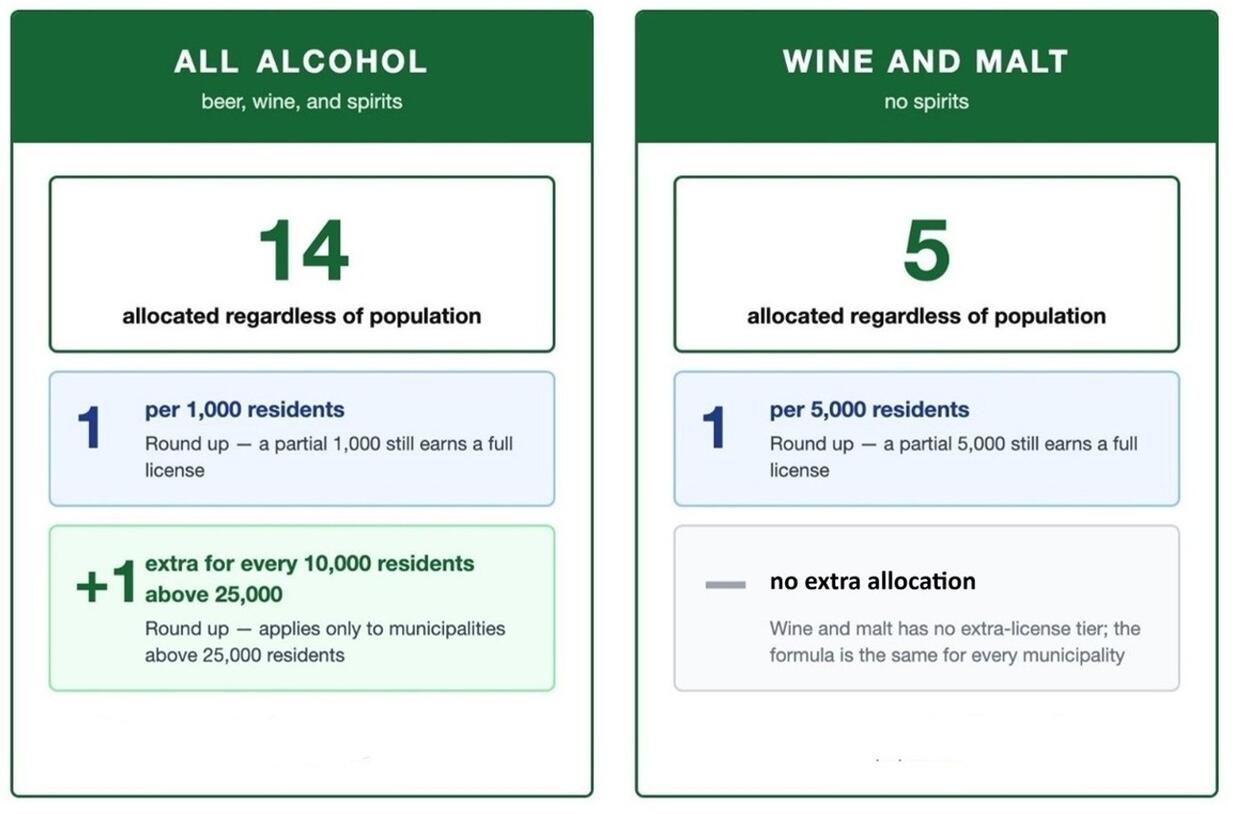
Figure 7 on the next page further illustrates operation of the quota formula as applied to varying municipal populations from 3,000 to 100,000 residents, with respect to allocated on-premises licenses.
Figure 7. Quota Calculations by Municipalities of Varying Population Sizes
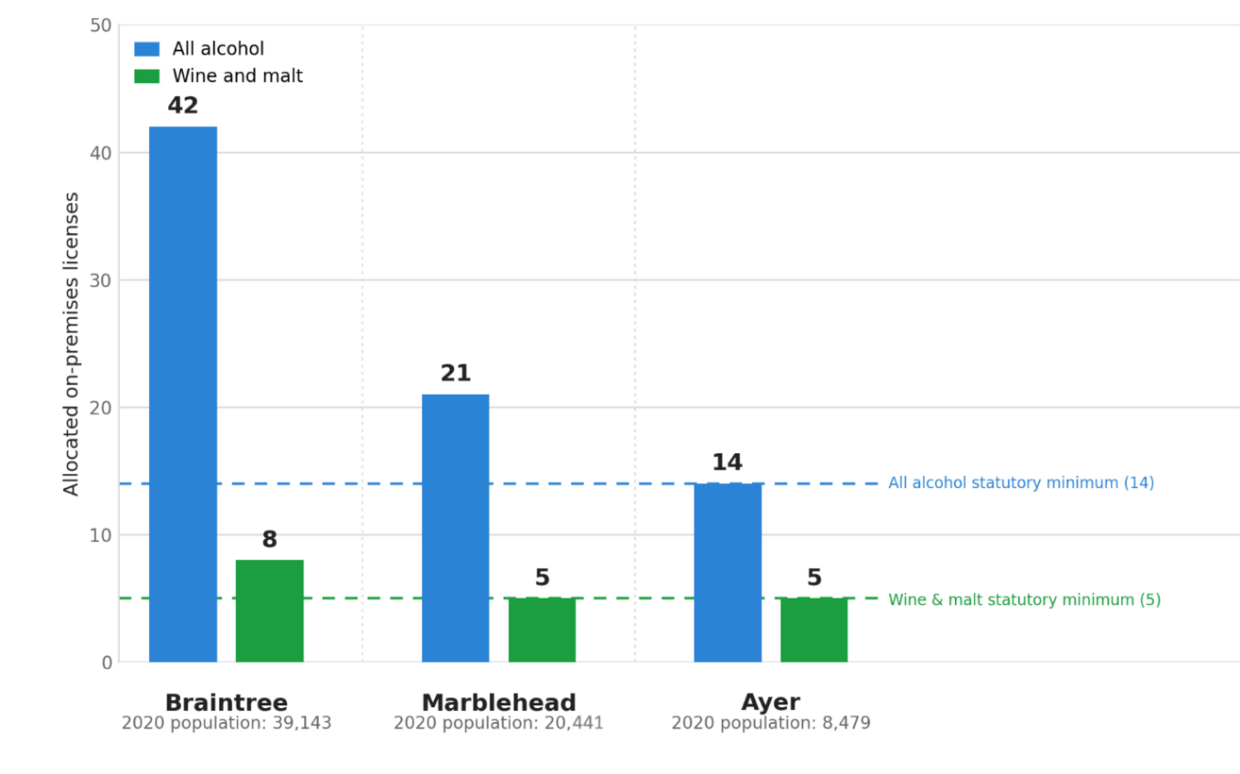
As illustrated above, Braintree, with a 2020 census population of 39,143, is allocated 42 All-Alcohol on-premises licenses, composed of 1 license for each 1,000 residents or fraction thereof (40) plus 1 additional license for each 10,000 residents or fraction thereof above 25,000 residents (2), and 8 Wine-and-Malt on-premises licenses, composed of 1 license for each 5,000 residents or fraction thereof. Marblehead, with a population of 20,441, is allocated 21 All-Alcohol licenses, composed of 1 license for each 1,000 residents or fraction thereof, and 5 Wine-and-Malt on-premises licenses, composed of 1 license for each 5,000 residents or fraction thereof. In comparison, Ayer benefits from the statutory minimum allocation of 14 All-Alcohol on-premises licenses and 5 Wine-and-Malt on-premises licenses despite having a population of only 8,479 residents.47
Of the Commonwealth’s 351 municipalities, 302 are subject to the statutory quota formula (quota municipalities).48 As of 2023, over half of the 302 quota municipalities, 173 (57.3%), have populations below 14,000 and thus are statutorily allocated the minimum number of on-premises licenses (14 All-Alcohol licenses and 5 Wine-and-Malt licenses). Another 61 quota municipalities (20.2%) have populations between 14,000 and 25,000, meaning their All-Alcohol license statutory allocations are determined in part by the minimum and in part by the population-based formula (1 per 1,000 residents, or fraction thereof, over 14,000) while their Wine-and-Malt license allocations remain at the 5-license minimum. The remaining 68 quota municipalities (22.5%) have populations exceeding 25,000, meaning all statutory allocations are driven by the population-based formula (1 per 1,000 residents, or fraction thereof, over 14,000, as well as 1 per 10,000 residents, or fraction thereof, over 25,000).49
2.3 Twenty-Six Municipalities Get Local Control⁵⁰
While 302 municipalities are subject to the restrictions of the state-imposed population-based quota on on-premises liquor licensing, 26 municipalities (local-control municipalities) were able to exempt themselves from on-premises quota limits under the Massachusetts Acts of 1978, c. 377, § 2.51 This legislation allowed municipalities that had granted seasonal licenses prior to January 1, 1978, and voted to accept the provisions of MGL c. 138, § 17A, to grant on-premises licenses “in addition to, and irrespective of any [quota] limitation” (emphasis added).52
On January 9, 1985, Chapter 491 of the Massachusetts Acts of 1984 closed this window of opportunity for eligible municipalities that had not accepted the provisions of § 17A prior to January 1, 1985. Municipalities that were previously precluded from exempting themselves from the state-imposed population-based quota on on-premises liquor licensing were never given a similar opportunity to become local-control municipalities. The benefits to local-control municipalities of the 1978 exemption and compounding implications for quota municipalities are discussed in Findings 1 and 2.
2.4 Control of Quota Relief Valve
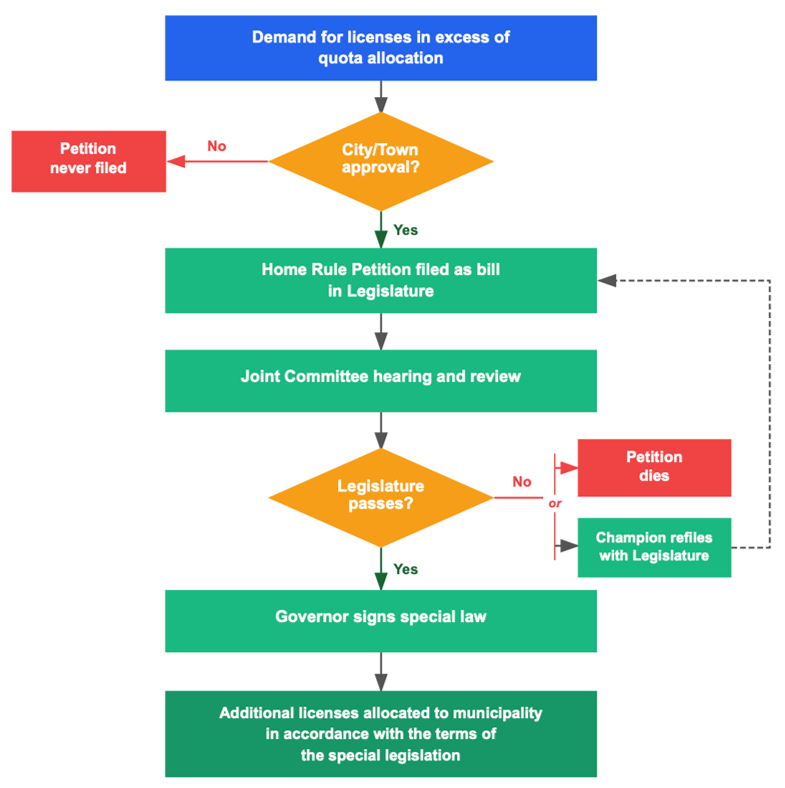
Quota municipalities seeking authority to issue on-premises licenses beyond their quota formula allocations generally have only one option—a special act of the Legislature obtained through a home rule petition. Under the Home Rule Amendment to the Massachusetts Constitution, approved by voters in 1966, municipalities may act on their own authority to enact some policy changes, but not in a manner inconsistent with a general law enacted by the Legislature.53 Notably, a municipality cannot unilaterally grant liquor licenses in excess of quota limits. It must instead petition the Legislature for a special law applying only to that municipality.
A home rule petition passes through a series of gates, each controlled by different actors. The petition begins locally, when municipal officials draft the request and the local legislative body approves it. A member of the municipality’s legislative delegation must then file it. Filing is only the first step at the State House. It does not determine whether the petition succeeds. Once filed, the bill is referred to a legislative committee, the chairs of which decide whether to hold a hearing and report it favorably, and on what terms. House and Senate leadership decide whether and when it reaches the floor. It must pass both chambers and be signed by the Governor, and there is no statutory deadline at any stage. A petition can fail, stall, or be narrowed at any stage, and the outcomes usually depend on the delegation’s support, committee preferences, leadership priorities, the legislative calendar, and how the request has been framed.
Despite the existence of the home rule petition process, system complexities leave some municipalities at or above quota and unable to meet license demand for extended periods of time; a more detailed analysis of the system and its impacts is discussed in Finding 4. Figure 8 on the next page illustrates an overview of the home rule petition process.
Figure 8. Overview of Home Rule Petition Process
2.5 Secondary Market: Liquor Licenses as Commodities
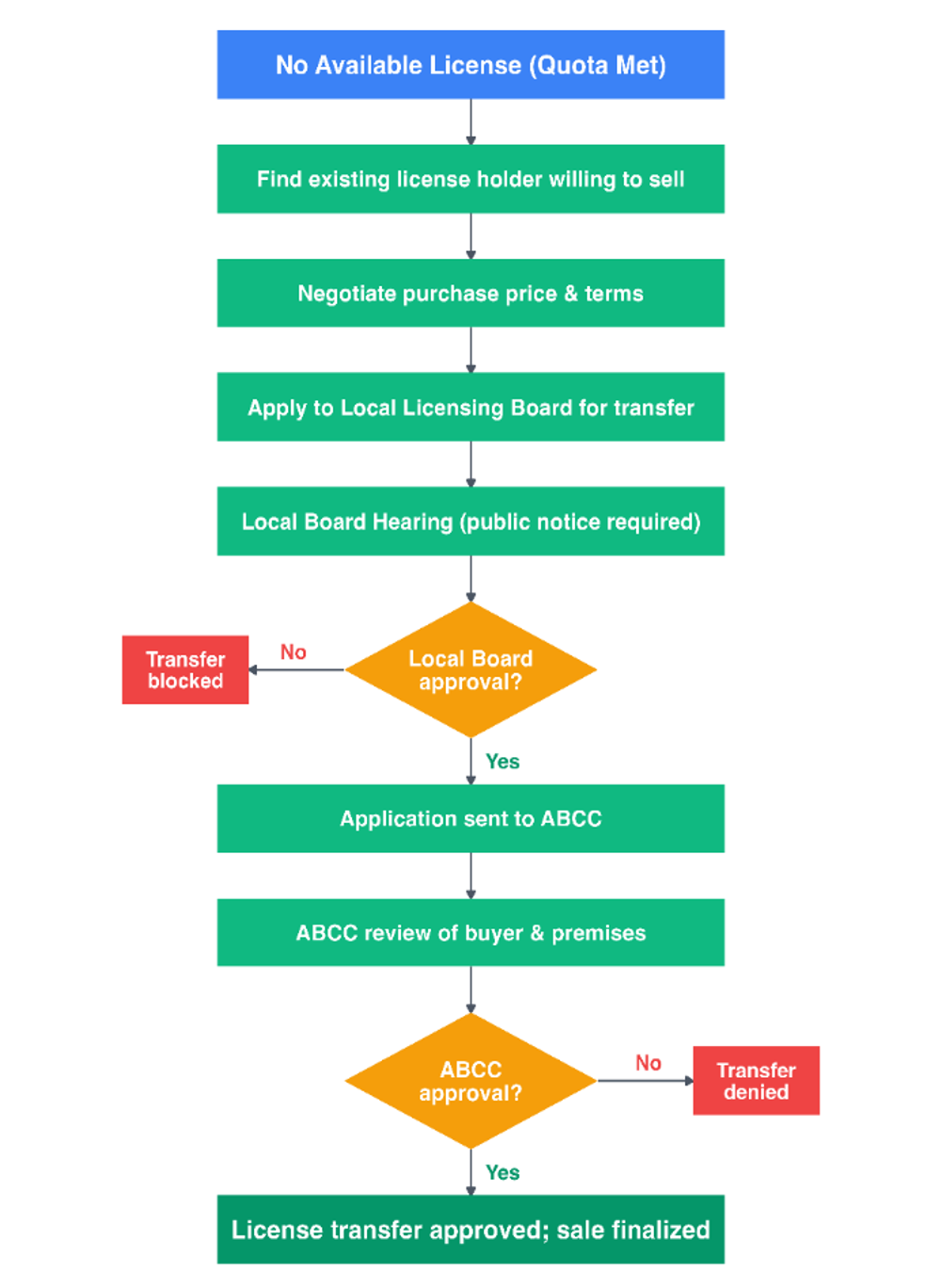
Prospective business owners in municipalities that have issued all of their allocated on-premises licenses generally have two avenues to acquire a license:
- ask the municipality to seek additional licenses through a home rule petition and/or
- look to purchase a license from an existing holder.
Where licenses are scarce, that scarcity attaches a market value to existing licenses and transfers in high-demand municipalities can command substantial sums; in municipalities that have not reached their cap, a comparable license may change hands for little more than application fees.54 This secondary market can transform a regulatory device intended as a public benefit into a privately held asset. Figure 9 below illustrates an overview of the license transfer process. Finding 4 examines both pathways, and the costs and delays each imposes, in detail.
Figure 9. Overview of License Transfer Process
State law seemingly discourages these liquor license transfers for private benefit through a secondary market. MGL c. 138, § 23, states that “the provisions for the issue of [liquor] licenses . . . imply no intention to create rights generally for persons to engage or continue in the transaction of the business authorized by the licenses” and, further, that “no holder of such a license . . . hereunder shall have any property right in . . . such license.”55 Additional language in this section indicates that any license transfers should be in the public interest.56
LLAs are also authorized to cancel licenses if a licensee ceases to conduct the licensed business, prohibiting what are sometimes called “pocket licenses” held solely for potential market value.57
2.6 Section 12D
In 2025, the Legislature added § 12D to MGL c. 138, effective July 1, 2025.58 In any municipality that votes to accept the provisions of § 12D, the LLA may allow any holder of a Wine-and-Malt on-premises license to trade it in for an All-Alcohol on-premises license, regardless of whether the municipality is at quota for either type of license. Pursuant to § 12D, any Wine-and-Malt license that is traded in to the LLA for an All-Alcohol license shall become non-transferable upon the issuance of the license to sell all alcoholic beverages. Conversions require ABCC approval and remain subject to MGL c. 138’s notice and hearing requirements; the LLA may charge a reasonable fee and set additional requirements. Critically, § 12D does not increase the total number of licenses authorized under § 17: It changes the beverage scope of an existing license rather than adding to the quota system. Most municipalities responding to DLM’s survey had not adopted § 12D: Of the 190 municipal officials who responded, only 33 (17%) from 25 municipalities reported that their municipality had accepted § 12D, 106 (56%) from 93 municipalities reported they had not, and 51 (27%) from 50 municipalities were not sure. Among 67 business owners, 49 (73%) were not sure whether any municipality where they hold a license had accepted § 12D, 13 said “Yes,” and 5 said “No.”59 Prospective licensees would have a difficult time determining which municipalities accepted § 12D and have this conversion opportunity, as ABCC currently does not publish a list of municipalities that have accepted this local option.
| Date published: | October 13, 2026 |
|---|